## Chart: Multiplication Accuracy vs. Number of Tokens
### Overview
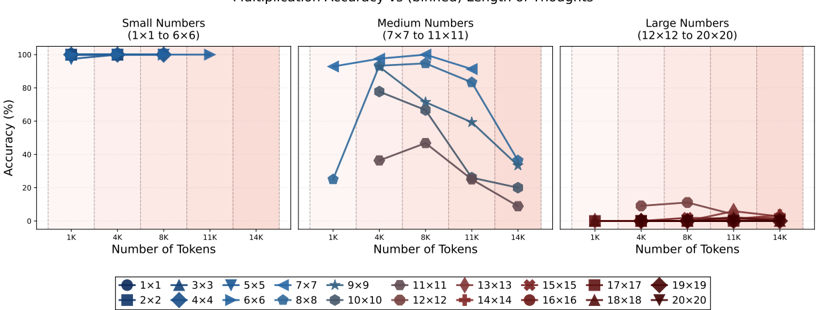
The image presents a chart comparing the accuracy of multiplication for different matrix sizes as a function of the number of tokens used. The chart is divided into three sub-charts, each representing a different range of matrix sizes: Small Numbers (1x1 to 6x6), Medium Numbers (7x7 to 11x11), and Large Numbers (12x12 to 20x20). Accuracy is measured in percentage, and the number of tokens is represented in increments of 1K, 4K, 8K, 11K, and 14K.
### Components/Axes
* **Title:** Multiplication Accuracy to (approx.) Length of Magnitudes
* **X-axis (all sub-charts):** Number of Tokens (1K, 4K, 8K, 11K, 14K)
* **Y-axis (all sub-charts):** Accuracy (%) - Scale ranges from 0 to 100.
* **Sub-chart Titles:**
* Small Numbers (1x1 to 6x6)
* Medium Numbers (7x7 to 11x11)
* Large Numbers (12x12 to 20x20)
* **Legend (bottom-center):** Contains labels for each matrix size, with corresponding colors:
* 1x1 (Blue)
* 2x2 (Light Blue)
* 3x3 (Green)
* 4x4 (Teal)
* 5x5 (Orange)
* 6x6 (Red)
* 7x7 (Gray)
* 8x8 (Purple)
* 9x9 (Brown)
* 10x10 (Pink)
* 11x11 (Olive)
* 12x12 (Cyan)
* 13x13 (Magenta)
* 14x14 (Yellow)
* 15x15 (Dark Red)
* 16x16 (Black)
* 17x17 (Dark Green)
* 18x18 (Dark Teal)
* 19x19 (Dark Orange)
* 20x20 (Dark Red)
### Detailed Analysis
**Small Numbers (1x1 to 6x6):**
* The 1x1 matrix (blue) maintains near 100% accuracy across all token counts.
* The 2x2 matrix (light blue) also shows high accuracy, around 95-100%, with a slight decrease at 14K tokens.
* The 3x3 (green) and 4x4 (teal) matrices exhibit similar trends, starting high and decreasing slightly at higher token counts.
* The 5x5 (orange) and 6x6 (red) matrices show a more pronounced decrease in accuracy as the number of tokens increases, but still remain above 70% at 14K tokens.
**Medium Numbers (7x7 to 11x11):**
* The 7x7 (gray) matrix starts around 95% accuracy at 1K tokens, then decreases to approximately 70% at 14K tokens.
* The 8x8 (purple) matrix shows a similar trend, starting at around 90% and decreasing to approximately 60% at 14K tokens.
* The 9x9 (brown) matrix exhibits a more significant drop, starting at around 90% and falling to approximately 30% at 14K tokens.
* The 10x10 (pink) and 11x11 (olive) matrices show a steep decline in accuracy, with the 11x11 matrix dropping to near 0% accuracy at 14K tokens.
**Large Numbers (12x12 to 20x20):**
* All matrix sizes in this range (cyan, magenta, yellow, dark red, black, dark green, dark teal, dark orange, dark red) exhibit very low accuracy, generally below 20%, across all token counts.
* There is minimal variation in accuracy between the different matrix sizes within this range.
* The 12x12 (cyan) matrix shows a slight increase in accuracy from 1K to 4K tokens, but then plateaus.
**Approximate Data Points (examples):**
* 1x1: 1K - 98%, 4K - 97%, 8K - 96%, 11K - 96%, 14K - 95%
* 6x6: 1K - 90%, 4K - 85%, 8K - 75%, 11K - 60%, 14K - 50%
* 11x11: 1K - 85%, 4K - 70%, 8K - 40%, 11K - 15%, 14K - 0%
* 16x16: 1K - 5%, 4K - 8%, 8K - 10%, 11K - 12%, 14K - 10%
### Key Observations
* Accuracy generally decreases as matrix size increases.
* Accuracy generally decreases as the number of tokens increases, particularly for larger matrix sizes.
* Small matrix sizes (1x1 to 6x6) maintain relatively high accuracy even with a large number of tokens.
* Large matrix sizes (12x12 to 20x20) exhibit consistently low accuracy regardless of the number of tokens.
* The most significant accuracy drops occur in the medium matrix size range (7x7 to 11x11).
### Interpretation
The data suggests that the model's ability to accurately perform multiplication is heavily influenced by the size of the numbers being multiplied. Smaller numbers are handled with high accuracy, even with a limited number of tokens. However, as the numbers grow larger, the accuracy declines significantly, and increasing the number of tokens does not substantially improve performance.
The steep decline in accuracy for medium-sized matrices indicates a potential threshold where the model begins to struggle with the complexity of the multiplication operation. The consistently low accuracy for large matrices suggests that the model may not be capable of accurately performing multiplication on numbers of that magnitude, even with a substantial number of tokens.
This could be due to limitations in the model's architecture, training data, or the inherent difficulty of representing and processing large numbers within the model's framework. The data highlights the importance of considering the scale of the input data when evaluating the performance of the model on mathematical tasks. The relationship between matrix size and accuracy is not linear, and there are clear breakpoints where performance degrades rapidly.