## Line Graph: Loss vs. Iteration
### Overview
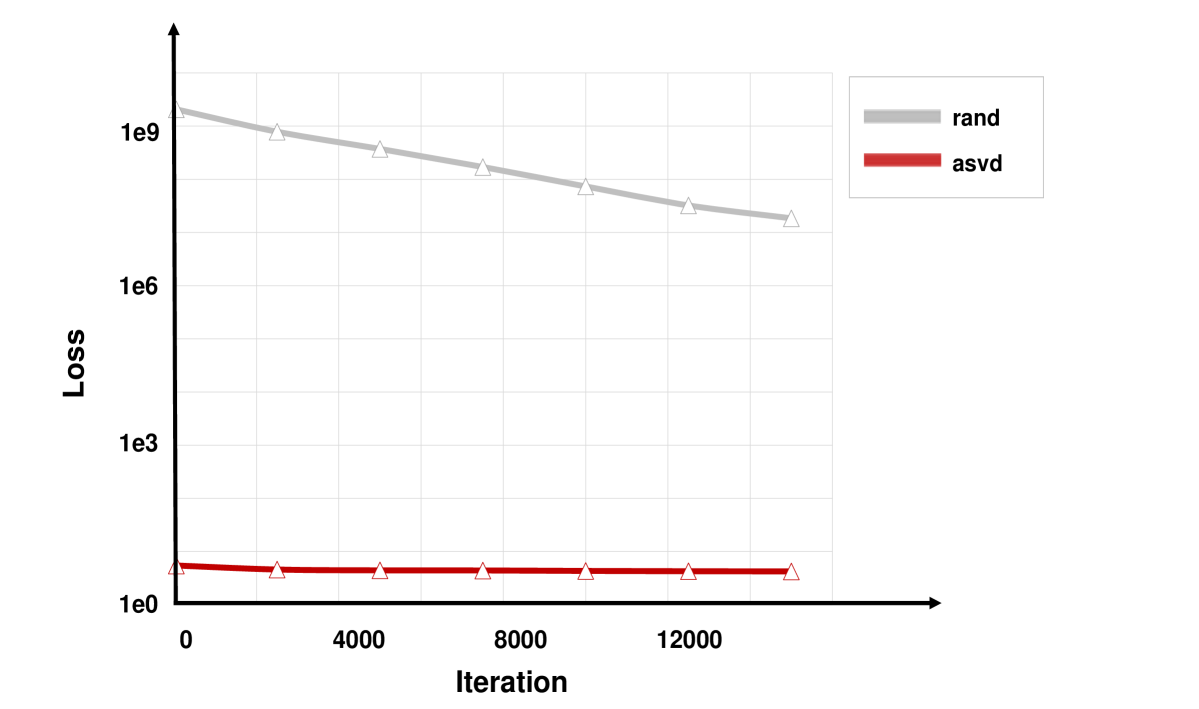
The image depicts a line graph comparing two data series ("rand" and "asvd") across iterations. The y-axis represents "Loss" on a logarithmic scale (1e0 to 1e9), and the x-axis represents "Iteration" (0 to 14,000). The legend is positioned in the top-right corner, with "rand" in gray and "asvd" in red.
### Components/Axes
- **X-axis (Iteration)**: Labeled "Iteration," with ticks at 0, 4,000, 8,000, 12,000, and 14,000.
- **Y-axis (Loss)**: Labeled "Loss," with logarithmic ticks at 1e0, 1e3, 1e6, and 1e9.
- **Legend**: Located in the top-right corner, with:
- Gray line labeled "rand"
- Red line labeled "asvd"
### Detailed Analysis
1. **Gray Line ("rand")**:
- Starts at approximately **1e9** at iteration 0.
- Decreases monotonically, reaching **~1e7** by iteration 14,000.
- Data points are marked with white triangles (▲) along the line.
- Trend: Steady exponential decay.
2. **Red Line ("asvd")**:
- Remains nearly flat at **~1e0** across all iterations.
- Data points are marked with white triangles (▲) along the line.
- Trend: Constant value with no discernible change.
### Key Observations
- The "rand" series exhibits a significant downward trend, while "asvd" remains static.
- The logarithmic y-axis emphasizes the scale difference between the two series.
- Both lines use identical triangle markers (▲), but differ in color and trend.
### Interpretation
- **Efficiency Comparison**: The "asvd" method maintains a consistently low loss (~1e0), suggesting superior stability or optimization compared to "rand," which starts with a high loss (1e9) and gradually improves.
- **Logarithmic Scale Impact**: The y-axis compression highlights the disparity in loss magnitudes, making the "rand" trend appear more dramatic despite its gradual decline.
- **Potential Implications**: The "asvd" method may represent a more efficient algorithm or initialization strategy, as its loss does not degrade over iterations. The "rand" method’s decay could indicate a learning or optimization process, but its initial high loss suggests suboptimal starting conditions.