## Chart: Risk-Coverage Curve (Dialect Task)
### Overview
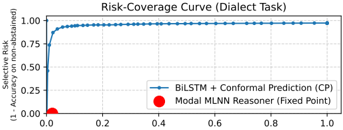
The image is a risk-coverage curve comparing two methods: BiLSTM + Conformal Prediction (CP) and Modal MLNN Reasoner (Fixed Point) on a dialect task. The y-axis represents Selective Risk (1 - Accuracy on non-abstained), and the x-axis represents coverage. The BiLSTM curve shows a rapid decrease in risk as coverage increases, eventually plateauing near zero risk. The Modal MLNN Reasoner is represented by a single point.
### Components/Axes
* **Title:** Risk-Coverage Curve (Dialect Task)
* **X-axis:** Coverage, ranging from 0.0 to 1.0 in increments of 0.2.
* **Y-axis:** Selective Risk (1 - Accuracy on non-abstained), ranging from 0.00 to 1.00 in increments of 0.25.
* **Legend:** Located in the bottom-right corner.
* Blue line with markers: BiLSTM + Conformal Prediction (CP)
* Red circle: Modal MLNN Reasoner (Fixed Point)
### Detailed Analysis
* **BiLSTM + Conformal Prediction (CP):**
* Color: Blue
* Trend: The curve starts at approximately (0, 0.9) and rapidly decreases to near 0.0 as coverage increases to approximately 0.2. From 0.2 to 1.0, the curve remains relatively flat, hovering around 0.0.
* Data Points (approximate):
* (0.0, 0.9)
* (0.1, 0.1)
* (0.2, 0.02)
* (0.4, 0.01)
* (0.6, 0.005)
* (0.8, 0.005)
* (1.0, 0.005)
* **Modal MLNN Reasoner (Fixed Point):**
* Color: Red
* Location: Appears to be at approximately (0.0, 0.0).
* Data Point (approximate):
* (0.0, 0.0)
### Key Observations
* The BiLSTM + Conformal Prediction method achieves very low selective risk with relatively low coverage.
* The Modal MLNN Reasoner has a fixed point at (0.0, 0.0), indicating perfect accuracy on the non-abstained data, but at zero coverage.
* The BiLSTM curve shows a steep initial drop, indicating that even a small amount of coverage significantly reduces the selective risk.
### Interpretation
The risk-coverage curve demonstrates the trade-off between coverage and selective risk for the two methods. The BiLSTM + Conformal Prediction method is highly effective, achieving near-zero risk with moderate coverage. The Modal MLNN Reasoner, while having perfect accuracy at its fixed point, offers no coverage. This suggests that the BiLSTM + CP method is superior for this dialect task, as it provides a good balance between accuracy and the ability to make predictions on a wider range of inputs. The steep initial drop in the BiLSTM curve highlights the value of even a small amount of coverage in reducing risk.