## Diagram: Cognitive Architecture Model
### Overview
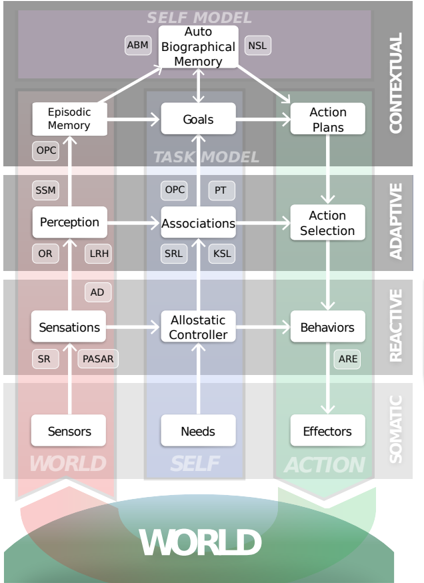
The image presents a cognitive architecture model, illustrating the flow of information and processes within an agent or system. The model is structured into layers representing different levels of processing, from sensory input to action execution, and includes components for self-modeling, task modeling, and adaptation.
### Components/Axes
The diagram is divided into five main vertical sections, each representing a different level of processing or domain:
1. **WORLD (Bottom):** Represents the external environment and the agent's interaction with it.
2. **SELF (Bottom-Center):** Represents the internal state and needs of the agent.
3. **ACTION (Bottom-Right):** Represents the actions the agent takes in the world.
4. **Processing Layers (Vertical, Top-to-Bottom):**
* **SOMATIC:** Bottom layer, associated with basic physical functions.
* **REACTIVE:** Second layer from the bottom, associated with immediate responses.
* **ADAPTIVE:** Middle layer, associated with learning and adjustment.
* **CONTEXTUAL:** Second layer from the top, associated with understanding the environment.
* **SELF MODEL:** Top layer, associated with self-awareness and long-term planning.
The diagram contains the following key components:
* **Self Model:** Contains "Auto Biographical Memory" with abbreviations "ABM" and "NSL".
* **Task Model:** Connects "Episodic Memory" (with abbreviation "OPC") and "Goals" to "Action Plans".
* **Perception:** Receives input from "Sensors" via "Sensations". Includes abbreviations "SSM", "OR", and "LRH".
* **Associations:** Connects "Perception" to "Action Selection". Includes abbreviations "OPC", "PT", "SRL", and "KSL".
* **Allostatic Controller:** Receives input from "Sensations" and influences "Behaviors". Includes abbreviation "AD".
* **Behaviors:** Connects "Allostatic Controller" to "Effectors". Includes abbreviation "ARE".
* **Sensors:** Located at the bottom-left, representing input from the environment. Includes abbreviations "SR" and "PASAR".
* **Needs:** Located at the bottom-center, representing the agent's internal requirements.
* **Effectors:** Located at the bottom-right, representing the agent's actions on the environment.
### Detailed Analysis
The diagram illustrates the flow of information between different components of the cognitive architecture.
* **Self Model:** "Auto Biographical Memory" feeds into "Goals" and "Action Plans".
* **Task Model:** "Episodic Memory" feeds into "Goals". "Goals" feed into "Action Plans".
* **Perception:** "Sensors" feed into "Sensations", which feed into "Perception".
* **Associations:** "Perception" feeds into "Associations", which feed into "Action Selection".
* **Allostatic Controller:** "Sensations" feed into "Allostatic Controller", which feeds into "Behaviors".
* **Action Selection:** Feeds into "Behaviors".
* **Behaviors:** Feed into "Effectors".
* **Needs:** Feed into "Allostatic Controller".
### Key Observations
* The model emphasizes the interaction between the agent's internal state (SELF), its perception of the environment (WORLD), and its actions (ACTION).
* The layered structure represents different levels of cognitive processing, from basic sensory input to high-level planning.
* The diagram highlights the importance of feedback loops, such as the influence of "Needs" on the "Allostatic Controller" and the connection between "Perception" and "Associations".
### Interpretation
The cognitive architecture model presented in the image provides a framework for understanding how an agent processes information and interacts with its environment. The model emphasizes the importance of both internal and external factors in shaping behavior. The layered structure suggests a hierarchical organization of cognitive processes, with lower-level processes providing input to higher-level processes. The feedback loops highlight the dynamic and adaptive nature of the system. The model could be used to design and implement artificial intelligence systems or to study the cognitive processes of biological organisms.