## Diagram: Cognitive Architecture Model
### Overview
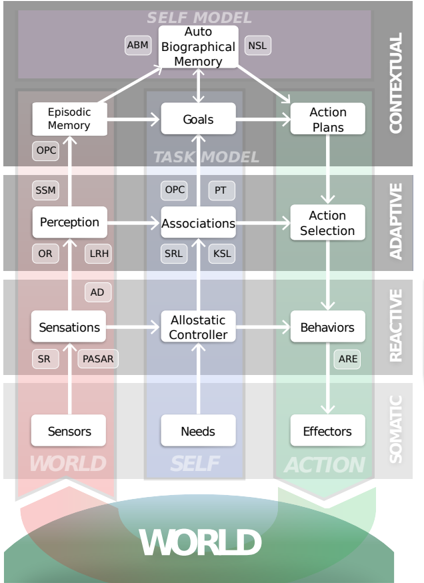
The image depicts a hierarchical cognitive architecture model titled "SELF MODEL," illustrating the interplay between internal states (self) and external interactions (world). It is divided into four vertical layers: **SELF MODEL** (top), **TASK MODEL** (middle), **WORLD** (bottom), and **ACTION** (right). Arrows indicate directional flow between components, with color-coded sections (purple, pink, blue, green) representing distinct functional domains.
---
### Components/Axes
#### Labels and Sections:
1. **SELF MODEL** (Top Layer, Purple):
- **Auto Biographical Memory** (ABM)
- **Episodic Memory** (OPC, SSM)
- **Goals**
- **Action Plans**
2. **TASK MODEL** (Middle Layer, Pink/Blue):
- **Perception** (OR, LRH, AD)
- **Sensations** (SR, PASAR)
- **Associations** (SRL, KSL)
- **Allostatic Controller**
- **Needs**
3. **WORLD** (Bottom Layer, Pink):
- **Sensors** (SR, PASAR)
4. **ACTION** (Right Layer, Green):
- **Action Selection**
- **Behaviors**
- **Effectors**
#### Arrows and Flow:
- **Bottom-Up Flow**: Sensations → Perception → Associations → Allostatic Controller → Needs.
- **Top-Down Flow**: Auto Biographical Memory → Goals → Action Plans → Action Selection → Behaviors → Effectors.
- **Bidirectional Links**: Associations connect Perception to Allostatic Controller; Goals influence Action Plans.
#### Legend (Right Side):
- **Purple**: SELF MODEL (memory, goals, plans).
- **Pink**: TASK MODEL (perception, sensations, needs).
- **Blue**: TASK MODEL (associations, allostatic control).
- **Green**: ACTION (selection, behaviors, effectors).
---
### Detailed Analysis
#### SELF MODEL (Purple):
- **Auto Biographical Memory (ABM)**: Integrates self-referential knowledge.
- **Episodic Memory**: Stores personal experiences (OPC = Object-Place Context, SSM = Semantic-Spatial Mapping).
- **Goals**: Derived from ABM and episodic memory, guiding behavior.
- **Action Plans**: Strategic pathways to achieve goals.
#### TASK MODEL (Pink/Blue):
- **Perception**: Processes sensory input (OR = Object Recognition, LRH = Location-Resource Hierarchy, AD = Attention-Driven).
- **Sensations**: Raw sensory data (SR = Stimulus Response, PASAR = Perceptual-Action-Sensory-Resource).
- **Associations**: Links perceptions to internal states (SRL = Stimulus-Resource Link, KSL = Knowledge-Sensory Link).
- **Allostatic Controller**: Regulates homeostasis (e.g., stress, energy).
- **Needs**: Drives behavior (e.g., hunger, safety).
#### WORLD (Pink):
- **Sensors**: Interface with the environment (SR, PASAR).
#### ACTION (Green):
- **Action Selection**: Chooses behaviors based on goals and perceptions.
- **Behaviors**: Reactive outputs (ARE = Action-Resource-Environment).
- **Effectors**: Physical outputs (e.g., muscles, tools).
---
### Key Observations
1. **Hierarchical Structure**: The model emphasizes top-down (goals) and bottom-up (sensory) processing.
2. **Integration Points**:
- **Associations** bridge perception and allostatic control.
- **Allostatic Controller** links needs to behavioral outputs.
3. **Color Coding**: Clearly separates functional domains (e.g., purple for self-referential processes, green for action execution).
4. **Bidirectional Flow**: Feedback loops exist between self-model and task-model components.
---
### Interpretation
This diagram represents a **cognitive architecture** where:
- **Self-Model** (memory, goals) provides context for decision-making.
- **Task-Model** processes sensory input and regulates homeostasis.
- **Action** executes behaviors to interact with the world.
- The **Allostatic Controller** acts as a homeostatic regulator, ensuring internal stability amid external demands.
The model suggests that adaptive behavior arises from the interplay of:
1. **Memory-driven goals** (top-down).
2. **Sensory-driven needs** (bottom-up).
3. **Dynamic associations** linking internal states to actions.
Notably, the absence of explicit numerical data implies this is a conceptual framework rather than a quantitative model. The emphasis on **bidirectional flow** highlights the importance of feedback in cognitive processing.