\n
## Diagram: Scene Categorization with Object Associations
### Overview
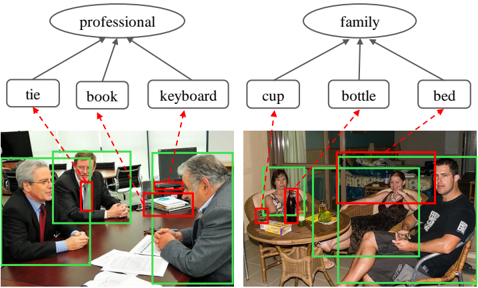
The image presents a diagram illustrating a categorization of scenes based on associated objects. Two photographs are shown, each linked to a conceptual category ("professional" and "family") via a tree-like structure of objects. Red boxes highlight specific objects within the images, and red dashed arrows connect these objects to their respective category and sub-categories. Green boxes highlight people in the images.
### Components/Axes
The diagram consists of:
* **Two Scene Photographs:** One depicting a business meeting, the other a casual family gathering.
* **Two Category Nodes:** Oval shapes labeled "professional" (top-left) and "family" (top-right).
* **Object Nodes:** Rectangular shapes representing objects associated with each category (e.g., "tie", "book", "cup", "bottle").
* **Association Arrows:** Red dashed lines connecting objects to their category nodes.
* **Bounding Boxes:** Red boxes around objects in the photographs, and green boxes around people.
### Detailed Analysis or Content Details
**Professional Scene:**
* **Category:** "professional"
* **Associated Objects:**
* "tie" - Associated with a person wearing a tie in the left photograph.
* "book" - Associated with a stack of books on the table in the left photograph.
* "keyboard" - Associated with a keyboard on the table in the left photograph.
* **Image Details:** The image shows three men in a meeting room. Two are seated at a table, and one is standing. All are wearing business attire.
**Family Scene:**
* **Category:** "family"
* **Associated Objects:**
* "cup" - Associated with a cup on the table in the right photograph.
* "bottle" - Associated with a bottle on the table in the right photograph.
* "bed" - Associated with a bed in the background of the right photograph.
* **Image Details:** The image shows a family gathering outdoors. Two women and two men are present, seated around a table. A dog is also visible.
### Key Observations
* The diagram demonstrates a simple form of scene understanding based on object recognition.
* The association between objects and categories is direct and hierarchical.
* The bounding boxes highlight the specific objects used for categorization.
* The inclusion of green boxes around people suggests that people are also considered as part of the scene, but are not directly linked to the category nodes.
### Interpretation
This diagram illustrates a basic approach to scene categorization using object-based reasoning. The system identifies key objects within a scene and uses these objects to infer the overall category of the scene. The "professional" category is associated with objects commonly found in office environments (tie, book, keyboard), while the "family" category is associated with objects commonly found in domestic settings (cup, bottle, bed).
The diagram suggests that scene understanding can be achieved by focusing on the presence and relationships of specific objects. This approach is a simplified model of human scene perception, but it provides a foundation for more complex scene understanding systems. The use of bounding boxes indicates that object detection is a crucial step in this process. The diagram does not provide any quantitative data or statistical analysis, but it serves as a conceptual illustration of a scene categorization framework. The diagram is a visual representation of a knowledge representation scheme, where objects serve as features for classifying scenes. The diagram does not provide any information about the accuracy or reliability of this categorization method.