TECHNICAL ASSET FINGERPRINT
da8c84399a1fcdadadc069dc
Click to view fullscreen
Press ESC or click to close
FOUND IN PAPERS
EXPERT: healer-alpha-free VERSION 1
RUNTIME: free/openrouter/healer-alpha
INTEL_VERIFIED
## Diagram: Hierarchical Object Recognition in Contextual Scenes
### Overview
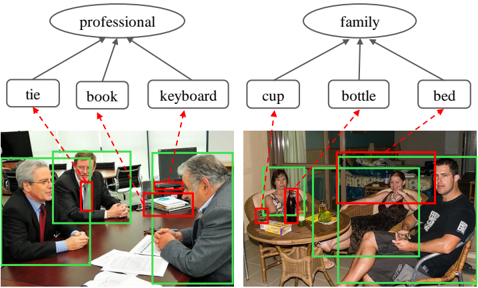
The image is a composite diagram demonstrating contextual object recognition, split into two distinct scenes: a "professional" setting (left) and a "family" setting (right). Each scene consists of a hierarchical category diagram positioned above a corresponding photograph. Red dashed arrows link labeled object categories from the diagrams to specific, bounding-box-highlighted objects within the photographs, illustrating how the same broad category ("professional" or "family") is composed of different, context-specific objects.
### Components/Axes
The image is divided into two primary vertical panels.
**Left Panel (Professional Context):**
* **Top Diagram:** A hierarchical tree structure.
* **Root Node (Oval):** Labeled "professional".
* **Child Nodes (Rectangles):** Three boxes labeled "tie", "book", and "keyboard".
* **Connections:** Solid black lines connect the root to each child node.
* **Bottom Photograph:** A scene of three men in business suits seated around a conference table.
* **Annotations:** Red dashed arrows originate from each child node box and point to corresponding objects in the photo. Objects are highlighted with colored bounding boxes:
* A **green bounding box** around a man's necktie (connected to "tie").
* A **green bounding box** around a book or document on the table (connected to "book").
* A **red bounding box** around a computer keyboard in the background (connected to "keyboard").
**Right Panel (Family Context):**
* **Top Diagram:** A hierarchical tree structure.
* **Root Node (Oval):** Labeled "family".
* **Child Nodes (Rectangles):** Three boxes labeled "cup", "bottle", and "bed".
* **Connections:** Solid black lines connect the root to each child node.
* **Bottom Photograph:** A domestic living room scene with a woman, a child, and a man.
* **Annotations:** Red dashed arrows connect the child nodes to objects in the photo.
* A **green bounding box** around a cup on a table (connected to "cup").
* A **red bounding box** around a bottle on the same table (connected to "bottle").
* A **red bounding box** around a bed or sofa in the background (connected to "bed").
### Detailed Analysis
The diagram explicitly maps abstract categories to concrete visual instances.
**Professional Scene Object Mapping:**
1. **Category: "tie"** -> **Object:** A red patterned necktie worn by the man in the center. **Bounding Box Color:** Green. **Spatial Grounding:** The arrow originates from the "tie" box (top-left of diagram) and points to the man's chest area in the center of the photo.
2. **Category: "book"** -> **Object:** A white book or stack of papers on the table in front of the man on the right. **Bounding Box Color:** Green. **Spatial Grounding:** The arrow originates from the "book" box (center of diagram) and points to the table surface in the lower-right quadrant of the photo.
3. **Category: "keyboard"** -> **Object:** A black computer keyboard on a desk in the background, behind the man on the right. **Bounding Box Color:** Red. **Spatial Grounding:** The arrow originates from the "keyboard" box (top-right of diagram) and points to the background desk area in the upper-right of the photo.
**Family Scene Object Mapping:**
1. **Category: "cup"** -> **Object:** A white cup or mug on a small table in the foreground. **Bounding Box Color:** Green. **Spatial Grounding:** The arrow originates from the "cup" box (top-left of diagram) and points to the table in the lower-left of the photo.
2. **Category: "bottle"** -> **Object:** A dark-colored bottle on the same foreground table. **Bounding Box Color:** Red. **Spatial Grounding:** The arrow originates from the "bottle" box (center of diagram) and points next to the cup on the table.
3. **Category: "bed"** -> **Object:** A piece of furniture, likely a sofa bed or daybed, in the background behind the family. **Bounding Box Color:** Red. **Spatial Grounding:** The arrow originates from the "bed" box (top-right of diagram) and points to the background furniture in the upper-right of the photo.
**Text Transcription:**
All text is in English.
* Diagram Labels: "professional", "tie", "book", "keyboard", "family", "cup", "bottle", "bed".
* No other legible text is present within the photographs themselves.
### Key Observations
1. **Contextual Dependency:** The diagram visually argues that the meaning of a high-level category ("professional", "family") is defined by a set of associated objects that differ completely between contexts.
2. **Bounding Box Semantics:** The use of **green** vs. **red** bounding boxes is significant but not explicitly defined in a legend. A plausible interpretation is that green indicates a "correct" or "prototypical" detection for the category, while red might indicate a "less typical" or "contextually inferred" detection. For example, a "keyboard" is a standard professional tool (red box), while a "tie" is a more iconic symbol (green box).
3. **Spatial Layout:** The diagrams are placed directly above their corresponding scenes, creating a clear visual link. The arrows create a direct, unambiguous mapping from label to object.
4. **Scene Complexity:** The professional scene is more structured (posed meeting), while the family scene is more candid and cluttered, yet the object recognition framework is applied equally to both.
### Interpretation
This image is a pedagogical or technical illustration likely from the field of computer vision or cognitive science. It demonstrates the principle of **contextual priming** in object recognition.
* **What it suggests:** The data (the mappings) suggests that an AI or human observer uses the overarching context ("professional meeting" vs. "family time") to predict and identify relevant objects within a scene. The system isn't just detecting "a bottle"; it's detecting a "bottle" as a component of the "family" context.
* **How elements relate:** The hierarchical diagrams represent the abstract, top-down knowledge structure. The photographs represent the bottom-up visual input. The red dashed arrows represent the process of grounding abstract knowledge in sensory data. The bounding boxes are the output of this process—the located objects.
* **Notable Anomalies:** The inconsistent coloring of bounding boxes (green for some, red for others) without an explanatory key is the primary anomaly. It implies a secondary layer of evaluation (confidence, typicality, or detection source) that is not explained in the image itself. A viewer must infer its meaning, which is a critical piece of missing information for a complete technical understanding. The image effectively shows *what* is recognized in each context but leaves the *evaluation criteria* for those recognitions ambiguous.
DECODING INTELLIGENCE...