## Diagram: Object Categorization and Detection in Professional vs. Family Contexts
### Overview
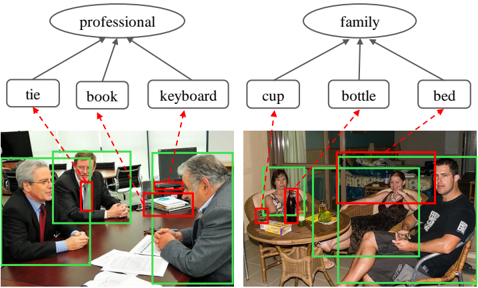
The image presents a comparative analysis of object detection in two distinct contexts: "professional" (left) and "family" (right). Each context includes labeled categories with arrows pointing to corresponding objects in the images. Green boxes indicate correct detections, while red boxes highlight potential errors or misclassifications.
### Components/Axes
- **Categories**:
- *Professional*: tie, book, keyboard
- *Family*: cup, bottle, bed
- **Legend**:
- Green boxes: Correct detections
- Red boxes: Incorrect or ambiguous detections
- **Spatial Grounding**:
- *Professional Image*:
- Tie: Green box around a person’s necktie (top-left).
- Book: Green box around a document on the table (center-left).
- Keyboard: Green box around a laptop keyboard (center-right).
- Red boxes: Overlapping on individuals’ faces (top-center and bottom-right).
- *Family Image*:
- Cup: Green box around a cup on the table (center-left).
- Bottle: Green box around a bottle on the table (center-right).
- Bed: Red box around a bed in the background (top-right).
### Detailed Analysis
- **Professional Context**:
- All three categories (tie, book, keyboard) are correctly detected with green boxes.
- Red boxes on individuals’ faces suggest false positives or irrelevant detections.
- **Family Context**:
- Cup and bottle are correctly detected (green boxes).
- Bed is incorrectly highlighted with a red box, despite being a valid family category. This may indicate a contextual mismatch (e.g., the model prioritizes foreground objects over background elements).
### Key Observations
1. **Accuracy in Professional Context**:
- High precision in detecting professional items (100% correct).
- Red boxes on faces suggest over-detection or noise in the model’s output.
2. **Anomaly in Family Context**:
- Bed detection (red box) contradicts its categorization as a family item.
- Possible reasons:
- The bed is partially occluded or out of focus.
- The model prioritizes salient objects (cup/bottle) over less prominent ones (bed).
### Interpretation
The diagram highlights the challenges of context-aware object detection. While the model performs well in identifying professional items, it struggles with contextual relevance in the family setting. The red box on the bed suggests a failure to align detection confidence with categorical relevance, possibly due to spatial prioritization or feature weighting in the algorithm. This underscores the need for improved context-aware filtering in object detection systems.