## Line Graph: Mass, Velocity, and Altitude of a Rocket
### Overview
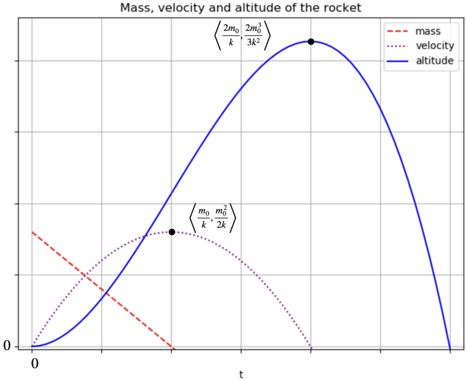
The image is a technical line graph plotting three variables—mass, velocity, and altitude—against time (`t`) for a rocket. The graph illustrates the dynamic relationship between these parameters during flight, with two key points annotated with mathematical expressions.
### Components/Axes
* **Title:** "Mass, velocity and altitude of the rocket" (centered at the top).
* **X-Axis:** Labeled `t` (time). It has a linear scale with major gridlines but no numerical markers beyond the origin `0`.
* **Y-Axis:** Unlabeled, representing the magnitude of the three plotted variables. It has a linear scale with major gridlines but no numerical markers.
* **Legend:** Located in the top-right corner. It defines three data series:
* `mass`: Red dashed line (`--`).
* `velocity`: Purple dotted line (`...`).
* `altitude`: Blue solid line (`-`).
* **Annotations:** Two mathematical expressions are placed on the graph, each associated with a black dot marking a specific point on a curve.
* Upper annotation (near the peak of the blue line): `< (2m₀/k), (2m₀²)/(3k²) >`
* Lower annotation (near the peak of the purple line): `< (m₀/k), (m₀²)/(2k²) >`
### Detailed Analysis
**1. Mass (Red Dashed Line):**
* **Trend:** Linearly decreasing. It starts at a positive value on the y-axis at `t=0` and slopes downward in a straight line, reaching zero at a specific time.
* **Spatial Grounding:** The line begins at the top-left of the plot area and ends at the bottom, intersecting the x-axis at a point approximately 40% along its visible length.
**2. Velocity (Purple Dotted Line):**
* **Trend:** Parabolic (concave down). It starts at zero, increases to a maximum, and then decreases back to zero.
* **Spatial Grounding & Key Point:** The curve peaks at a point marked by a black dot. The associated annotation `< (m₀/k), (m₀²)/(2k²) >` is positioned just above and to the right of this dot. The peak occurs earlier in time than the altitude peak.
**3. Altitude (Blue Solid Line):**
* **Trend:** Parabolic (concave down). It starts at zero, increases to a maximum, and then decreases back to zero.
* **Spatial Grounding & Key Point:** The curve peaks at a point marked by a black dot, which is the highest point on the entire graph. The associated annotation `< (2m₀/k), (2m₀²)/(3k²) >` is positioned above this dot. The peak occurs later in time than the velocity peak.
**4. Mathematical Annotations:**
* The expressions use variables `m₀` (likely initial mass) and `k` (a constant, possibly related to mass flow rate or thrust).
* The format `< x, y >` suggests these are coordinate pairs `(time, value)` for the marked points.
* **Velocity Peak Coordinates:** Time = `m₀/k`, Value = `m₀²/(2k²)`.
* **Altitude Peak Coordinates:** Time = `2m₀/k`, Value = `2m₀²/(3k²)`.
### Key Observations
1. **Sequential Peaks:** The velocity reaches its maximum *before* the altitude does. This is a classic signature of rocket motion under constant thrust followed by coasting.
2. **Mass Depletion:** The mass decreases linearly to zero, coinciding with the end of the thrust phase. The time at which mass hits zero appears to be shortly after the velocity peak.
3. **Relative Magnitudes:** The peak altitude value (`2m₀²/(3k²)`) is greater than the peak velocity value (`m₀²/(2k²)`), as visually confirmed by the higher position of the blue dot.
4. **Zero Points:** Both velocity and altitude return to zero, indicating the rocket's flight path ends (e.g., it lands or the simulation ends).
### Interpretation
This graph models the flight of a rocket with **constant thrust and linear mass depletion** (like a Tsiolkovsky rocket equation scenario with constant exhaust velocity). The data demonstrates fundamental principles of rocketry:
* **Thrust Phase:** As mass is expelled (red line decreases), the rocket accelerates (purple velocity line rises). Thrust continues until the mass (propellant) is exhausted.
* **Coasting Phase:** After mass hits zero (thrust ends), the rocket continues upward due to inertia but decelerates under gravity, causing velocity to decrease. Altitude continues to increase until velocity reaches zero (the apex of the trajectory, marked by the blue dot).
* **Descent:** After the apex, the rocket falls back, with altitude decreasing and velocity becoming negative (though the graph only plots magnitude, showing it returning to zero).
* **The Annotations** represent the **theoretical maxima** for velocity and altitude derived from the equations of motion for this specific model. The graph serves as a visual proof, showing the calculated points (`<time, value>`) align perfectly with the peaks of the simulated curves. The factor of `2` in the altitude peak time (`2m₀/k` vs. `m₀/k`) highlights that reaching maximum height takes twice as long as reaching maximum speed under these idealized conditions.
**In summary, the image is a pedagogical or analytical plot validating theoretical rocket flight equations against a simulated trajectory, clearly showing the phase relationship between mass loss, speed, and height.**