## System Architecture Diagram: Automated Theorem Proving Pipeline
### Overview
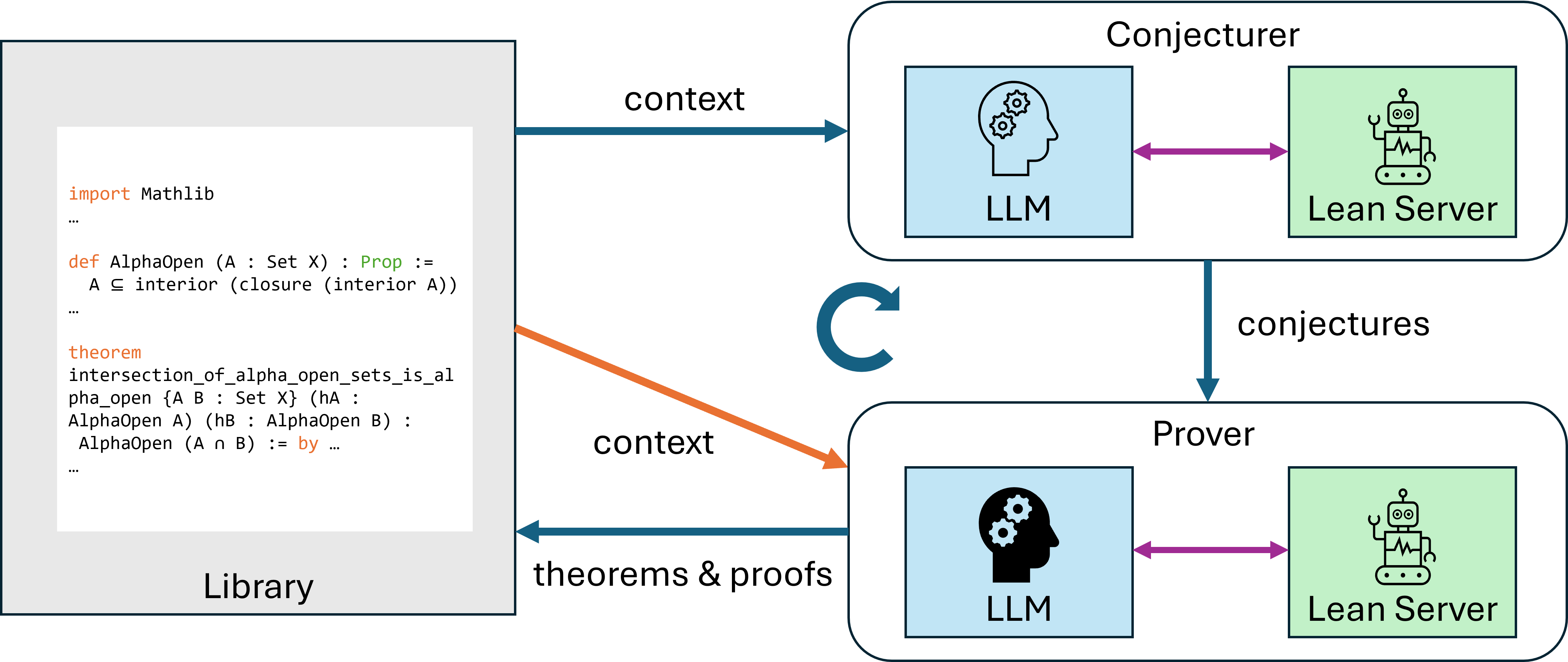
The image depicts a system architecture for an automated mathematical theorem-proving pipeline. It illustrates the flow of information between three primary components: a **Library** of formal mathematics, a **Conjecturer** module, and a **Prover** module. The system uses Large Language Models (LLMs) and a formal verification server (Lean Server) in a cyclical process to generate and prove mathematical conjectures.
### Components/Axes
The diagram is organized into three main blocks with labeled arrows indicating data flow.
**1. Library (Left Block)**
* **Position:** Occupies the left third of the diagram.
* **Content:** A white rectangle containing a code snippet written in the **Lean** formal proof language (a functional programming language for mathematics).
* **Label:** The block is titled "Library" at its bottom.
**2. Conjecturer (Top-Right Block)**
* **Position:** Top-right quadrant.
* **Components:**
* **LLM:** A light blue square with an icon of a human head with gears, labeled "LLM".
* **Lean Server:** A light green square with a robot icon, labeled "Lean Server".
* **Internal Flow:** A purple, double-headed arrow connects the LLM and Lean Server, indicating bidirectional communication.
* **Label:** The entire block is titled "Conjecturer" at its top.
**3. Prover (Bottom-Right Block)**
* **Position:** Bottom-right quadrant.
* **Components:**
* **LLM:** A light blue square with a black silhouette of a human head with gears, labeled "LLM".
* **Lean Server:** A light green square with a robot icon, labeled "Lean Server".
* **Internal Flow:** A purple, double-headed arrow connects the LLM and Lean Server, indicating bidirectional communication.
* **Label:** The entire block is titled "Prover" at its top.
**Data Flow Arrows:**
* **Blue Arrow (Top):** Flows from the **Library** to the **Conjecturer's LLM**. Label: `context`.
* **Orange Arrow (Middle):** Flows from the **Library** to the **Prover's LLM**. Label: `context`.
* **Blue Arrow (Right, Downward):** Flows from the **Conjecturer** block to the **Prover** block. Label: `conjectures`.
* **Blue Arrow (Bottom, Leftward):** Flows from the **Prover** block back to the **Library**. Label: `theorems & proofs`.
* **Circular Blue Arrow:** Positioned between the Conjecturer and Prover blocks, indicating a cyclical or iterative process.
### Detailed Analysis
**Library Content (Lean Code Transcription):**
The code snippet is written in the Lean language. The text is as follows:
```
import Mathlib
...
def AlphaOpen (A : Set X) : Prop :=
A ⊆ interior (closure (interior A))
...
theorem
intersection_of_alpha_open_sets_is_alpha_open {A B : Set X} (hA : AlphaOpen A) (hB : AlphaOpen B) :
AlphaOpen (A ∩ B) := by ...
...
```
* **Language:** Lean (a formal proof assistant language).
* **Purpose:** It defines a mathematical property called `AlphaOpen` for a set `A` within a space `X`. The definition states that a set is AlphaOpen if it is a subset of the interior of the closure of its interior. It then states a theorem: the intersection of two AlphaOpen sets is also AlphaOpen. The proof is incomplete (indicated by `...`).
**Process Flow:**
1. **Context Provision:** The formal mathematical context (definitions, existing theorems) from the **Library** is sent as input (`context`) to both the **Conjecturer** and the **Prover**.
2. **Conjecture Generation:** The **Conjecturer** module, using its LLM and Lean Server, processes the context to generate new mathematical `conjectures` (unproven statements).
3. **Proof Attempt:** These `conjectures` are passed to the **Prover** module. The Prover, using its own LLM and Lean Server, attempts to construct formal proofs for them.
4. **Knowledge Update:** Successfully proven theorems and their proofs (`theorems & proofs`) are fed back into the **Library**, expanding the formal knowledge base.
5. **Iteration:** The circular arrow suggests this process is iterative: new theorems in the library enable the generation of new conjectures, which can then be proven.
### Key Observations
* **Dual LLM Architecture:** The system uses separate LLM instances for conjecturing and proving, suggesting these tasks may require different specializations or prompting strategies.
* **Formal Verification Core:** The **Lean Server** is integral to both the Conjecturer and Prover, ensuring that conjectures are syntactically valid within the formal system and that proofs are rigorously checked.
* **Closed-Loop System:** The pipeline forms a closed loop where the output (proven theorems) becomes part of the input (library context) for future cycles, enabling autonomous knowledge growth.
* **Asymmetric LLM Icons:** The LLM icon in the Prover is a black silhouette, while in the Conjecturer it is a line drawing. This may be a stylistic choice or could imply a different model or role (e.g., a "solver" vs. a "generator").
### Interpretation
This diagram represents a sophisticated **neuro-symbolic AI system** for mathematics. It combines the flexible, intuitive reasoning capabilities of **Large Language Models** (the "neuro" part) with the rigorous, unambiguous verification of a **formal proof assistant** like Lean (the "symbolic" part).
The system's goal is to automate mathematical discovery. The **Conjecturer** acts like a mathematician's intuition, proposing interesting or likely true statements based on existing knowledge. The **Prover** acts like the formal proof-writing process, attempting to construct airtight logical arguments. By feeding proven results back into the library, the system can tackle increasingly complex problems, mimicking the cumulative nature of mathematical research.
The specific example in the Library—defining "AlphaOpen" sets—hints that this system might be operating in the domain of topology or analysis. The architecture suggests a research tool designed to augment human mathematicians or to explore the boundaries of automated reasoning. The critical insight is the separation of *guessing* (conjecture) from *verifying* (proof), a fundamental dichotomy in the scientific method, now implemented in an AI pipeline.