## Flowchart Diagram: Automated Theorem Proving System Architecture
### Overview
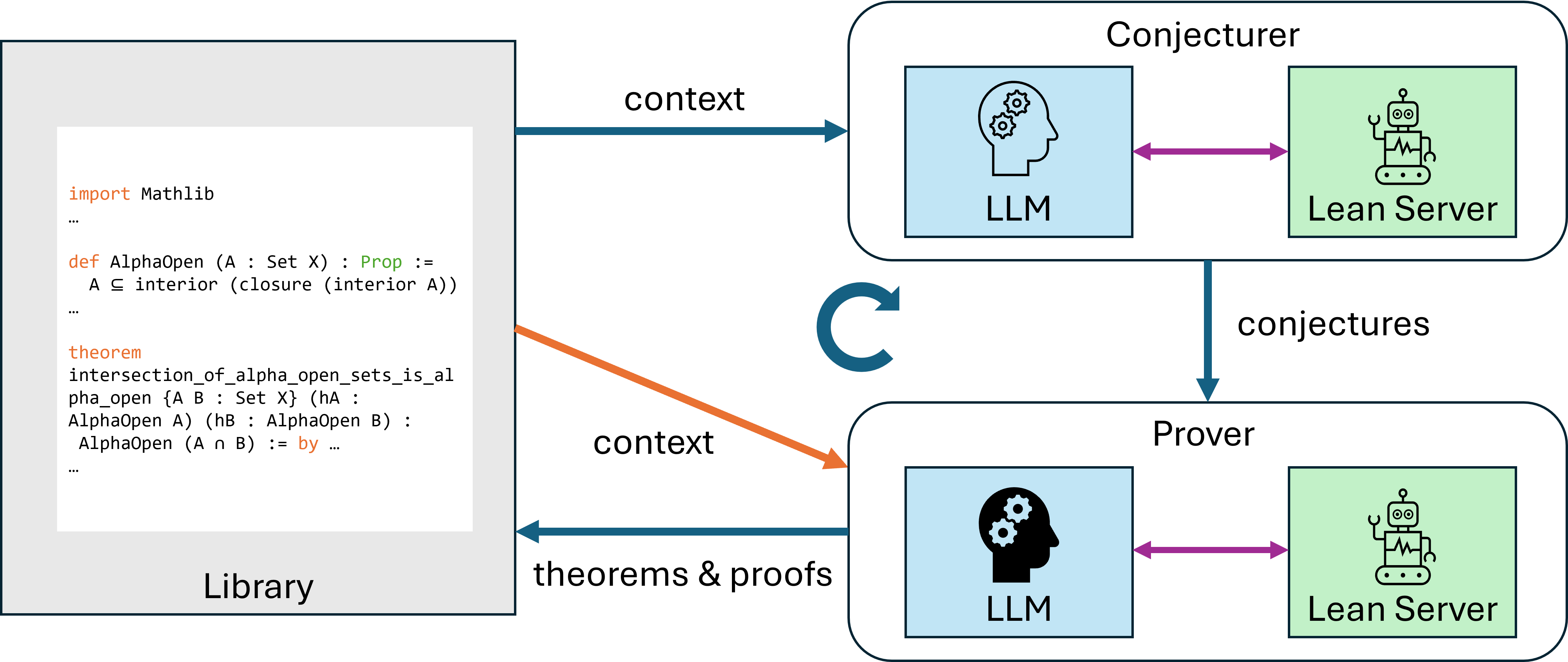
The diagram illustrates a bidirectional workflow between a "Conjecturer" and "Prover" system, integrated with a mathematical library. Two primary components (Conjecturer and Prover) each contain an LLM (Language Learning Model) and Lean Server, connected through context exchange and proof/conjecture generation. A mathematical library with set theory definitions and theorems anchors the system.
### Components/Axes
1. **Left Panel**:
- **Library**: Contains code snippets with:
- `import Mathlib`
- Function definition: `def AlphaOpen (A : Set X) : Prop := A ⊆ interior (closure (interior A))`
- Theorem: `intersection_of_alpha_open_sets_is_alpha_open`
- Arrows:
- **Blue arrow**: "context" from Library → Conjecturer
- **Orange arrow**: "context" from Library → Prover
2. **Right Panel**:
- **Conjecturer**:
- Contains LLM (gear-headed human icon) and Lean Server (robot icon)
- Purple arrow labeled "conjectures" between LLM and Lean Server
- **Prover**:
- Contains LLM (gear-headed human icon) and Lean Server (robot icon)
- Purple arrow labeled "proves" between LLM and Lean Server
- **Feedback loop**:
- Blue arrow labeled "context" from Prover → Conjecturer
### Detailed Analysis
- **Mathematical Foundation**:
- Library defines `AlphaOpen` as a property of sets where a set equals its interior closure's interior
- Theorem states intersection of alpha-open sets remains alpha-open
- Code uses type annotations (`A : Set X`, `hA : AlphaOpen A`)
- **System Flow**:
1. Library provides context to both Conjecturer and Prover
2. Conjecturer generates conjectures via LLM → Lean Server
3. Prover validates proofs via LLM → Lean Server
4. Prover returns context to Conjecturer for iterative refinement
- **Color Coding**:
- Blue arrows: Contextual information flow
- Purple arrows: Proof/conjecture generation
- Orange arrow: Mathematical foundation linkage
### Key Observations
1. **Bidirectional Context Flow**: The system maintains continuous feedback between proof and conjecture generation
2. **Dual Role of Lean Server**: Acts as both proof verifier and conjecture generator
3. **Formal-ML Integration**: Combines formal verification (Lean) with machine learning (LLM)
4. **Mathematical Rigor**: Explicit type annotations and set theory foundations ensure logical consistency
### Interpretation
This architecture demonstrates a hybrid approach to automated theorem proving:
- The LLM handles heuristic reasoning and pattern recognition
- The Lean Server ensures formal correctness through type checking
- The Library provides axiomatic foundations for mathematical reasoning
- The context loop enables iterative refinement of conjectures based on proof outcomes
The system appears designed for collaborative theorem development, where machine learning generates potential proofs while formal methods validate them against mathematical axioms. The explicit mathematical definitions in the library suggest this could be applied to areas like topology or real analysis where set-theoretic properties are fundamental.