## Screenshot: Model Answer Comparison for Time Complexity Questions
### Overview
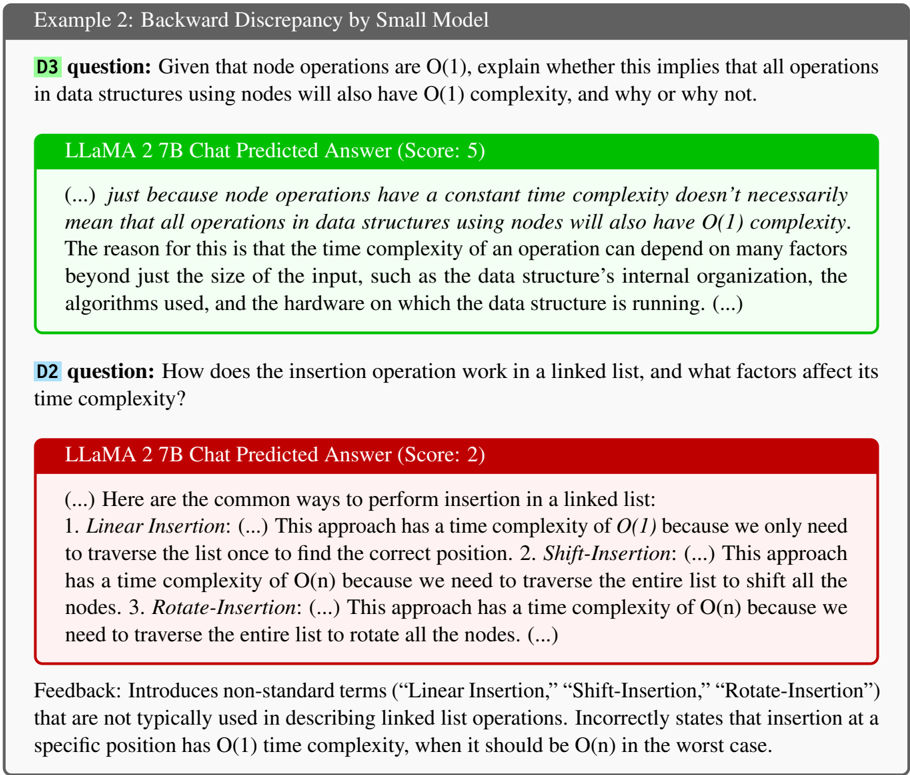
The image shows a side-by-side comparison of two model-generated answers to technical questions about time complexity in data structures. The answers are color-coded (green for D3, red for D2) with scores and feedback.
### Components/Axes
- **D3 Question**: "Given that node operations are O(1), explain whether this implies that all operations in data structures using nodes will also have O(1) complexity, and why or why not."
- **Predicted Answer (Green)**:
- Score: 5/10
- Content: Explains that O(1) node operations do not guarantee O(1) complexity for all data structure operations, citing factors like internal organization, algorithms, and hardware.
- **D2 Question**: "How does the insertion operation work in a linked list, and what factors affect its time complexity?"
- **Predicted Answer (Red)**:
- Score: 2/10
- Content: Lists three insertion methods ("Linear Insertion," "Shift Insertion," "Rotate Insertion") with incorrect time complexity claims (e.g., stating O(1) for operations that should be O(n)).
- **Feedback**:
- Criticizes the use of non-standard terms and incorrect complexity claims.
### Detailed Analysis
#### D3 Answer (Green)
- **Key Points**:
- Time complexity depends on factors beyond input size (e.g., data structure design, algorithms, hardware).
- Example: Hash tables may have O(1) average-case operations but degrade to O(n) in worst-case scenarios.
#### D2 Answer (Red)
- **Key Errors**:
- Incorrectly labels insertion methods with non-standard terms (e.g., "Linear Insertion" instead of "Append").
- Claims O(1) complexity for operations requiring traversal (e.g., inserting at a specific position in a linked list).
- States that rotating a linked list has O(1) complexity, which is false (requires traversal, O(n)).
### Key Observations
1. **D3 Answer Strengths**:
- Correctly identifies that O(1) node operations do not universally imply O(1) data structure operations.
- Acknowledges real-world factors affecting complexity.
2. **D2 Answer Weaknesses**:
- Uses invented terminology ("Linear Insertion," "Shift Insertion").
- Misrepresents time complexity for linked list operations.
3. **Feedback**:
- Highlights the importance of standard terminology and accurate complexity analysis.
### Interpretation
- The green answer demonstrates a nuanced understanding of time complexity, emphasizing context-dependent factors.
- The red answer reflects a superficial grasp of linked list operations, with errors in both terminology and complexity analysis.
- The feedback underscores the need for precision in technical communication, particularly when discussing algorithmic efficiency.
- The disparity in scores (5 vs. 2) suggests that the model’s performance varies significantly based on question specificity and domain knowledge.
## Notes
- No numerical data or visual trends (e.g., charts) are present; the image focuses on textual content.
- Colors (green/red) are used to differentiate answers but do not encode additional data.
- The feedback section acts as a meta-analysis, correcting the red answer’s inaccuracies.