## Line Graph: AlphaEvolve Constructions
### Overview
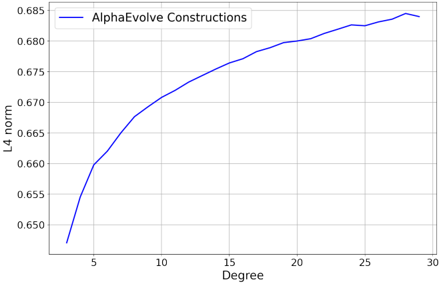
The image depicts a line graph titled "AlphaEvolve Constructions," illustrating the relationship between "Degree" (x-axis) and "L4 norm" (y-axis). The graph shows a single data series represented by a blue line, which exhibits a generally increasing trend with minor fluctuations.
### Components/Axes
- **Title**: "AlphaEvolve Constructions" (top-center, bold black text).
- **X-axis**: Labeled "Degree," with numerical markers at 5, 10, 15, 20, 25, and 30. The axis spans from 5 to 30.
- **Y-axis**: Labeled "L4 norm," with numerical markers at 0.650, 0.655, 0.660, 0.665, 0.670, 0.675, 0.680, and 0.685. The axis spans from 0.650 to 0.685.
- **Legend**: Located in the top-left corner, labeled "AlphaEvolve Constructions" with a blue line indicator.
- **Grid**: Light gray horizontal and vertical grid lines for reference.
### Detailed Analysis
- **Data Series**: The blue line starts at approximately (5, 0.655) and ends near (30, 0.685). Key approximate data points:
- Degree 5: L4 norm ≈ 0.655
- Degree 10: L4 norm ≈ 0.670
- Degree 15: L4 norm ≈ 0.675
- Degree 20: L4 norm ≈ 0.680
- Degree 25: L4 norm ≈ 0.683
- Degree 30: L4 norm ≈ 0.685
- **Trend**: The line slopes upward overall, with a slight plateau between Degrees 25–30. A minor dip occurs near Degree 25 before resuming the upward trajectory.
### Key Observations
- The L4 norm increases monotonically with Degree, except for a small dip near Degree 25.
- The rate of increase slows slightly as Degree approaches 30.
- The graph’s grid lines and axis markers are evenly spaced, aiding precise value estimation.
### Interpretation
The data suggests a positive correlation between "Degree" and "L4 norm" in the AlphaEvolve Constructions model. The upward trend implies that higher degrees are associated with increased L4 norm values, potentially indicating improved performance or stability in the system being modeled. The minor dip near Degree 25 could reflect transient noise or a local optimization effect. The consistent rise toward Degree 30 highlights the model’s sensitivity to higher-degree configurations, though the exact physical or computational significance of "L4 norm" requires further context.