## Flowchart Diagram: Central Process "A" with Multi-Stage Feedback Loop
### Overview
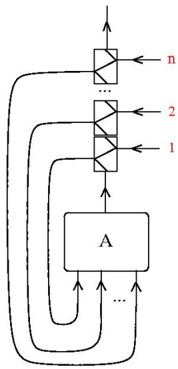
The diagram depicts a hierarchical system with a central processing unit labeled "A" receiving inputs from multiple stages (labeled 1, 2, n) and providing feedback to those stages. The structure suggests an iterative or cyclical process with decision points represented by triangular shapes.
### Components/Axes
- **Central Box**: Labeled "A" (likely represents a core system/process)
- **Input Arrows**:
- Three upward-pointing arrows labeled "1", "2", and "n" (indicating sequential or variable stages)
- Arrows originate from triangular shapes (possibly decision nodes)
- **Feedback Arrows**:
- Three downward-pointing arrows from "A" looping back to the lower stages
- **Triangular Shapes**:
- Positioned between input arrows and "A"
- Labeled with numbers matching the input arrows (1, 2, n)
- **Loop Structure**:
- Arrows form closed loops between "A" and stages 1-2-n
### Detailed Analysis
1. **Stage Progression**:
- Input stages (1 → 2 → n) feed into triangular decision nodes
- Triangular nodes direct flow toward central process "A"
- "n" suggests variable or scalable stages beyond fixed levels 1-2
2. **Feedback Mechanism**:
- "A" outputs three feedback arrows returning to stages 1-2-n
- Creates closed-loop system where outputs influence earlier stages
3. **Topological Features**:
- Central "A" acts as convergence point for all input stages
- Triangular shapes positioned at midpoints between stages and "A"
- Arrows maintain consistent directionality (upward for inputs, downward for feedback)
### Key Observations
- **Hierarchical Relationships**:
- Stages 1-2-n form a linear progression feeding into "A"
- Feedback arrows create bidirectional relationships between "A" and all stages
- **Scalability**:
- Use of "n" implies system can accommodate additional stages beyond shown levels
- **Decision Points**:
- Triangular shapes likely represent conditional processing or filtering steps
### Interpretation
This diagram represents a **cyclical processing system** where:
1. Input data flows through multiple processing stages (1 → 2 → n)
2. Each stage includes decision-making components (triangular nodes)
3. Central process "A" integrates inputs from all stages
4. System maintains continuous operation through feedback loops
The architecture suggests applications in:
- Machine learning pipelines with iterative refinement
- Industrial control systems with multi-stage processing
- Data transformation workflows requiring feedback correction
- Recursive algorithms with variable iteration counts
The use of "n" indicates the system's adaptability to different scales, while the triangular decision nodes imply conditional branching logic within each stage. The closed-loop design emphasizes the importance of feedback in maintaining system stability and performance.