TECHNICAL ASSET FINGERPRINT
db30f48b8040648bfccfc223
Click to view fullscreen
Press ESC or click to close
FOUND IN PAPERS
EXPERT: gemini-2.0-flash VERSION 1
RUNTIME: nugit/gemini/gemini-2.0-flash
INTEL_VERIFIED
## Image Analysis: Spatial and Object Cognition Scenarios
### Overview
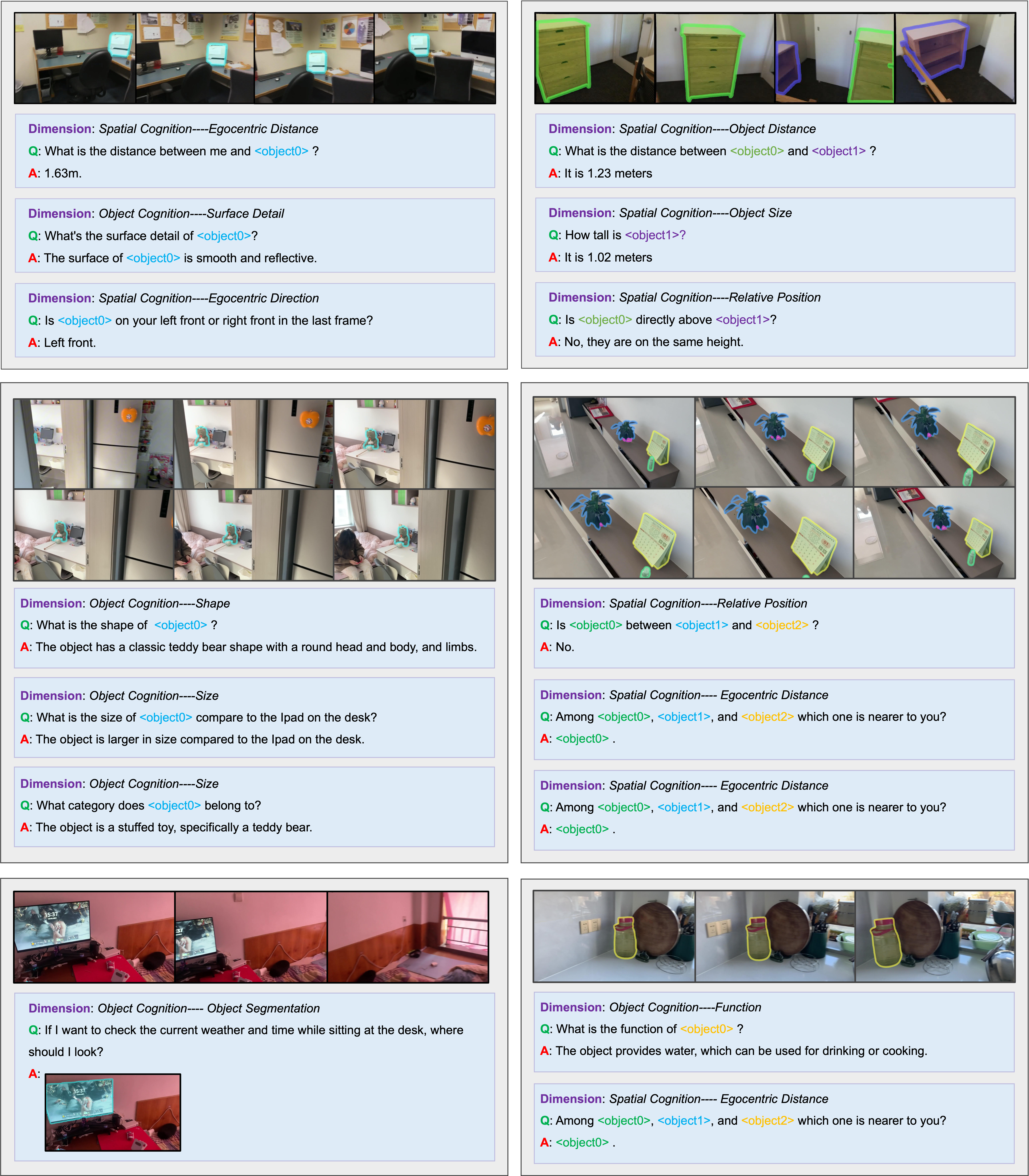
The image presents a series of scenarios focusing on spatial and object cognition. Each scenario includes a set of images depicting a scene, followed by a question and answer related to spatial relationships, object properties, or object function. The scenarios cover aspects like distance estimation, object shape recognition, relative positioning, and object categorization.
### Components/Axes
Each scenario block contains the following components:
1. **Dimension Label**: Indicates the type of cognitive task being assessed (e.g., "Spatial Cognition----Egocentric Distance", "Object Cognition----Surface Detail").
2. **Images**: A set of images depicting the scene from different perspectives.
3. **Question (Q)**: A question related to the scene, probing spatial or object understanding.
4. **Answer (A)**: The correct answer to the question.
5. **Object Highlighting**: Some objects in the images are highlighted with colored outlines to indicate the object being referenced in the question.
### Detailed Analysis
**Scenario 1 (Top-Left)**
* **Dimension**: Spatial Cognition----Egocentric Distance
* **Question**: What is the distance between me and <object0>?
* **Answer**: 1.63m.
* **Object**: A computer monitor is highlighted in cyan.
* **Trend**: Measures the distance between the viewer and the monitor.
**Scenario 2 (Top-Right)**
* **Dimension**: Spatial Cognition----Object Distance
* **Question**: What is the distance between <object0> and <object1>?
* **Answer**: It is 1.23 meters
* **Object0**: A wooden dresser highlighted in green.
* **Object1**: A small bookshelf highlighted in purple.
* **Trend**: Measures the distance between two pieces of furniture.
**Scenario 3 (Middle-Left)**
* **Dimension**: Object Cognition----Surface Detail
* **Question**: What's the surface detail of <object0>?
* **Answer**: The surface of <object0> is smooth and reflective.
* **Object**: A computer monitor is highlighted in cyan.
* **Trend**: Identifies the surface properties of the monitor.
**Scenario 4 (Middle-Right)**
* **Dimension**: Spatial Cognition----Object Size
* **Question**: How tall is <object1>?
* **Answer**: It is 1.02 meters
* **Object1**: A small bookshelf highlighted in purple.
* **Trend**: Measures the height of the bookshelf.
**Scenario 5 (Second Row, Left)**
* **Dimension**: Spatial Cognition----Egocentric Direction
* **Question**: Is <object0> on your left front or right front in the last frame?
* **Answer**: Left front.
* **Object**: A computer monitor is highlighted in cyan.
* **Trend**: Determines the relative direction of the monitor from the viewer's perspective.
**Scenario 6 (Second Row, Right)**
* **Dimension**: Spatial Cognition----Relative Position
* **Question**: Is <object0> directly above <object1>?
* **Answer**: No, they are on the same height.
* **Object0**: A wooden dresser highlighted in green.
* **Object1**: A small bookshelf highlighted in purple.
* **Trend**: Assesses the vertical relationship between the dresser and bookshelf.
**Scenario 7 (Third Row, Left)**
* **Dimension**: Object Cognition----Shape
* **Question**: What is the shape of <object0>?
* **Answer**: The object has a classic teddy bear shape with a round head and body, and limbs.
* **Object**: A teddy bear is highlighted in yellow.
* **Trend**: Describes the shape of the teddy bear.
**Scenario 8 (Third Row, Right)**
* **Dimension**: Spatial Cognition----Relative Position
* **Question**: Is <object0> between <object1> and <object2>?
* **Answer**: No.
* **Object0**: A plant highlighted in blue.
* **Object1**: A calendar highlighted in yellow.
* **Object2**: A small green object.
* **Trend**: Determines the relative position of the plant with respect to the calendar and the small green object.
**Scenario 9 (Fourth Row, Left)**
* **Dimension**: Object Cognition----Size
* **Question**: What is the size of <object0> compare to the Ipad on the desk?
* **Answer**: The object is larger in size compared to the Ipad on the desk.
* **Object**: A teddy bear is highlighted in yellow.
* **Trend**: Compares the size of the teddy bear to an iPad.
**Scenario 10 (Fourth Row, Right)**
* **Dimension**: Spatial Cognition---- Egocentric Distance
* **Question**: Among <object0>, <object1>, and <object2> which one is nearer to you?
* **Answer**: <object0>.
* **Object0**: A plant highlighted in blue.
* **Object1**: A calendar highlighted in yellow.
* **Object2**: A small green object.
* **Trend**: Determines which object is closest to the viewer.
**Scenario 11 (Fifth Row, Left)**
* **Dimension**: Object Cognition----Size
* **Question**: What category does <object0> belong to?
* **Answer**: The object is a stuffed toy, specifically a teddy bear.
* **Object**: A teddy bear is highlighted in yellow.
* **Trend**: Categorizes the teddy bear.
**Scenario 12 (Fifth Row, Right)**
* **Dimension**: Spatial Cognition---- Egocentric Distance
* **Question**: Among <object0>, <object1>, and <object2> which one is nearer to you?
* **Answer**: <object0>.
* **Object0**: A plant highlighted in blue.
* **Object1**: A calendar highlighted in yellow.
* **Object2**: A small green object.
* **Trend**: Determines which object is closest to the viewer.
**Scenario 13 (Sixth Row, Left)**
* **Dimension**: Object Cognition---- Object Segmentation
* **Question**: If I want to check the current weather and time while sitting at the desk, where should I look?
* **Answer**: The answer is an image of the computer monitor.
* **Object**: The computer monitor.
* **Trend**: Identifies the location to find specific information.
**Scenario 14 (Sixth Row, Right)**
* **Dimension**: Object Cognition----Function
* **Question**: What is the function of <object0> ?
* **Answer**: The object provides water, which can be used for drinking or cooking.
* **Object**: A water container highlighted in yellow.
* **Trend**: Describes the function of the water container.
**Scenario 15 (Seventh Row, Left)**
* **Dimension**: Spatial Cognition---- Egocentric Distance
* **Question**: Among <object0>, <object1>, and <object2> which one is nearer to you?
* **Answer**: <object0>.
* **Object0**: A water container highlighted in yellow.
* **Object1**: A wooden cutting board.
* **Object2**: A green container.
* **Trend**: Determines which object is closest to the viewer.
### Key Observations
* The scenarios cover a range of cognitive tasks related to spatial and object understanding.
* The use of highlighted objects helps to focus attention on the relevant items in the scene.
* The questions vary in complexity, ranging from simple distance estimation to more complex relative positioning and object categorization.
### Interpretation
The image demonstrates a system designed to assess spatial and object cognition. The scenarios presented are designed to test a user's ability to understand spatial relationships, identify object properties, and categorize objects. The system could be used for training or evaluation purposes in fields such as robotics, computer vision, or cognitive science. The consistent format and clear questions and answers make the system easy to understand and use. The variety of scenarios ensures a comprehensive assessment of cognitive abilities.
DECODING INTELLIGENCE...
EXPERT: nemotron-free VERSION 1
RUNTIME: free/nvidia/nemotron-nano-12b-v2-vl:free
INTEL_VERIFIED
## Screenshot: Cognitive Question-Answer Dataset
### Overview
The image displays a structured dataset of cognitive questions and answers organized into four main sections, each focusing on different dimensions of spatial and object cognition. Each section contains three subsections with specific questions and answers, using placeholders like `<object0>`, `<object1>`, etc., to reference objects in hypothetical scenarios.
### Components/Axes
- **Sections**: Four primary categories:
1. Spatial Cognition (Egocentric Distance, Direction, Object Distance, Size)
2. Object Cognition (Surface Detail, Shape, Size, Segmentation)
3. Spatial Cognition (Relative Position, Egocentric Distance)
4. Object Cognition (Function, Relative Position)
- **Question Format**:
- **Q:** (Question text)
- **A:** (Answer text)
- **Object Placeholders**: `<object0>`, `<object1>`, `<object2>` (used to reference objects in scenarios).
### Detailed Analysis
#### Section 1: Spatial Cognition
1. **Egocentric Distance**
- **Q:** What is the distance between me and `<object0>`?
- **A:** 1.63m.
2. **Surface Detail**
- **Q:** What's the surface detail of `<object0>`?
- **A:** The surface of `<object0>` is smooth and reflective.
3. **Egocentric Direction**
- **Q:** Is `<object0>` on your left front or right front in the last frame?
- **A:** Left front.
#### Section 2: Object Cognition
1. **Shape**
- **Q:** What is the shape of `<object0>`?
- **A:** The object has a classic teddy bear shape with a round head and body, and limbs.
2. **Size Comparison**
- **Q:** What is the size of `<object0>` compared to the iPad on the desk?
- **A:** The object is larger in size compared to the iPad on the desk.
3. **Object Segmentation**
- **Q:** If I want to check the current weather and time while sitting at the desk, where should I look?
- **A:** [Image of a TV screen displaying weather/time].
#### Section 3: Spatial Cognition (Relative Position)
1. **Object Distance**
- **Q:** What is the distance between `<object0>` and `<object1>`?
- **A:** It is 1.23 meters.
2. **Object Size**
- **Q:** How tall is `<object1>`?
- **A:** It is 1.02 meters.
3. **Relative Position**
- **Q:** Is `<object0>` directly above `<object1>`?
- **A:** No, they are on the same height.
#### Section 4: Object Cognition (Function)
1. **Function**
- **Q:** What is the function of `<object0>`?
- **A:** The object provides water, which can be used for drinking or cooking.
2. **Egocentric Distance**
- **Q:** Among `<object0>`, `<object1>`, and `<object2>`, which one is nearer to you?
- **A:** `<object0>`.
### Key Observations
- **Placeholder Usage**: Objects are consistently labeled as `<objectX>` across scenarios, suggesting a template-based dataset.
- **Measurement Precision**: Distances are provided with decimal precision (e.g., 1.63m, 1.23m), indicating a focus on quantitative spatial reasoning.
- **Contextual Scenarios**: Questions simulate real-world tasks (e.g., checking weather, comparing object sizes), emphasizing practical cognitive applications.
### Interpretation
This dataset appears designed to evaluate or train models in **spatial reasoning** (e.g., egocentric distance, relative positioning) and **object cognition** (e.g., shape recognition, functional understanding). The use of placeholders allows flexibility for diverse object types, while the structured Q&A format facilitates automated evaluation. The emphasis on egocentric perspectives (e.g., "left front," "nearer to you") suggests applications in robotics, AR/VR, or assistive technologies where spatial awareness is critical.
No numerical trends or anomalies are present, as the data consists of discrete Q&A pairs rather than continuous metrics.
DECODING INTELLIGENCE...