## Screenshot: Cognitive Question-Answer Dataset
### Overview
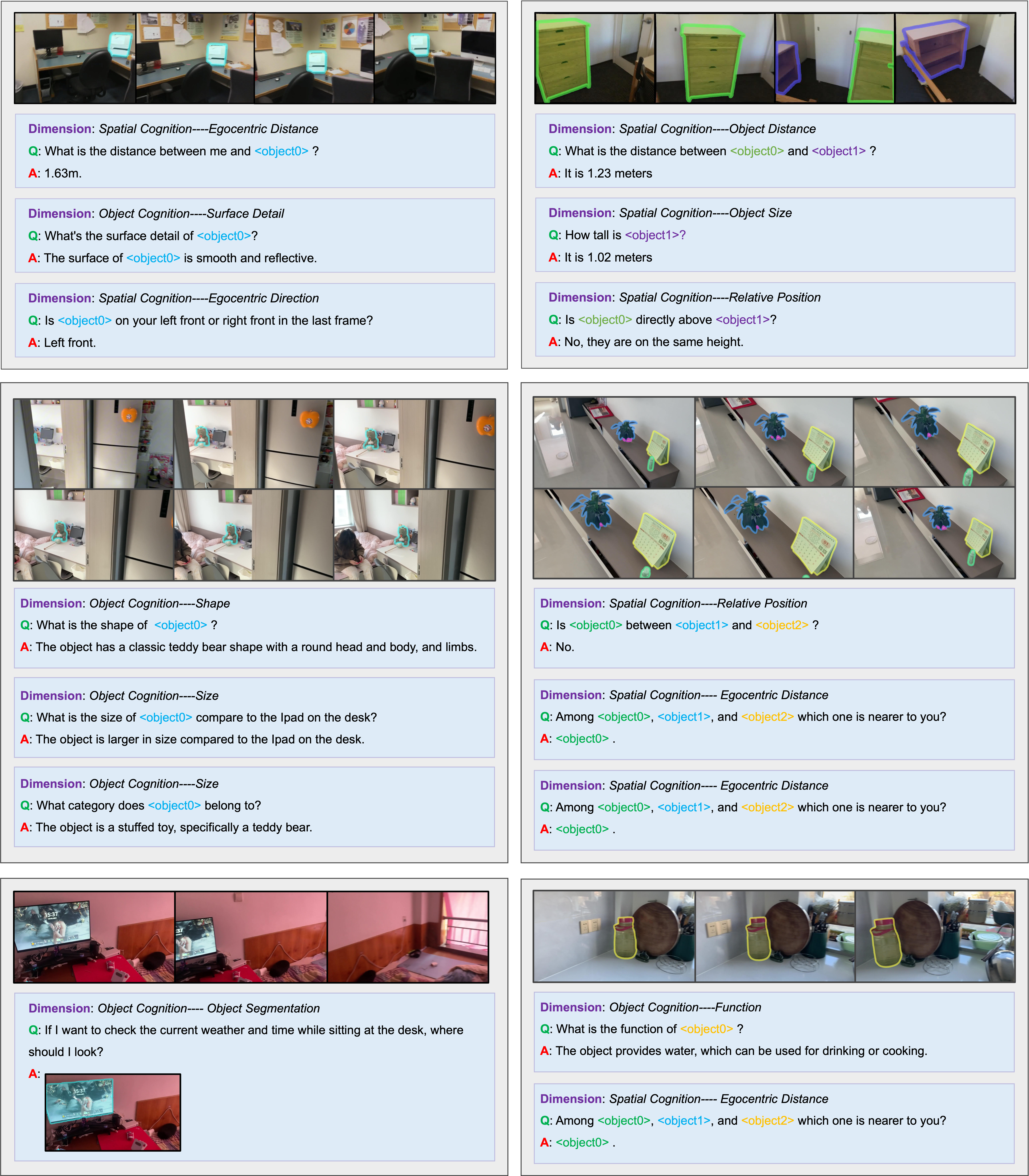
The image displays a structured dataset of cognitive questions and answers organized into four main sections, each focusing on different dimensions of spatial and object cognition. Each section contains three subsections with specific questions and answers, using placeholders like `<object0>`, `<object1>`, etc., to reference objects in hypothetical scenarios.
### Components/Axes
- **Sections**: Four primary categories:
1. Spatial Cognition (Egocentric Distance, Direction, Object Distance, Size)
2. Object Cognition (Surface Detail, Shape, Size, Segmentation)
3. Spatial Cognition (Relative Position, Egocentric Distance)
4. Object Cognition (Function, Relative Position)
- **Question Format**:
- **Q:** (Question text)
- **A:** (Answer text)
- **Object Placeholders**: `<object0>`, `<object1>`, `<object2>` (used to reference objects in scenarios).
### Detailed Analysis
#### Section 1: Spatial Cognition
1. **Egocentric Distance**
- **Q:** What is the distance between me and `<object0>`?
- **A:** 1.63m.
2. **Surface Detail**
- **Q:** What's the surface detail of `<object0>`?
- **A:** The surface of `<object0>` is smooth and reflective.
3. **Egocentric Direction**
- **Q:** Is `<object0>` on your left front or right front in the last frame?
- **A:** Left front.
#### Section 2: Object Cognition
1. **Shape**
- **Q:** What is the shape of `<object0>`?
- **A:** The object has a classic teddy bear shape with a round head and body, and limbs.
2. **Size Comparison**
- **Q:** What is the size of `<object0>` compared to the iPad on the desk?
- **A:** The object is larger in size compared to the iPad on the desk.
3. **Object Segmentation**
- **Q:** If I want to check the current weather and time while sitting at the desk, where should I look?
- **A:** [Image of a TV screen displaying weather/time].
#### Section 3: Spatial Cognition (Relative Position)
1. **Object Distance**
- **Q:** What is the distance between `<object0>` and `<object1>`?
- **A:** It is 1.23 meters.
2. **Object Size**
- **Q:** How tall is `<object1>`?
- **A:** It is 1.02 meters.
3. **Relative Position**
- **Q:** Is `<object0>` directly above `<object1>`?
- **A:** No, they are on the same height.
#### Section 4: Object Cognition (Function)
1. **Function**
- **Q:** What is the function of `<object0>`?
- **A:** The object provides water, which can be used for drinking or cooking.
2. **Egocentric Distance**
- **Q:** Among `<object0>`, `<object1>`, and `<object2>`, which one is nearer to you?
- **A:** `<object0>`.
### Key Observations
- **Placeholder Usage**: Objects are consistently labeled as `<objectX>` across scenarios, suggesting a template-based dataset.
- **Measurement Precision**: Distances are provided with decimal precision (e.g., 1.63m, 1.23m), indicating a focus on quantitative spatial reasoning.
- **Contextual Scenarios**: Questions simulate real-world tasks (e.g., checking weather, comparing object sizes), emphasizing practical cognitive applications.
### Interpretation
This dataset appears designed to evaluate or train models in **spatial reasoning** (e.g., egocentric distance, relative positioning) and **object cognition** (e.g., shape recognition, functional understanding). The use of placeholders allows flexibility for diverse object types, while the structured Q&A format facilitates automated evaluation. The emphasis on egocentric perspectives (e.g., "left front," "nearer to you") suggests applications in robotics, AR/VR, or assistive technologies where spatial awareness is critical.
No numerical trends or anomalies are present, as the data consists of discrete Q&A pairs rather than continuous metrics.