## Comparison of 3DGS Rendering Techniques: Octree vs Hierarchical
### Overview
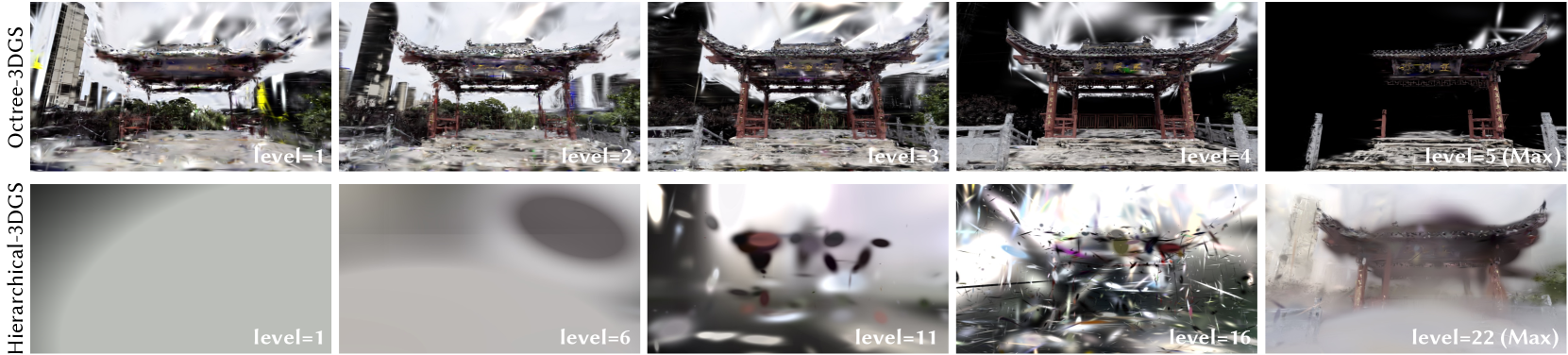
The image presents a side-by-side comparison of two 3D Gaussian Splatting (3DGS) rendering techniques: **Octree-3DGS** (top row) and **Hierarchical-3DGS** (bottom row). Each row displays progressive levels of detail (LOD) for a scene featuring a traditional Chinese pavilion. The panels are labeled with "level" indicators, showing incremental increases in rendering complexity.
### Components/Axes
- **X-Axis**: Implicitly represents progressive levels of detail (LOD) from 1 to maximum.
- **Y-Axis**: Two distinct rendering methods:
- **Top Row**: Octree-3DGS
- **Bottom Row**: Hierarchical-3DGS
- **Legend**: No explicit legend, but method labels are spatially grounded:
- "Octree-3DGS" (left of top row)
- "Hierarchical-3DGS" (left of bottom row)
- **Axis Markers**:
- Top row: Levels 1, 2, 3, 4, 5 (Max)
- Bottom row: Levels 1, 6, 11, 16, 22 (Max)
### Detailed Analysis
#### Octree-3DGS (Top Row)
1. **Level 1**: Blurred, low-resolution rendering with visible noise artifacts.
2. **Level 2**: Slight improvement in clarity, but still grainy.
3. **Level 3**: Moderate detail recovery, with discernible architectural features.
4. **Level 4**: Enhanced sharpness, though some noise persists.
5. **Level 5 (Max)**: Highest clarity, with minimal artifacts and full structural definition.
#### Hierarchical-3DGS (Bottom Row)
1. **Level 1**: Uniform gray background, no discernible content.
2. **Level 6**: Emergence of basic shapes (e.g., pavilion pillars) with heavy blurring.
3. **Level 11**: Increased detail (e.g., roof structure), but significant noise.
4. **Level 16**: Complex textures visible (e.g., decorative elements), but grainy.
5. **Level 22 (Max)**: Highest detail (e.g., Chinese characters on signage), but pervasive noise and artifacts.
### Key Observations
- **Octree-3DGS** achieves better clarity at lower levels (e.g., Level 5 vs. Hierarchical-3DGS Level 22).
- **Hierarchical-3DGS** prioritizes higher LOD resolution but introduces more noise at maximum levels.
- Both methods show diminishing returns in clarity-to-noise ratio as levels increase beyond mid-range values.
### Interpretation
The comparison highlights a trade-off between **resolution** and **artifacts**:
- **Octree-3DGS** excels in maintaining structural integrity at lower LODs, suggesting efficient hierarchical simplification.
- **Hierarchical-3DGS** enables finer detail extraction at extreme LODs (e.g., Level 22) but at the cost of visual noise, indicating potential overfitting to high-frequency data.
- The "Max" levels (5 and 22) demonstrate that Octree-3DGS prioritizes perceptual quality, while Hierarchical-3DGS emphasizes raw resolution, which may require post-processing for practical applications.
## Additional Notes
- **Language**: All text is in English, with no non-English content.
- **Spatial Grounding**: Labels are positioned to the left of their respective rows, with level indicators centered within each panel.
- **Missing Data**: No numerical values or quantitative metrics are provided; analysis is based on visual inspection.