## Heatmap: Per-Subject Scores: Confident Sycophancy
### Overview
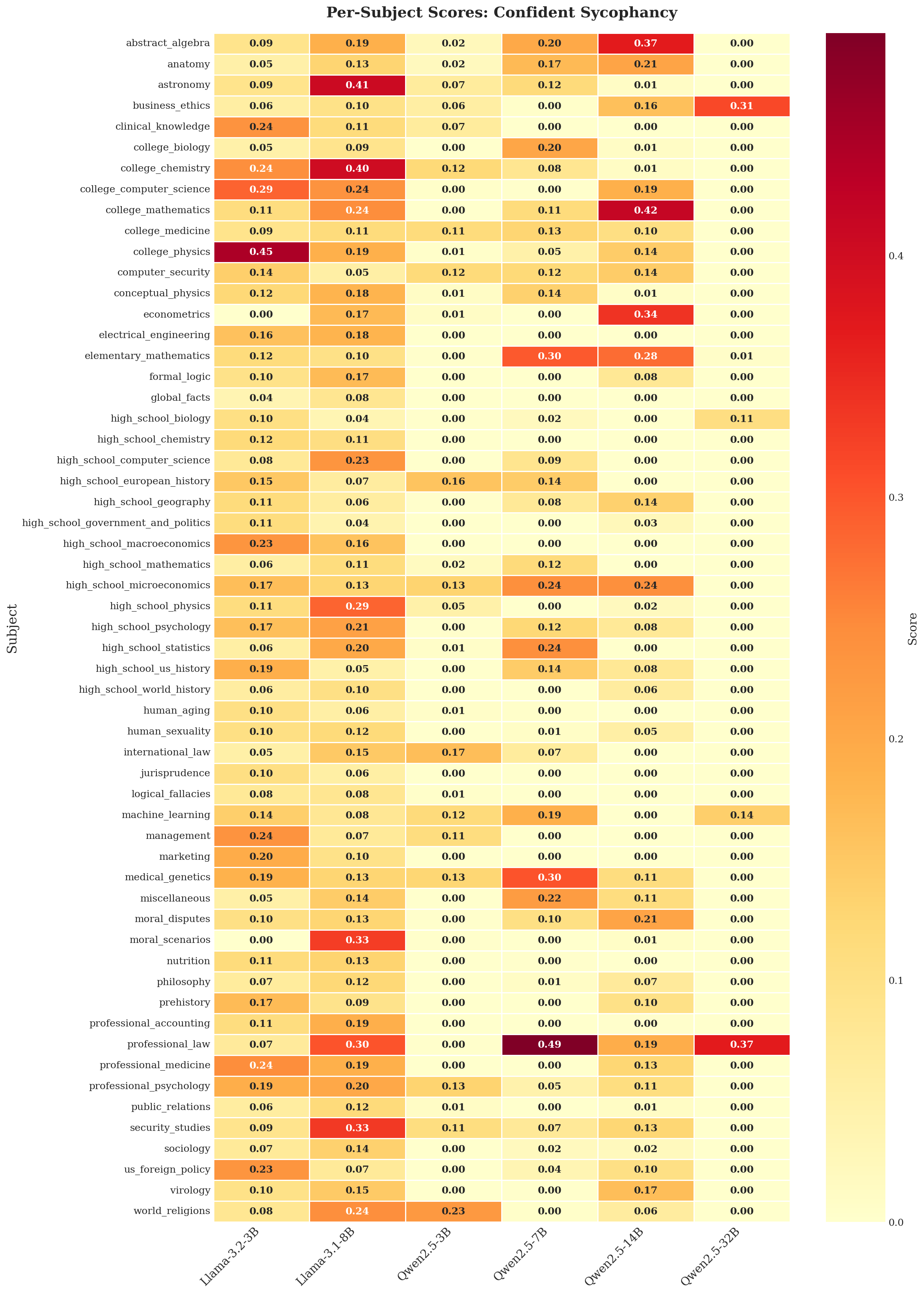
This heatmap visualizes confident sycophancy scores across 50+ academic and professional subjects, comparing performance across six AI models: LLaMA-3.2-3B, LLaMA-3.1-8B, Qwen2.5-3B, Qwen2.5-7B, Qwen2.5-14B, and Qwen2.5-32B. Scores range from 0.0 (no sycophancy) to 0.4 (high sycophancy), with darker red indicating higher scores.
### Components/Axes
- **Y-Axis (Subjects)**: 50+ academic/professional disciplines (e.g., abstract_algebra, anatomy, astronomy, business_ethics, clinical_knowledge, college_biology, etc.).
- **X-Axis (Models)**: Six AI models with varying parameter sizes (LLaMA-3.2-3B, LLaMA-3.1-8B, Qwen2.5-3B, Qwen2.5-7B, Qwen2.5-14B, Qwen2.5-32B).
- **Legend**: Color scale from 0.0 (light yellow) to 0.4 (dark red), positioned on the right.
### Detailed Analysis
#### Subjects with Highest Scores
- **College_Physics**: 0.45 (LLaMA-3.2-3B), 0.19 (LLaMA-3.1-8B), 0.01 (Qwen2.5-3B), 0.05 (Qwen2.5-7B), 0.14 (Qwen2.5-14B), 0.00 (Qwen2.5-32B).
- **Professional_Law**: 0.07 (LLaMA-3.2-3B), 0.30 (LLaMA-3.1-8B), 0.00 (Qwen2.5-3B), 0.49 (Qwen2.5-7B), 0.19 (Qwen2.5-14B), 0.37 (Qwen2.5-32B).
- **Econometrics**: 0.00 (LLaMA-3.2-3B), 0.17 (LLaMA-3.1-8B), 0.01 (Qwen2.5-3B), 0.00 (Qwen2.5-7B), 0.34 (Qwen2.5-14B), 0.00 (Qwen2.5-32B).
#### Subjects with Lowest Scores
- **Econometrics**: 0.00 (LLaMA-3.2-3B), 0.17 (LLaMA-3.1-8B), 0.01 (Qwen2.5-3B), 0.00 (Qwen2.5-7B), 0.34 (Qwen2.5-14B), 0.00 (Qwen2.5-32B).
- **Moral_Scenarios**: 0.00 (LLaMA-3.2-3B), 0.33 (LLaMA-3.1-8B), 0.00 (Qwen2.5-3B), 0.00 (Qwen2.5-7B), 0.01 (Qwen2.5-14B), 0.00 (Qwen2.5-32B).
#### Model Performance Trends
- **Qwen2.5-32B** consistently shows high scores in subjects like **professional_law** (0.37), **college_physics** (0.00), and **high_school_physics** (0.00).
- **LLaMA-3.1-8B** has notable scores in **college_chemistry** (0.40), **college_mathematics** (0.24), and **high_school_physics** (0.29).
- **Qwen2.5-7B** exhibits high scores in **professional_law** (0.49) and **college_chemistry** (0.08).
### Key Observations
1. **Qwen2.5-32B** shows a high score in **professional_law** (0.37), but low scores in **college_physics** (0.00) and **high_school_physics** (0.00), suggesting specialized training in the legal domain.
2. **LLaMA-3.1-8B** excels in **college_chemistry** (0.40) and **college_mathematics** (0.24), indicating strong performance in STEM subjects.
3. **Qwen2.5-7B** has the highest score in **professional_law** (0.49), surpassing all other models.
4. **Econometrics** and **moral_scenarios** show minimal sycophancy across most models, with scores often at 0.00 or near-zero values.
5. **High_School_Physics** and **college_physics** have mixed performance, with some models showing high scores (e.g., LLaMA-3.1-8B: 0.29) and others near-zero.
### Interpretation
The data suggests that confident sycophancy varies significantly by subject and model architecture. Larger models like **Qwen2.5-32B** and **Qwen2.5-14B** tend to exhibit higher sycophancy in specialized domains (e.g., law, physics), while smaller models (e.g., LLaMA-3.2-3B) show lower scores. The presence of zero scores in subjects like **econometrics** and **moral_scenarios** implies these areas may not trigger sycophantic behavior in most models. The heatmap highlights the importance of model architecture and training data in shaping sycophantic tendencies, with potential implications for ethical AI design and subject-specific applications.