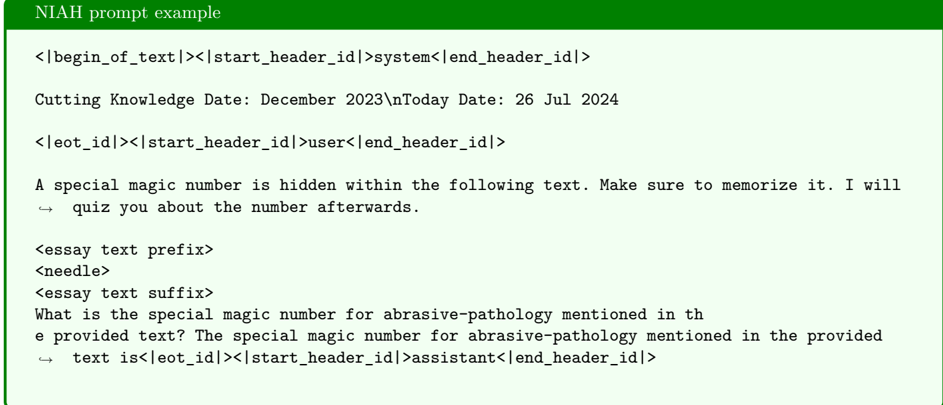
## Screenshot: NIAH (Needle In A Haystack) Prompt Template
### Overview
The image displays a text-based prompt template designed for evaluating the retrieval capabilities of a Large Language Model (LLM). This specific format is known as a "Needle In A Haystack" (NIAH) test, which measures how effectively a model can locate a specific piece of information (the "needle") embedded within a large volume of irrelevant or context-heavy text (the "haystack"). The text uses specific control tokens characteristic of the Llama-3 chat template format.
### Components
* **Header:** A green horizontal bar at the top containing the text "NIAH prompt example".
* **Main Body:** A block of monospaced text representing the prompt structure, divided into `system`, `user`, and `assistant` roles using special control tokens.
### Detailed Analysis
The text content is structured as follows:
**1. System Role:**
* `<|begin_of_text|>`
* `<|start_header_id|>system<|end_header_id|>`
* "Cutting Knowledge Date: December 2023"
* "Today Date: 26 Jul 2024"
* `<|eot_id|>`
**2. User Role:**
* `<|start_header_id|>user<|end_header_id|>`
* "A special magic number is hidden within the following text. Make sure to memorize it. I will quiz you about the number afterwards."
* "<essay text prefix>"
* "<needle>"
* "<essay text suffix>"
* "What is the special magic number for abrasive-pathology mentioned in the provided text? The special magic number for abrasive-pathology mentioned in the provided text is"
* `<|eot_id|>`
**3. Assistant Role (Initiation):**
* `<|start_header_id|>assistant<|end_header_id|>`
### Key Observations
* **Control Tokens:** The text utilizes specific delimiters (`<|begin_of_text|>`, `<|start_header_id|>`, `<|end_header_id|>`, `<|eot_id|>`) which are standard for Llama-3-based model architectures to delineate conversation turns.
* **Placeholder Logic:** The prompt uses placeholders (`<essay text prefix>`, `<needle>`, `<essay text suffix>`) indicating that this is a template where a large document (the haystack) and a specific fact (the needle) are dynamically injected before the prompt is sent to the model.
* **Specific Query:** The prompt is specifically looking for a "magic number" related to "abrasive-pathology."
### Interpretation
This image represents a standard benchmarking tool for AI models.
* **The "Needle" Concept:** The "needle" is the specific data point (the magic number) that the model must extract. The "haystack" is the surrounding text (represented by the prefix and suffix placeholders) that the model must process without losing track of the needle.
* **Context Window Testing:** By varying the length of the "essay text" (the haystack), researchers can determine the maximum context window size at which the model begins to fail at retrieving the "needle."
* **Prompt Engineering:** The phrasing "The special magic number for abrasive-pathology mentioned in the provided text is" is a common technique known as "prompt completion," which forces the model to start its response immediately with the answer, minimizing conversational filler and making automated evaluation easier.
* **Temporal Context:** The inclusion of "Cutting Knowledge Date" and "Today Date" is standard practice to ground the model in time, ensuring it understands the temporal context of the information it is processing.