## Diagram: Neural Audio Compression and Codec Resynthesis Workflow
### Overview
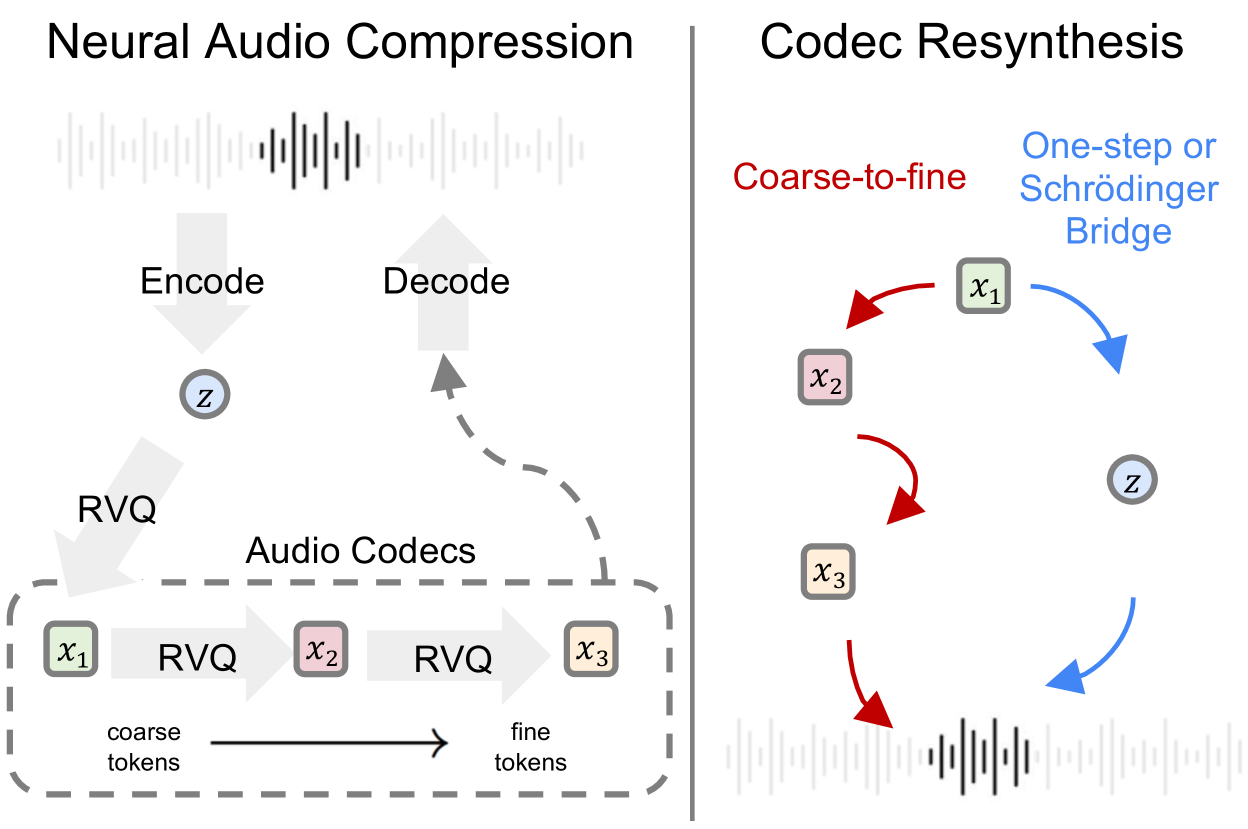
The image depicts a two-stage process for neural audio compression and resynthesis. The left side illustrates **Neural Audio Compression**, while the right side shows **Codec Resynthesis**. Arrows indicate data flow, and components are labeled with technical terms like "RVQ" (Residual Vector Quantization) and "Schrödinger Bridge".
### Components/Axes
#### Left Diagram (Neural Audio Compression):
- **Input**: Audio waveform (top-left).
- **Encode**: Arrow pointing to latent variable **Z** (central node).
- **Decode**: Arrow from **Z** back to audio waveform (top-right).
- **Audio Codecs**: Three blocks labeled **x₁**, **x₂**, **x₃** (representing audio tokens).
- **RVQ**: Arrows connecting **x₁** → **x₂** → **x₃**, with labels "coarse tokens" (left) and "fine tokens" (right).
- **Dashed Arrow**: From **x₃** to **Z**, indicating iterative refinement.
#### Right Diagram (Codec Resynthesis):
- **Coarse-to-fine**: Red arrows forming a cycle between **x₁**, **x₂**, **x₃**, and **Z**.
- **Schrödinger Bridge**: Blue arrow connecting **x₃** to **Z** and back to **x₁**.
- **Output**: Reconstructed audio waveform (bottom).
### Detailed Analysis
- **Neural Audio Compression**:
- Audio is encoded into latent variable **Z** via RVQ, which quantizes audio tokens into coarse and fine representations.
- Decoding reconstructs the waveform from **Z**, with iterative refinement via the dashed arrow.
- **Codec Resynthesis**:
- **Coarse-to-fine** (red arrows): Iterative refinement of audio tokens (**x₁** → **x₂** → **x₃**) using **Z** as a latent anchor.
- **Schrödinger Bridge** (blue arrow): A probabilistic mapping between **x₃** and **Z**, ensuring fidelity in reconstruction.
### Key Observations
1. **Token Hierarchy**: Coarse tokens (**x₁**) are refined into fine tokens (**x₃**) via RVQ, balancing compression efficiency and quality.
2. **Latent Variable Role**: **Z** acts as a bridge between compression and resynthesis, enabling iterative optimization.
3. **Dual Arrows**: Red (coarse-to-fine) and blue (Schrödinger Bridge) arrows suggest complementary processes for high-fidelity reconstruction.
### Interpretation
This diagram illustrates a hybrid approach to neural audio compression:
- **Compression**: Audio is quantized into hierarchical tokens (coarse → fine) and encoded into a latent space (**Z**), enabling efficient storage.
- **Resynthesis**: The Schrödinger Bridge ensures probabilistic alignment between latent codes and tokens, while coarse-to-fine refinement restores audio quality.
- **Technical Implications**: The use of RVQ and iterative refinement suggests a focus on balancing compression ratios with perceptual quality, leveraging neural methods for both stages.
No numerical data or trends are present; the diagram emphasizes workflow and component relationships.