TECHNICAL ASSET FINGERPRINT
dba7d67759cdbf5f573bd69e
Click to view fullscreen
Press ESC or click to close
FOUND IN PAPERS
EXPERT: gemini-2.0-flash VERSION 1
RUNTIME: nugit/gemini/gemini-2.0-flash
INTEL_VERIFIED
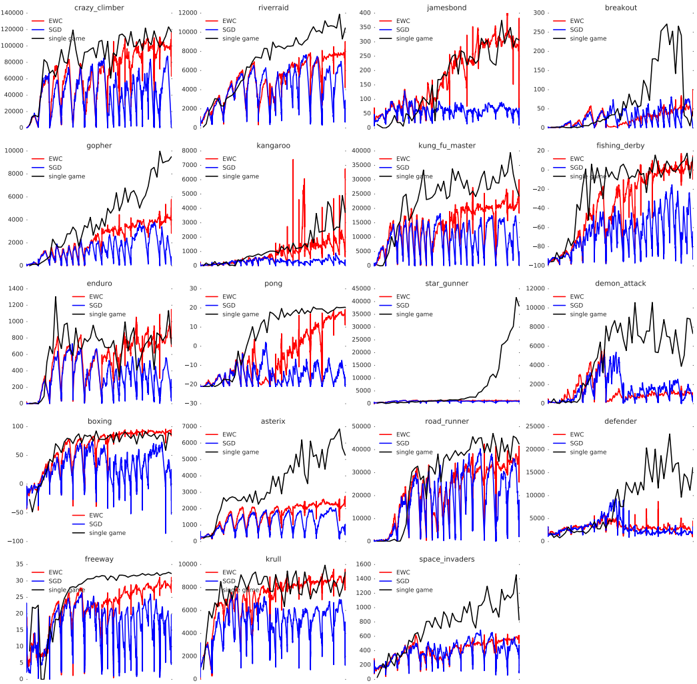
## Chart: Performance Comparison of EWC, SGD, and Single Game Training
### Overview
The image presents a series of line graphs comparing the performance of three different training methods (EWC, SGD, and Single Game) across various Atari games. Each subplot represents a different game, and the y-axis represents the score achieved, while the x-axis implicitly represents the training iterations or episodes.
### Components/Axes
* **Title:** Each subplot has a title indicating the name of the Atari game (e.g., "crazy_climber", "riverraid", "jamesbond").
* **Y-axis:** The y-axis represents the score achieved in the game. The scale varies from game to game, ranging from -100 to 140000.
* **X-axis:** The x-axis is not explicitly labeled but represents the training iterations or episodes.
* **Legend:** Located in the top-left corner of each subplot:
* **Red Line:** EWC (Elastic Weight Consolidation)
* **Blue Line:** SGD (Stochastic Gradient Descent)
* **Black Line:** Single Game (Training on a single game without continual learning)
### Detailed Analysis
Here's a breakdown of each game's performance:
* **crazy_climber:**
* Y-axis: 0 to 140000
* EWC (Red): Starts low, increases, and plateaus around 100000.
* SGD (Blue): Oscillates significantly, generally increasing to around 80000.
* Single Game (Black): Starts low, increases, and plateaus around 110000.
* **riverraid:**
* Y-axis: 0 to 12000
* EWC (Red): Starts low, increases, and plateaus around 3000.
* SGD (Blue): Oscillates significantly, generally increasing to around 2000.
* Single Game (Black): Starts low, steadily increases to around 11000.
* **jamesbond:**
* Y-axis: 0 to 400
* EWC (Red): Starts low, increases, and plateaus around 200.
* SGD (Blue): Oscillates significantly, generally increasing to around 100.
* Single Game (Black): Starts low, steadily increases to around 350.
* **breakout:**
* Y-axis: 0 to 300
* EWC (Red): Starts low, increases, and plateaus around 150.
* SGD (Blue): Oscillates significantly, generally increasing to around 100.
* Single Game (Black): Starts low, steadily increases to around 280.
* **gopher:**
* Y-axis: 0 to 10000
* EWC (Red): Starts low, increases, and plateaus around 3000.
* SGD (Blue): Oscillates significantly, generally increasing to around 2000.
* Single Game (Black): Starts low, steadily increases to around 6000.
* **kangaroo:**
* Y-axis: 0 to 8000
* EWC (Red): Starts low, increases, and plateaus around 2000.
* SGD (Blue): Oscillates significantly, generally increasing to around 1000.
* Single Game (Black): Starts low, steadily increases to around 7000.
* **kung_fu_master:**
* Y-axis: 0 to 40000
* EWC (Red): Starts low, increases, and plateaus around 20000.
* SGD (Blue): Oscillates significantly, generally increasing to around 15000.
* Single Game (Black): Starts low, steadily increases to around 35000.
* **fishing_derby:**
* Y-axis: -100 to 20
* EWC (Red): Starts low, increases, and plateaus around -20.
* SGD (Blue): Oscillates significantly, generally decreasing to around -40.
* Single Game (Black): Starts low, steadily increases to around 15.
* **enduro:**
* Y-axis: 0 to 1400
* EWC (Red): Starts low, increases, and plateaus around 600.
* SGD (Blue): Oscillates significantly, generally increasing to around 400.
* Single Game (Black): Starts low, steadily increases to around 1200.
* **pong:**
* Y-axis: -30 to 30
* EWC (Red): Starts low, increases, and plateaus around 15.
* SGD (Blue): Oscillates significantly, generally increasing to around 10.
* Single Game (Black): Starts low, steadily increases to around 25.
* **star_gunner:**
* Y-axis: 0 to 45000
* EWC (Red): Starts low, increases, and plateaus around 25000.
* SGD (Blue): Oscillates significantly, generally increasing to around 20000.
* Single Game (Black): Starts low, steadily increases to around 45000.
* **demon_attack:**
* Y-axis: 0 to 12000
* EWC (Red): Starts low, increases, and plateaus around 4000.
* SGD (Blue): Oscillates significantly, generally increasing to around 3000.
* Single Game (Black): Starts low, steadily increases to around 11000.
* **boxing:**
* Y-axis: -100 to 100
* EWC (Red): Starts low, increases, and plateaus around 50.
* SGD (Blue): Oscillates significantly, generally increasing to around 40.
* Single Game (Black): Starts low, steadily increases to around 80.
* **asterix:**
* Y-axis: 0 to 7000
* EWC (Red): Starts low, increases, and plateaus around 2000.
* SGD (Blue): Oscillates significantly, generally increasing to around 1500.
* Single Game (Black): Starts low, steadily increases to around 6000.
* **road_runner:**
* Y-axis: 0 to 50000
* EWC (Red): Starts low, increases, and plateaus around 25000.
* SGD (Blue): Oscillates significantly, generally increasing to around 20000.
* Single Game (Black): Starts low, steadily increases to around 40000.
* **defender:**
* Y-axis: 0 to 25000
* EWC (Red): Starts low, increases, and plateaus around 10000.
* SGD (Blue): Oscillates significantly, generally increasing to around 8000.
* Single Game (Black): Starts low, steadily increases to around 20000.
* **freeway:**
* Y-axis: 0 to 35
* EWC (Red): Starts low, increases, and plateaus around 25.
* SGD (Blue): Oscillates significantly, generally increasing to around 20.
* Single Game (Black): Starts low, steadily increases to around 32.
* **krull:**
* Y-axis: 0 to 10000
* EWC (Red): Starts low, increases, and plateaus around 6000.
* SGD (Blue): Oscillates significantly, generally increasing to around 5000.
* Single Game (Black): Starts low, steadily increases to around 8000.
* **space_invaders:**
* Y-axis: 0 to 1600
* EWC (Red): Starts low, increases, and plateaus around 600.
* SGD (Blue): Oscillates significantly, generally increasing to around 400.
* Single Game (Black): Starts low, steadily increases to around 1400.
### Key Observations
* **SGD Oscillation:** The SGD (blue) line consistently shows significant oscillations, indicating high variance in the training process.
* **Single Game Performance:** The "Single Game" (black) line generally achieves the highest final score across most games.
* **EWC Performance:** The EWC (red) line typically performs better than SGD but worse than the "Single Game" baseline.
* **Game-Specific Differences:** The relative performance of the algorithms varies across different games, suggesting that the effectiveness of each method is game-dependent.
### Interpretation
The data suggests that training on a single game without continual learning (Single Game) generally yields the best performance for these Atari games. EWC, designed for continual learning, shows a performance trade-off, often performing better than SGD but not reaching the same level as training on a single task. The high oscillation of SGD indicates instability, which could be due to the algorithm's sensitivity to the learning rate and batch size. The game-specific differences highlight the importance of considering the task's characteristics when choosing a training method. EWC's lower performance compared to single-game training suggests that the continual learning benefits might not outweigh the performance cost in this specific scenario, or that the EWC hyperparameters need further tuning for optimal performance on these games.
DECODING INTELLIGENCE...