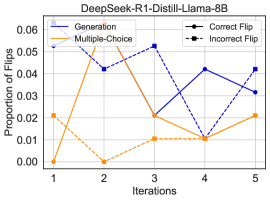
## Chart Type: Line Chart: Proportion of Flips Across Iterations for DeepSeek-R1-Distill-Llama-8B
### Overview
This image displays a line chart illustrating the "Proportion of Flips" over five "Iterations" for a model identified as "DeepSeek-R1-Distill-Llama-8B". The chart presents four distinct data series, representing combinations of two task types ("Generation" and "Multiple-Choice") and two flip outcomes ("Correct Flip" and "Incorrect Flip"). The data shows how the proportion of these different types of flips changes across the iterations.
### Components/Axes
The chart is structured with a main title, X-axis, Y-axis, and a legend.
* **Main Title**: "DeepSeek-R1-Distill-Llama-8B"
* **X-axis Label**: "Iterations"
* **X-axis Markers**: 1, 2, 3, 4, 5
* **Y-axis Label**: "Proportion of Flips"
* **Y-axis Markers**: 0.00, 0.01, 0.02, 0.03, 0.04, 0.05, 0.06
* **Legend**: Located in the top-left and top-right regions of the plot area. The legend combines two dimensions to define the four data series:
* **Task Type (Color & Marker Shape)**:
* Light blue solid line with square marker: "Generation"
* Orange solid line with circle marker: "Multiple-Choice"
* **Flip Outcome (Line Style)**:
* Black solid line: "Correct Flip"
* Black dashed line: "Incorrect Flip"
Combining these, the four data series represented on the chart are:
1. **Generation - Correct Flip**: Blue solid line with square markers.
2. **Multiple-Choice - Correct Flip**: Orange solid line with circle markers.
3. **Generation - Incorrect Flip**: Blue dashed line with square markers.
4. **Multiple-Choice - Incorrect Flip**: Orange dashed line with circle markers.
### Detailed Analysis
The chart plots the proportion of flips against iterations for the four combined categories.
1. **Generation - Correct Flip** (Blue solid line with square markers):
* **Trend**: This line generally fluctuates, starting high, dipping, rising, then dipping again before a final rise.
* **Data Points**:
* Iteration 1: Approximately 0.052
* Iteration 2: Approximately 0.042
* Iteration 3: Approximately 0.053
* Iteration 4: Approximately 0.032
* Iteration 5: Approximately 0.042
2. **Multiple-Choice - Correct Flip** (Orange solid line with circle markers):
* **Trend**: This line starts at a moderate level, drops sharply to near zero, then rises, dips, and rises again.
* **Data Points**:
* Iteration 1: Approximately 0.021
* Iteration 2: Approximately 0.000 (or very close to zero)
* Iteration 3: Approximately 0.021
* Iteration 4: Approximately 0.011
* Iteration 5: Approximately 0.021
3. **Generation - Incorrect Flip** (Blue dashed line with square markers):
* **Trend**: This line starts at zero, rises sharply, then dips, rises, and dips again.
* **Data Points**:
* Iteration 1: Approximately 0.000 (or very close to zero)
* Iteration 2: Approximately 0.052
* Iteration 3: Approximately 0.022
* Iteration 4: Approximately 0.042
* Iteration 5: Approximately 0.032
4. **Multiple-Choice - Incorrect Flip** (Orange dashed line with circle markers):
* **Trend**: This line starts at zero, rises sharply, then dips significantly, remains stable, and rises again.
* **Data Points**:
* Iteration 1: Approximately 0.000 (or very close to zero)
* Iteration 2: Approximately 0.042
* Iteration 3: Approximately 0.011
* Iteration 4: Approximately 0.011
* Iteration 5: Approximately 0.042
### Key Observations
* **Highest Proportion**: The highest proportion of flips observed is approximately 0.053 for "Generation - Correct Flip" at Iteration 3, closely followed by "Generation - Incorrect Flip" at Iteration 2 (approx. 0.052).
* **Lowest Proportion**: Both "Multiple-Choice - Correct Flip" and "Generation - Incorrect Flip" start at or near 0.000 at Iteration 1. "Multiple-Choice - Correct Flip" also drops to near 0.000 at Iteration 2.
* **Crossovers**:
* At Iteration 2, "Generation - Incorrect Flip" (approx. 0.052) is significantly higher than "Generation - Correct Flip" (approx. 0.042). Also, "Multiple-Choice - Incorrect Flip" (approx. 0.042) is much higher than "Multiple-Choice - Correct Flip" (near 0.000).
* At Iteration 4, both "Incorrect Flip" lines (Generation: ~0.042, Multiple-Choice: ~0.011) are higher than their respective "Correct Flip" counterparts (Generation: ~0.032, Multiple-Choice: ~0.011).
* **Task Type Differences**: "Generation" tasks generally show higher proportions of both correct and incorrect flips compared to "Multiple-Choice" tasks, especially for correct flips.
* **Initial State**: All "Incorrect Flip" categories start at or near zero at Iteration 1, suggesting that the model initially makes few incorrect flips.
### Interpretation
The chart provides insights into the dynamic behavior of the "DeepSeek-R1-Distill-Llama-8B" model across different task types and iterations, specifically concerning "flips." A "flip" likely refers to a change in the model's output or prediction, and "correct" or "incorrect" indicates whether this change was desirable or undesirable.
1. **Model Stability and Learning**: The "Iterations" on the X-axis could represent training epochs, evaluation rounds, or stages of a process. The fluctuating nature of the lines suggests that the model's "flipping" behavior is not monotonic and evolves over these iterations. This could indicate ongoing learning, adaptation, or perhaps instability in certain phases.
2. **Task-Specific Performance**:
* For the **Generation** task, the model generally exhibits a higher proportion of "Correct Flips" than "Incorrect Flips" at iterations 1, 3, and 5. This suggests that when the model changes its output in a generation context, it tends to do so beneficially more often than not in these iterations. However, at Iterations 2 and 4, "Incorrect Flips" for Generation surpass "Correct Flips," indicating periods where the model's changes are more detrimental.
* For the **Multiple-Choice** task, the "Proportion of Flips" is generally lower overall. Critically, at Iteration 2, the "Correct Flip" proportion drops to near zero, while "Incorrect Flips" peak. This highlights a significant weakness or instability in the Multiple-Choice task at this specific iteration, where the model is making many erroneous changes and almost no beneficial ones.
3. **Trade-offs and Anomalies**: The inverse relationship between "Correct Flips" and "Incorrect Flips" at certain points (e.g., Iteration 2 for both task types) is notable. When "Correct Flips" are low, "Incorrect Flips" tend to be high, suggesting that the model might be over-correcting or making poor decisions during those phases. The sharp drop in "Multiple-Choice - Correct Flip" at Iteration 2, coupled with a peak in "Multiple-Choice - Incorrect Flip" and "Generation - Incorrect Flip," represents a critical point where the model's performance in terms of beneficial changes is severely hampered, while detrimental changes are prevalent.
In summary, the "DeepSeek-R1-Distill-Llama-8B" model demonstrates a complex and dynamic "flipping" behavior. While it shows periods of effective self-correction (high "Correct Flips") in the "Generation" task, it also exhibits significant instability and detrimental changes (high "Incorrect Flips") at specific iterations, particularly for the "Multiple-Choice" task. Understanding the underlying reasons for these fluctuations, especially the sharp decline in "Correct Flips" for Multiple-Choice at Iteration 2, would be crucial for further model development and optimization.