## Diagram: Audio Signal Processing Neural Network Architecture
### Overview
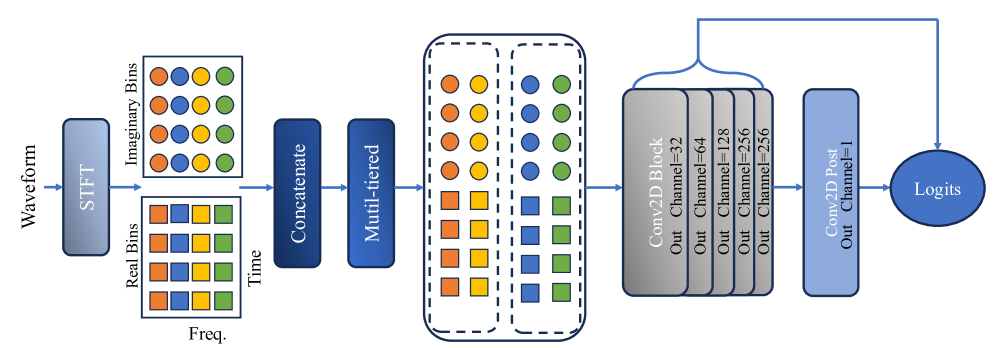
The diagram illustrates a convolutional neural network (CNN) architecture for audio signal processing. It shows the flow of data from raw waveform input through multiple processing stages to final logit outputs. The architecture combines time-frequency analysis with hierarchical convolutional feature extraction.
### Components/Axes
1. **Input Stage**:
- **Waveform**: Raw audio input
- **STFT (Short-Time Fourier Transform)**: Splits waveform into:
- Imaginary Bins (orange circles)
- Real Bins (blue squares)
- **Time** (horizontal axis) and **Freq.** (vertical axis) dimensions
2. **Processing Blocks**:
- **Concatenate**: Merges real/freq. and imaginary/time dimensions
- **Multi-tiered**: Processes concatenated features
- **Conv2D Blocks** (4 layers):
- Channel=32 (gray)
- Channel=64 (dark gray)
- Channel=128 (medium gray)
- Channel=256 (light gray)
- **Conv2D Post**: Final processing layer
3. **Output**:
- **Logits**: Single-channel output (blue oval)
4. **Legend**:
- Orange: Imaginary components
- Blue: Real components
- Green: Time components
- Yellow: Frequency components
### Detailed Analysis
- **STFT Output**:
- Imaginary bins: 4x4 grid (16 elements)
- Real bins: 4x4 grid (16 elements)
- Time dimension: 4 elements
- Frequency dimension: 4 elements
- **Conv2D Block Parameters**:
- Channel sizes increase exponentially: 32 → 64 → 128 → 256
- Spatial dimensions reduce progressively through convolutional operations
- **Color Coding**:
- Orange circles consistently represent imaginary components
- Blue squares consistently represent real components
- Green squares represent time-domain features
- Yellow squares represent frequency-domain features
### Key Observations
1. **Hierarchical Feature Extraction**:
- Channel sizes double with each Conv2D layer (32→64→128→256)
- Suggests multi-scale feature learning from simple to complex patterns
2. **Complex Number Handling**:
- Separate processing of real/imaginary components from STFT
- Recombination through concatenation before multi-tiered processing
3. **Temporal-Frequency Fusion**:
- Time and frequency dimensions merged early in processing pipeline
- Enables joint analysis of temporal and spectral features
4. **Output Structure**:
- Final Conv2D Post layer reduces to single channel
- Logits output suggests classification task (e.g., speech recognition)
### Interpretation
This architecture demonstrates a sophisticated approach to audio processing by:
1. **Time-Frequency Decomposition**: Using STFT to capture both temporal and spectral characteristics
2. **Complex Feature Representation**: Maintaining phase information through separate real/imaginary processing
3. **Hierarchical Learning**: Progressively learning features at increasing abstraction levels through convolutional layers
4. **Efficient Output**: Final Conv2D Post layer condenses features to logits for classification
The design suggests optimization for tasks requiring both temporal and spectral analysis, such as speech recognition or environmental sound classification. The exponential growth in channel sizes indicates a focus on capturing increasingly complex audio patterns through deeper network layers.