## Diagram: Cognitive Flow Model
### Overview
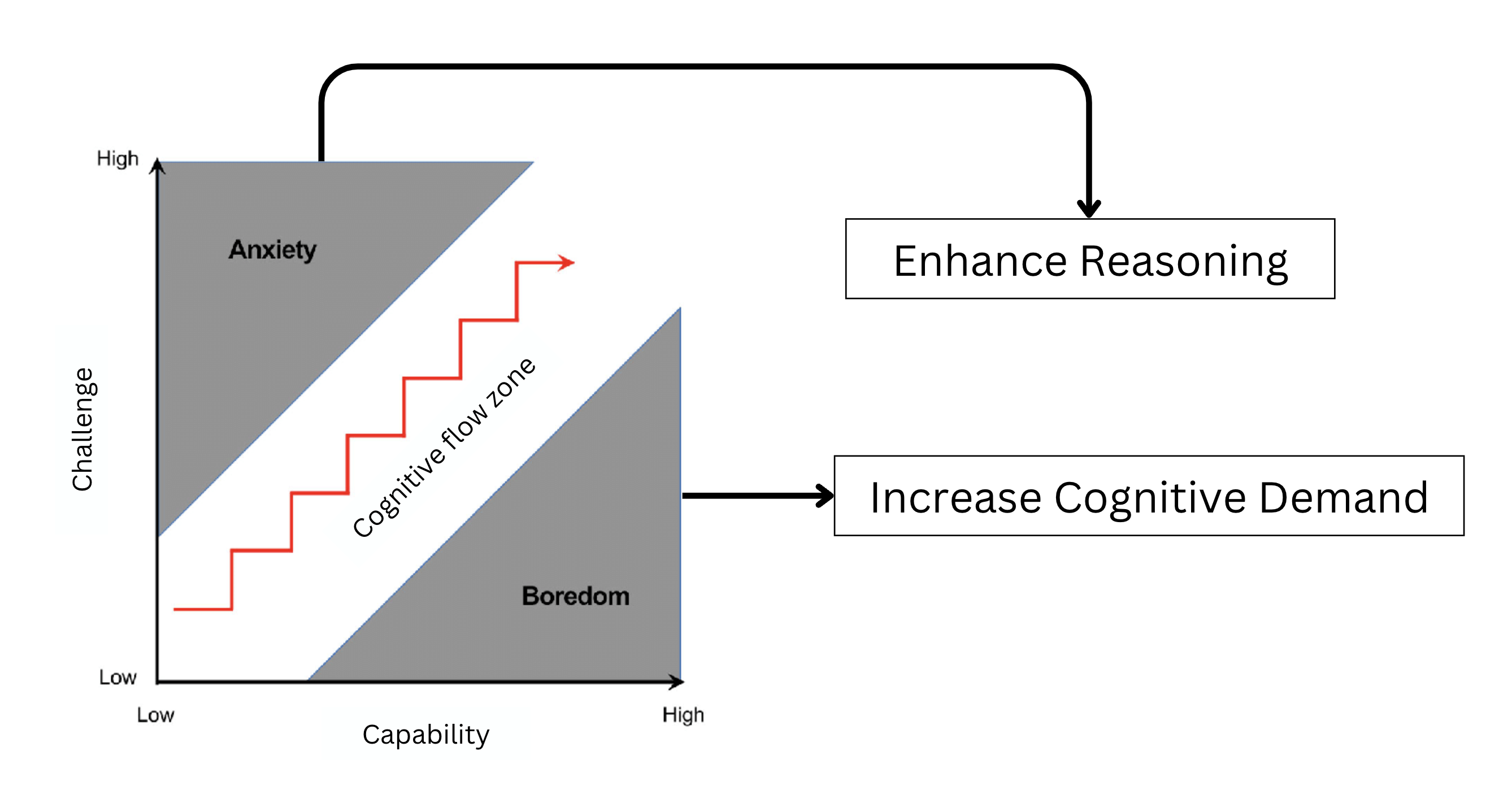
The diagram illustrates a two-dimensional model mapping psychological states based on the interplay between **Challenge** (vertical axis) and **Capability** (horizontal axis). It identifies three key regions: "Anxiety," "Boredom," and the "Cognitive flow zone," with directional guidance for optimizing cognitive performance.
---
### Components/Axes
1. **Axes**:
- **Vertical Axis**: "Challenge" (Low to High)
- **Horizontal Axis**: "Capability" (Low to High)
2. **Regions**:
- **Anxiety**: Top-left quadrant (High Challenge, Low Capability)
- **Boredom**: Bottom-right quadrant (Low Challenge, High Capability)
- **Cognitive flow zone**: Diagonal band between Anxiety and Boredom (Balanced Challenge/Capability)
3. **Arrows**:
- **Top Arrow**: Points to "Enhance Reasoning" (linked to high Challenge)
- **Right Arrow**: Points to "Increase Cognitive Demand" (linked to high Capability)
---
### Detailed Analysis
- **Cognitive Flow Zone**:
- Defined by a white diagonal band with a red zigzag line labeled "Cognitive flow zone."
- Positioned between the Anxiety and Boredom regions, suggesting an optimal balance of Challenge and Capability.
- **Shaded Regions**:
- **Anxiety**: Overlaps with high Challenge and low Capability (top-left).
- **Boredom**: Overlaps with low Challenge and high Capability (bottom-right).
- **Arrows**:
- **Top Arrow**: Originates from the top edge of the diagram, directing toward "Enhance Reasoning."
- **Right Arrow**: Originates from the right edge, directing toward "Increase Cognitive Demand."
---
### Key Observations
1. The model emphasizes balancing Challenge and Capability to avoid extremes (Anxiety/Boredom).
2. The cognitive flow zone represents a dynamic equilibrium, requiring adjustment based on current states.
3. Arrows suggest actionable strategies:
- **Enhance Reasoning**: Likely involves increasing Capability when Challenge is high.
- **Increase Cognitive Demand**: Likely involves raising Challenge when Capability is high.
---
### Interpretation
This diagram aligns with principles of **Flow Theory** (Csikszentmihalyi) and **motivational psychology**, where optimal performance occurs when tasks match an individual’s skill level. The "Cognitive flow zone" reflects the ideal state for engagement and productivity.
- **Anxiety** arises when tasks exceed one’s capabilities, leading to stress.
- **Boredom** occurs when tasks are too easy, causing disengagement.
- The arrows imply that cognitive performance can be optimized by:
- **Enhancing Reasoning**: Building skills (Capability) to handle high Challenge.
- **Increasing Cognitive Demand**: Introducing complexity (Challenge) to leverage high Capability.
The model underscores the need for adaptive task design and skill development to maintain cognitive flow.