\n
## Multi-Panel Heatmap Grid: Heads Importance Across Cognitive Tasks
### Overview
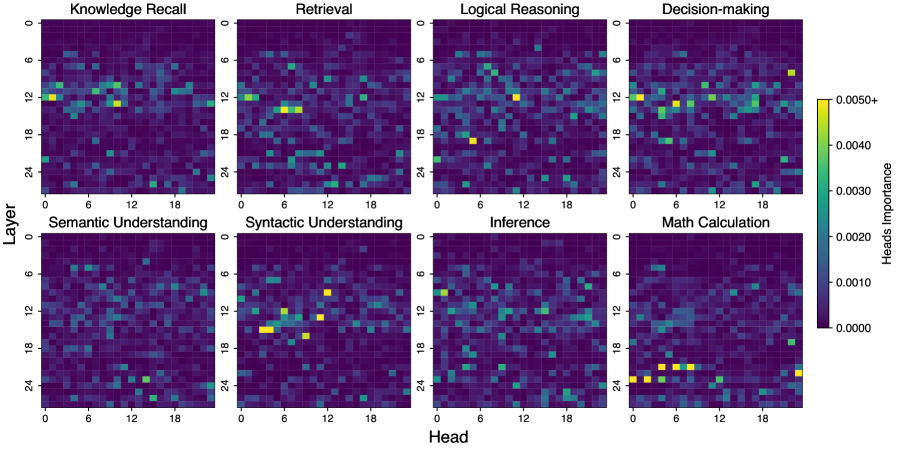
The image displays a grid of eight heatmaps, arranged in two rows of four. Each heatmap visualizes the "Heads Importance" for a specific cognitive task within what appears to be a neural network model. The x-axis represents the "Head" index (0-18), and the y-axis represents the "Layer" index (0-24). A color bar on the right provides the scale for "Heads Importance," ranging from 0.0000 (dark purple) to 0.0050+ (bright yellow).
### Components/Axes
* **Main Title/Labels:** None present as a single overarching title. Each subplot has its own title.
* **Y-Axis Label (Common to all):** "Layer" (vertical text on the far left).
* **Y-Axis Scale (Common to all):** Linear scale from 0 to 24, with major ticks at 0, 6, 12, 18, 24.
* **X-Axis Label (Common to all):** "Head" (horizontal text at the bottom center).
* **X-Axis Scale (Common to all):** Linear scale from 0 to 18, with major ticks at 0, 6, 12, 18.
* **Color Bar Legend (Right side):**
* **Title:** "Heads Importance"
* **Scale:** Continuous gradient from dark purple (0.0000) through teal and green to bright yellow (0.0050+).
* **Tick Values:** 0.0000, 0.0010, 0.0020, 0.0030, 0.0040, 0.0050+.
* **Subplot Titles (Top of each panel, left to right, top to bottom):**
1. Knowledge Recall
2. Retrieval
3. Logical Reasoning
4. Decision-making
5. Semantic Understanding
6. Syntactic Understanding
7. Inference
8. Math Calculation
### Detailed Analysis
Each heatmap is a 25 (layers) x 19 (heads) grid of colored cells. The color intensity represents the importance value for a specific head at a specific layer for the given task.
**Panel-by-Panel Description (Approximate Patterns):**
1. **Knowledge Recall:** Shows scattered medium-intensity (teal/green) spots, with a few brighter (yellow-green) points concentrated in the mid-layers (approx. layers 12-18). No single dominant head.
2. **Retrieval:** Similar to Knowledge Recall but with slightly more defined clusters. A notable bright spot (yellow) appears around Head 6, Layer 12.
3. **Logical Reasoning:** Features a few distinct bright spots. One prominent yellow point is near Head 12, Layer 12. Another cluster of medium-high importance is visible in the lower layers (approx. 18-24).
4. **Decision-making:** Displays a more dispersed pattern of medium importance. Several bright yellow spots are present, notably around Head 18, Layer 12 and Head 12, Layer 6.
5. **Semantic Understanding:** Appears relatively uniform with low-to-medium importance (mostly dark purple to teal). A few slightly brighter spots are scattered, with no strong concentration.
6. **Syntactic Understanding:** Shows a distinct cluster of high importance (bright yellow) in the mid-layers, centered around Head 6-12, Layer 12-18. This is one of the most concentrated patterns.
7. **Inference:** Has a moderate, scattered pattern. A few brighter points are visible, such as near Head 0, Layer 12.
8. **Math Calculation:** Exhibits a very distinct pattern. High importance (bright yellow) is concentrated in the lower layers (approx. layers 18-24), particularly around Heads 0-6 and Head 18. The upper layers are predominantly low importance (dark purple).
### Key Observations
* **Task-Specific Specialization:** Different cognitive tasks activate distinct patterns of head importance across the network layers.
* **Layer Specialization:** Some tasks show importance concentrated in specific layer bands:
* **Mid-Layers (12-18):** Syntactic Understanding, Retrieval, Knowledge Recall.
* **Lower Layers (18-24):** Math Calculation, Logical Reasoning.
* **Head Specificity:** Certain heads appear highly important for multiple tasks (e.g., Head 12, Layer 12 is bright in Logical Reasoning and Decision-making), while others are task-unique.
* **Pattern Variance:** "Semantic Understanding" shows the most diffuse, low-contrast pattern, suggesting less localized head importance. "Math Calculation" and "Syntactic Understanding" show the most localized, high-contrast patterns.
* **Outlier:** The "Math Calculation" heatmap is an outlier due to its strong, low-layer concentration, contrasting with the more mid-layer focus of language-oriented tasks.
### Interpretation
This visualization likely represents an analysis of a multi-layer, multi-head transformer model (like an LLM), probing which specific "attention heads" are most important for performing different cognitive functions. The "Heads Importance" metric could be derived from methods like integrated gradients, attention rollout, or ablation studies.
The data suggests a **functional specialization within the network**:
* **Lower Layers (18-24):** Appear crucial for **structured, formal reasoning** like mathematical calculation and logical reasoning. This aligns with the idea that lower layers handle more fundamental, syntactic, or structural processing.
* **Mid-Layers (12-18):** Are heavily involved in **language-specific processing**, including syntactic understanding, retrieval of knowledge, and general recall. This is the core "semantic processing" zone.
* **Higher Layers (0-6):** Show less concentrated importance in these tasks, possibly indicating they are involved in more abstract integration or task-specific output formatting not captured by these probes.
The stark difference in the "Math Calculation" pattern implies that mathematical reasoning relies on a fundamentally different computational pathway or set of features within the model compared to linguistic tasks. The diffuse pattern for "Semantic Understanding" might indicate that this capability is more distributed across the network rather than being localized to specific heads.
**In summary, the heatmap grid provides evidence for a hierarchical and modular organization of cognitive functions within the neural network, with clear anatomical (layer) and unit (head) specialization for different types of tasks.**