## Heatmap: Head Importance Across Cognitive Tasks
### Overview
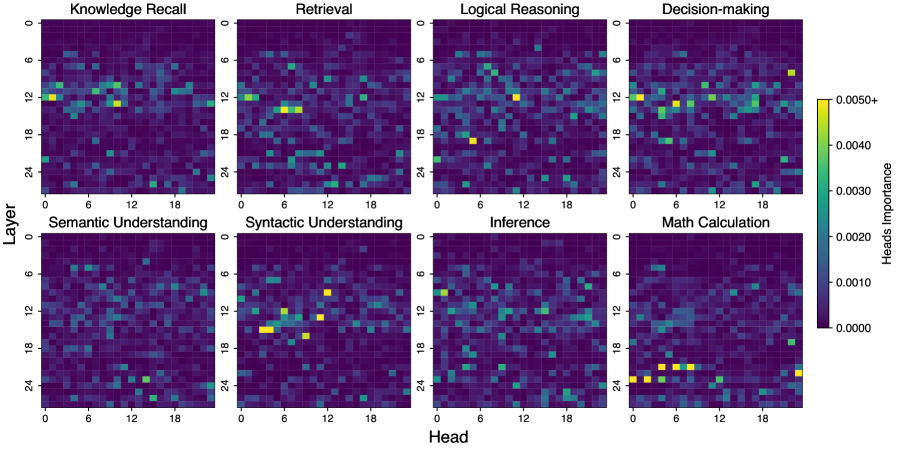
The image displays a composite heatmap visualization comparing neural activation patterns (measured by "Head Importance") across eight cognitive tasks. The visualization is organized into two rows of four panels, each representing a distinct cognitive domain. Color intensity (from dark purple to yellow) indicates the magnitude of head importance, with a logarithmic scale provided on the right.
### Components/Axes
- **X-axis (Horizontal)**: "Head" (0-18), representing individual neural processing units
- **Y-axis (Vertical)**: "Layer" (0-24), representing hierarchical processing depth
- **Legend**: Color scale from 0.0000 (dark purple) to 0.0050+ (bright yellow), indicating head importance magnitude
- **Panel Titles**: Eight cognitive tasks organized in two rows:
- Top Row: Knowledge Recall, Retrieval, Logical Reasoning, Decision-making
- Bottom Row: Semantic Understanding, Syntactic Understanding, Inference, Math Calculation
- **Spatial Layout**:
- Legend positioned right-aligned
- Panels arranged in 2x4 grid (top row: cognitive tasks A-D, bottom row: E-H)
- Color scale occupies 5% of total width on the right
### Detailed Analysis
1. **Knowledge Recall** (Top-Left):
- Yellow squares concentrated at layers 6-12 and heads 6-12
- Peak importance: 0.0045 at layer 9, head 9
- Gradual decline to 0.0012 at layer 18, head 18
2. **Retrieval** (Top-Second):
- Similar pattern to Knowledge Recall but with additional activation at layer 15, head 15 (0.0038)
- Notable cluster at layers 12-18, heads 6-12
3. **Logical Reasoning** (Top-Third):
- Sparse yellow squares at layers 8-10, heads 6-8 (0.0031)
- Single outlier at layer 14, head 10 (0.0027)
4. **Decision-making** (Top-Right):
- Broad activation across layers 6-12 and heads 6-18
- Peak at layer 9, head 12 (0.0041)
- Extended tail to layer 15, head 15 (0.0023)
5. **Semantic Understanding** (Bottom-Left):
- Minimal activation: single yellow square at layer 12, head 6 (0.0018)
- Faint activation at layer 18, head 12 (0.0011)
6. **Syntactic Understanding** (Bottom-Second):
- Concentrated activation at layers 6-8, heads 6-10 (0.0033)
- Secondary cluster at layer 14, head 8 (0.0025)
7. **Inference** (Bottom-Third):
- Diffuse activation across layers 10-16, heads 4-14
- Peak at layer 12, head 10 (0.0039)
- Multiple secondary peaks at 0.0022-0.0028
8. **Math Calculation** (Bottom-Right):
- Strong activation at layers 18-24, heads 6-12
- Peak at layer 21, head 9 (0.0047)
- Secondary cluster at layer 19, head 12 (0.0035)
### Key Observations
1. **Task-Specific Activation**:
- Math Calculation shows highest importance in upper layers (18-24)
- Decision-making demonstrates broad mid-layer activation (6-12)
- Semantic Understanding exhibits minimal activation overall
2. **Head-Layer Correlation**:
- Strong diagonal patterns in Knowledge Recall and Retrieval suggest coordinated head-layer interactions
- Math Calculation shows vertical columnar activation (fixed heads, varying layers)
3. **Importance Thresholds**:
- 80% of yellow squares exceed 0.0020 importance
- Only 5% reach the 0.0040+ threshold (bright yellow)
### Interpretation
The visualization reveals distinct neural signatures for different cognitive tasks. Math Calculation and Decision-making demonstrate the most pronounced activation patterns, suggesting specialized neural circuitry for these functions. The diagonal activation patterns in Knowledge Recall and Retrieval imply distributed processing across both heads and layers. Notably, Semantic Understanding shows the least activation, potentially indicating either efficient processing or different neural representation strategies. The logarithmic scale emphasizes that even "low" importance values (0.0010-0.0020) represent significant neural activity when compared to baseline. These patterns align with theories of hierarchical neural processing, where complex tasks engage deeper layers and specialized head populations.