## Flow Diagram: Assistant Response Refinement
### Overview
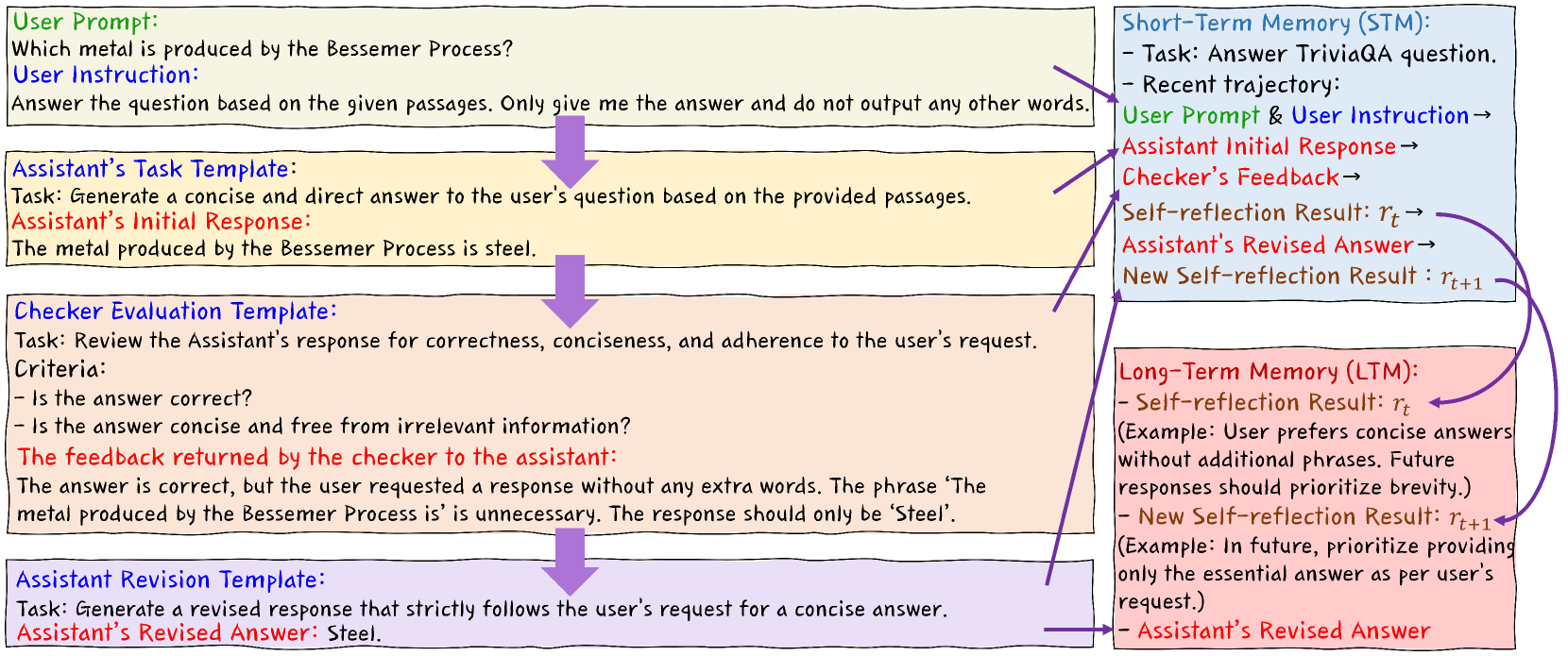
The image is a flow diagram illustrating the process of refining an assistant's response to a user's question through a series of steps involving task templates, checker evaluations, and memory components (Short-Term Memory and Long-Term Memory). The diagram shows how the assistant's response is iteratively improved based on feedback and self-reflection.
### Components/Axes
* **User Prompt (Top-Left, Green Box):**
* "Which metal is produced by the Bessemer Process?"
* "Answer the question based on the given passages. Only give me the answer and do not output any other words."
* **Assistant's Task Template (Middle-Left, Yellow Box):**
* "Task: Generate a concise and direct answer to the user's question based on the provided passages."
* "Assistant's Initial Response: The metal produced by the Bessemer Process is steel."
* **Checker Evaluation Template (Middle-Left, Pink Box):**
* "Task: Review the Assistant's response for correctness, conciseness, and adherence to the user's request."
* "Criteria: Is the answer correct? Is the answer concise and free from irrelevant information?"
* "The feedback returned by the checker to the assistant: The answer is correct, but the user requested a response without any extra words. The phrase 'The metal produced by the Bessemer Process is' is unnecessary. The response should only be 'Steel'."
* **Assistant Revision Template (Bottom-Left, Purple Box):**
* "Task: Generate a revised response that strictly follows the user's request for a concise answer."
* "Assistant's Revised Answer: Steel."
* **Short-Term Memory (STM) (Top-Right, Blue Box):**
* "Task: Answer TriviaQA question."
* "Recent trajectory:"
* "User Prompt & User Instruction →"
* "Assistant Initial Response →"
* "Checker's Feedback →"
* "Self-reflection Result: rt →"
* "Assistant's Revised Answer →"
* "New Self-reflection Result: rt+1"
* **Long-Term Memory (LTM) (Bottom-Right, Red Box):**
* "Self-reflection Result: rt (Example: User prefers concise answers without additional phrases. Future responses should prioritize brevity.)"
* "New Self-reflection Result: rt+1 (Example: In future, prioritize providing only the essential answer as per user's request.)"
* "Assistant's Revised Answer"
* **Arrows:** Purple arrows indicate the flow of information and the iterative process.
### Detailed Analysis or Content Details
The diagram illustrates a process where a user provides a prompt and instruction. The assistant generates an initial response based on a task template. A checker evaluates the response based on predefined criteria and provides feedback. The assistant then revises the response based on this feedback, using a revision template. The Short-Term Memory (STM) tracks the recent trajectory of this process, while the Long-Term Memory (LTM) stores self-reflection results to improve future responses.
The flow starts with the User Prompt and Instruction, which leads to the Assistant's Task Template and Initial Response. The Checker Evaluation Template then provides feedback, which is used by the Assistant Revision Template to generate a revised answer. The STM tracks this process, and the LTM stores self-reflection results to improve future responses. The LTM feeds back into the STM, creating a loop for continuous improvement.
### Key Observations
* The process emphasizes iterative refinement of the assistant's response.
* The checker's feedback is crucial for guiding the revision process.
* Both Short-Term and Long-Term Memory play a role in improving the assistant's performance over time.
* The example provided in the LTM highlights the importance of understanding user preferences for concise answers.
### Interpretation
The diagram demonstrates a system designed to improve the quality and relevance of an assistant's responses. By incorporating feedback from a checker and leveraging both short-term and long-term memory, the system aims to provide more accurate, concise, and user-aligned answers. The iterative nature of the process allows the assistant to learn from its mistakes and adapt to user preferences over time. The use of task templates and revision templates ensures consistency and adherence to predefined criteria. The system is designed to learn and adapt to user preferences, as demonstrated by the example in the Long-Term Memory.