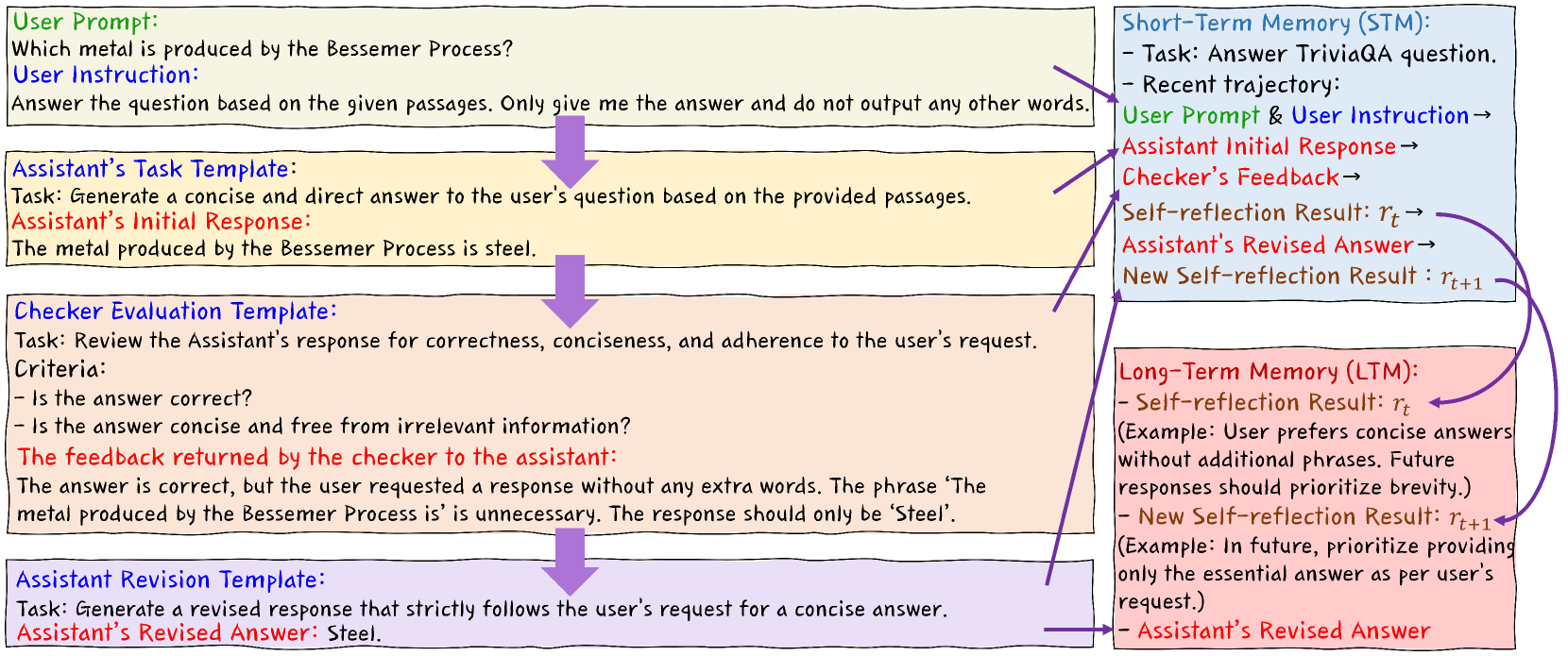
## Flowchart: Bessemer Process QA System Workflow
### Overview
The flowchart depicts an iterative question-answering system for technical queries, emphasizing conciseness and correctness. It includes feedback loops, memory components, and revision mechanisms.
### Components/Axes
1. **User Prompt (Green Box)**:
- Text: "Which metal is produced by the Bessemer Process?"
- User Instruction: "Answer the question based on the given passages. Only give me the answer and do not output any other words."
2. **Assistant’s Task Template (Blue Box)**:
- Task: Generate a concise and direct answer based on provided passages.
- Initial Response: "The metal produced by the Bessemer Process is steel."
3. **Checker Evaluation Template (Orange Box)**:
- Task: Review response for correctness, conciseness, and adherence to instructions.
- Criteria:
- Is the answer correct?
- Is the answer concise and free from irrelevant information?
- Feedback: "The answer is correct, but the user requested a response without any extra words. The phrase ‘The metal produced by the Bessemer Process is’ is unnecessary. The response should only be ‘Steel.’"
4. **Assistant Revision Template (Purple Box)**:
- Task: Generate a revised response following the user’s request for conciseness.
- Revised Answer: "Steel."
5. **Short-Term Memory (STM) (Blue Box)**:
- Task: Answer TriviaQA questions.
- Recent Trajectory:
- User Prompt & Instruction → Assistant Initial Response → Checker Feedback → Self-reflection Result (`r_t`) → Assistant Revised Answer → New Self-reflection Result (`r_{t+1}`).
6. **Long-Term Memory (LTM) (Pink Box)**:
- Self-reflection Result (`r_t`): Example: "User prefers concise answers without additional phrases. Future responses should prioritize brevity."
- New Self-reflection Result (`r_{t+1}`): Example: "Prioritize providing only the essential answer as per user’s request."
### Detailed Analysis
- **Flow Direction**:
- User input → Assistant’s initial response → Checker evaluation → Feedback → Revised answer.
- STM and LTM components influence future responses via self-reflection results.
- **Textual Content**:
- All boxes contain explicit instructions, criteria, and examples. No numerical data or trends are present.
### Key Observations
- The system enforces strict adherence to user instructions (e.g., removing unnecessary phrases).
- Feedback loops ensure iterative improvement of responses.
- Memory components (`r_t`, `r_{t+1}`) store preferences for future interactions.
### Interpretation
This flowchart illustrates a closed-loop QA system where user feedback drives continuous refinement of answers. The integration of STM and LTM allows the system to adapt to user preferences over time, prioritizing brevity and precision. The example of correcting "steel" to "Steel" highlights the system’s focus on eliminating redundant language while maintaining accuracy.