## Classification Scheme: Citation Alignment Framework
### Overview
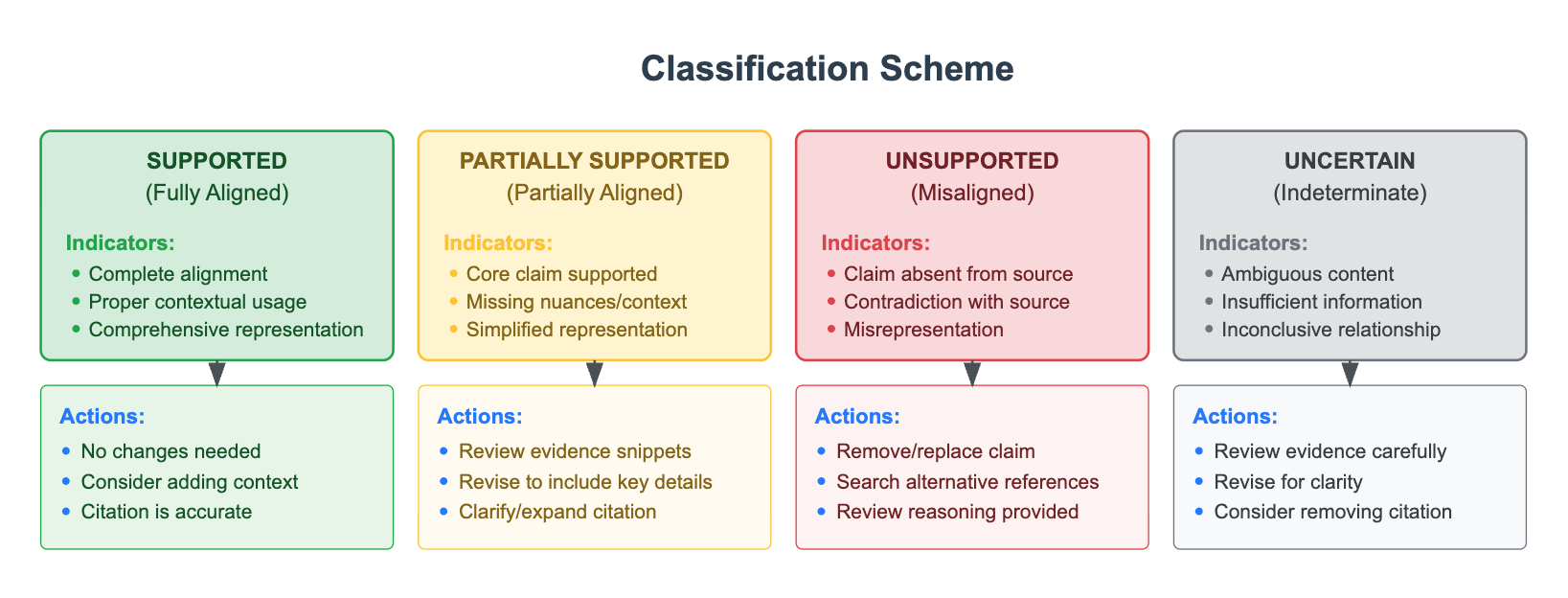
The image presents a four-quadrant classification system for evaluating citation alignment, with color-coded categories (green, yellow, red, gray) and corresponding indicators and actions. The framework guides reviewers in assessing and addressing citation accuracy and contextual relevance.
### Components/Axes
1. **Legend (Top Section)**:
- **Green**: SUPPORTED (Fully Aligned)
- **Yellow**: PARTIALLY SUPPORTED (Partially Aligned)
- **Red**: UNSUPPORTED (Misaligned)
- **Gray**: UNCERTAIN (Indeterminate)
2. **Categories (Left-to-Right Flow)**:
- **SUPPORTED (Fully Aligned)**:
- Indicators: Complete alignment, proper contextual usage, comprehensive representation
- Actions: No changes needed, consider adding context, citation is accurate
- **PARTIALLY SUPPORTED (Partially Aligned)**:
- Indicators: Core claim supported, missing nuances/context, simplified representation
- Actions: Review evidence snippets, revise to include key details, clarify/expand citation
- **UNSUPPORTED (Misaligned)**:
- Indicators: Claim absent from source, contradiction with source, misrepresentation
- Actions: Remove/replace claim, search alternative references, review reasoning provided
- **UNCERTAIN (Indeterminate)**:
- Indicators: Ambiguous content, insufficient information, inconclusive relationship
- Actions: Review evidence carefully, revise for clarity, consider removing citation
### Detailed Analysis
- **Color Coding**:
- Green (SUPPORTED) represents optimal alignment.
- Yellow (PARTIALLY SUPPORTED) indicates partial but incomplete alignment.
- Red (UNSUPPORTED) signals direct contradictions or missing evidence.
- Gray (UNCERTAIN) denotes ambiguous or inconclusive cases.
- **Indicators**:
- **SUPPORTED**: Emphasizes full fidelity to source material.
- **PARTIALLY SUPPORTED**: Highlights gaps in nuance or context.
- **UNSUPPORTED**: Focuses on direct conflicts or absence of evidence.
- **UNCERTAIN**: Addresses cases where evidence is unclear or insufficient.
- **Actions**:
- **SUPPORTED**: Minimal intervention required.
- **PARTIALLY SUPPORTED**: Targeted revisions to strengthen alignment.
- **UNSUPPORTED**: Radical changes or replacement of claims.
- **UNCERTAIN**: Cautious evaluation with potential removal.
### Key Observations
1. **Hierarchical Structure**: Categories progress from fully aligned (green) to misaligned (red), with uncertain (gray) as a neutral outlier.
2. **Action Gradient**: Interventions escalate from "no changes" (green) to "consider removal" (gray).
3. **Contextual Focus**: All categories emphasize contextual accuracy, with SUPPORTED requiring only minor adjustments and UNSUPPORTED demanding complete overhaul.
### Interpretation
This framework operationalizes citation evaluation by linking alignment quality to specific corrective actions. The color-coded system enables rapid assessment, while the actionable indicators provide clear pathways for improvement. Notably:
- **SUPPORTED** (green) prioritizes preservation of accurate citations.
- **PARTIALLY SUPPORTED** (yellow) bridges minor gaps through targeted revisions.
- **UNSUPPORTED** (red) enforces strict adherence to source material, rejecting misrepresentations.
- **UNCERTAIN** (gray) introduces a risk-averse approach, acknowledging limitations in evidence quality.
The framework reflects a Peircean investigative logic: starting with the assumption of alignment (green) and progressively addressing contradictions (red) or ambiguities (gray) through iterative refinement. The emphasis on contextual usage across all categories underscores the importance of semantic fidelity beyond mere textual matching.