## Diagram: Classification Scheme for Claim-Source Alignment
### Overview
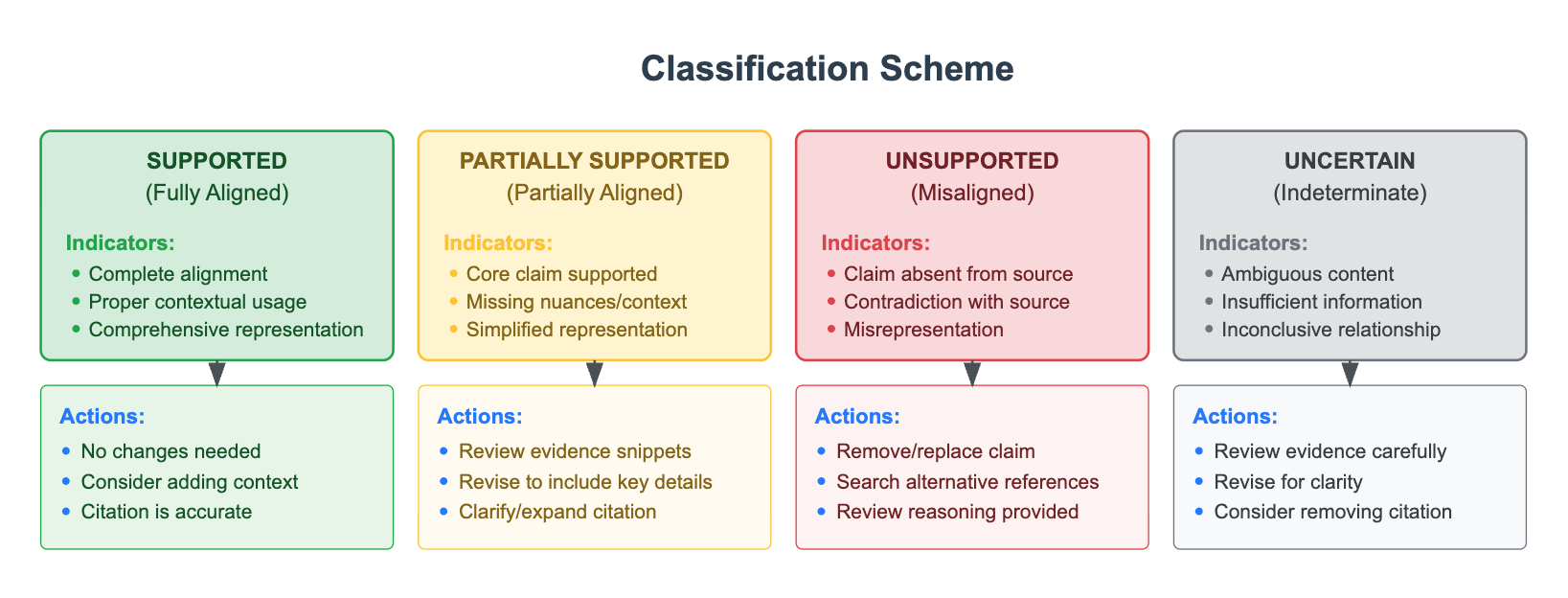
The image displays a structured classification scheme titled "Classification Scheme" for evaluating the alignment between a claim and its source material. It presents four distinct categories of alignment, each with defined indicators and recommended actions. The diagram uses a color-coded, columnar layout to organize this information.
### Components/Axes
The diagram is organized into four vertical columns, each representing a classification category. Each column consists of two main boxes:
1. **Top Box (Category & Indicators):** Contains the category name, a parenthetical alignment descriptor, and a list of indicators.
2. **Bottom Box (Actions):** Contains a list of recommended actions for that category.
A downward-pointing arrow connects the top and bottom boxes within each column.
**Categories (from left to right):**
1. **SUPPORTED (Fully Aligned)** - Green color scheme.
2. **PARTIALLY SUPPORTED (Partially Aligned)** - Yellow/Orange color scheme.
3. **UNSUPPORTED (Misaligned)** - Red color scheme.
4. **UNCERTAIN (Indeterminate)** - Gray color scheme.
### Detailed Analysis
| Category | Indicators | Actions |
| :--- | :--- | :--- |
| **SUPPORTED (Fully Aligned)** | • Complete alignment<br>• Proper contextual usage<br>• Comprehensive representation | • No changes needed<br>• Consider adding context<br>• Citation is accurate |
| **PARTIALLY SUPPORTED (Partially Aligned)** | • Core claim supported<br>• Missing nuances/context<br>• Simplified representation | • Review evidence snippets<br>• Revise to include key details<br>• Clarify/expand citation |
| **UNSUPPORTED (Misaligned)** | • Claim absent from source<br>• Contradiction with source<br>• Misrepresentation | • Remove/replace claim<br>• Search alternative references<br>• Review reasoning provided |
| **UNCERTAIN (Indeterminate)** | • Ambiguous content<br>• Insufficient information<br>• Inconclusive relationship | • Review evidence carefully<br>• Revise for clarity<br>• Consider removing citation |
### Key Observations
* The scheme progresses from positive alignment (green/SUPPORTED) to negative alignment (red/UNSUPPORTED), with intermediate (yellow/PARTIALLY SUPPORTED) and ambiguous (gray/UNCERTAIN) states.
* The "Actions" for each category are directly informed by its "Indicators." For example, a "SUPPORTED" claim requires no changes, while an "UNSUPPORTED" one may need removal or replacement.
* The "UNCERTAIN" category is distinct from "PARTIALLY SUPPORTED"; it implies a lack of clear evidence for or against the claim, rather than partial evidence.
### Interpretation
This diagram provides a systematic framework for assessing the fidelity of a written claim to its source material. It moves beyond a simple true/false binary by introducing granularity for partial support and uncertainty.
* **Purpose:** It is likely used in fields like fact-checking, academic research, legal review, or content moderation to standardize the evaluation of evidence and guide editorial decisions.
* **Relationships:** The categories are mutually exclusive and collectively exhaustive for the purpose of this evaluation model. The flow from Indicators to Actions creates a clear decision-making pathway: diagnose the alignment issue, then apply the prescribed remedy.
* **Underlying Logic:** The scheme emphasizes not just the presence or absence of support, but also the *quality* of representation (e.g., "comprehensive" vs. "simplified," "proper contextual usage" vs. "missing nuances"). The "UNCERTAIN" category acknowledges the real-world problem of ambiguous or insufficient data, preventing forced classifications. The recommended actions are pragmatic, focusing on improving the accuracy and clarity of the final document.