## Reasoning Path Diagram: Question Answering System
### Overview
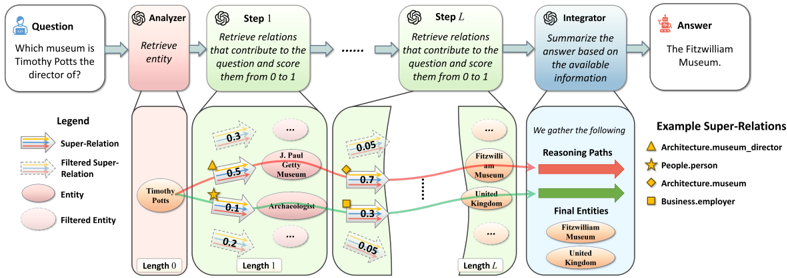
The image presents a diagram illustrating a reasoning path for a question-answering system. It outlines the process from receiving a question to providing an answer, involving entity retrieval, relation scoring, and information summarization. The diagram uses visual elements like arrows, shapes, and colors to represent different components and their relationships.
### Components/Axes
* **Question:** The initial input, represented by a speech bubble icon and the text "Which museum is Timothy Potts the director of?".
* **Analyzer:** A step that retrieves the entity from the question.
* **Step 1:** Retrieves relations that contribute to the question and scores them from 0 to 1.
* **Step L:** Retrieves relations that contribute to the question and scores them from 0 to 1.
* **Integrator:** Summarizes the answer based on the available information.
* **Answer:** The final output, "The Fitzwilliam Museum."
* **Legend:** Located on the left side of the diagram.
* **Super-Relation:** Represented by a solid arrow.
* **Filtered Super-Relation:** Represented by a dashed arrow.
* **Entity:** Represented by a filled oval.
* **Filtered Entity:** Represented by an unfilled oval.
* **Example Super-Relations:** Located on the right side of the diagram.
* Architecture.museum\_director (Triangle)
* People.person (Star)
* Architecture.museum (Diamond)
* Business.employer (Square)
* **Reasoning Paths:**
* Red line
* Green line
* **Final Entities:**
* Fitzwilliam Museum
* United Kingdom
* **Length:**
* Length 0
* Length 1
* Length L
### Detailed Analysis or Content Details
The diagram shows a flow from left to right, starting with the question and ending with the answer.
1. **Question:** "Which museum is Timothy Potts the director of?"
2. **Analyzer:** Retrieves the entity "Timothy Potts".
3. **Step 1:**
* From "Timothy Potts", a red line (Reasoning Path) leads to "J. Paul Getty Museum". A filtered super-relation (dashed arrow) with a score of approximately 0.3 points away from "J. Paul Getty Museum" with a triangle symbol (Architecture.museum\_director). Another filtered super-relation with a score of approximately 0.5 points away from "J. Paul Getty Museum" with a triangle symbol (Architecture.museum\_director).
* From "Timothy Potts", a green line (Reasoning Path) leads to "Archaeologist". A filtered super-relation (dashed arrow) with a score of approximately 0.1 points away from "Archaeologist" with a star symbol (People.person). Another filtered super-relation with a score of approximately 0.2 points away from "Archaeologist" with a triangle symbol (Architecture.museum\_director).
4. **Step L:**
* A red line (Reasoning Path) leads to "Fitzwilliam Museum". A filtered super-relation (dashed arrow) with a score of approximately 0.05 points away from "Fitzwilliam Museum" with a diamond symbol (Architecture.museum). Another filtered super-relation with a score of approximately 0.7 points away from "Fitzwilliam Museum" with a triangle symbol (Architecture.museum\_director).
* A green line (Reasoning Path) leads to "United Kingdom". A filtered super-relation (dashed arrow) with a score of approximately 0.3 points away from "United Kingdom" with a square symbol (Business.employer). Another filtered super-relation with a score of approximately 0.05 points away from "United Kingdom" with a triangle symbol (Architecture.museum\_director).
5. **Integrator:** Summarizes the answer based on the available information.
6. **Answer:** "The Fitzwilliam Museum."
### Key Observations
* The diagram uses different colored lines (red and green) to represent different reasoning paths.
* The filtered super-relations are scored between 0 and 1, indicating the strength of the relation.
* The example super-relations provide context for the types of relationships being considered.
### Interpretation
The diagram illustrates a knowledge graph traversal approach to answering questions. The system starts with an initial entity, explores related entities through different reasoning paths, and scores these relations to arrive at the final answer. The use of filtered super-relations and scoring allows the system to prioritize more relevant information. The diagram highlights the importance of entity recognition, relation extraction, and reasoning in question-answering systems. The different reasoning paths suggest that the system explores multiple possibilities before arriving at the final answer.