## Diagram: Benchmark Generation Pipeline
### Overview
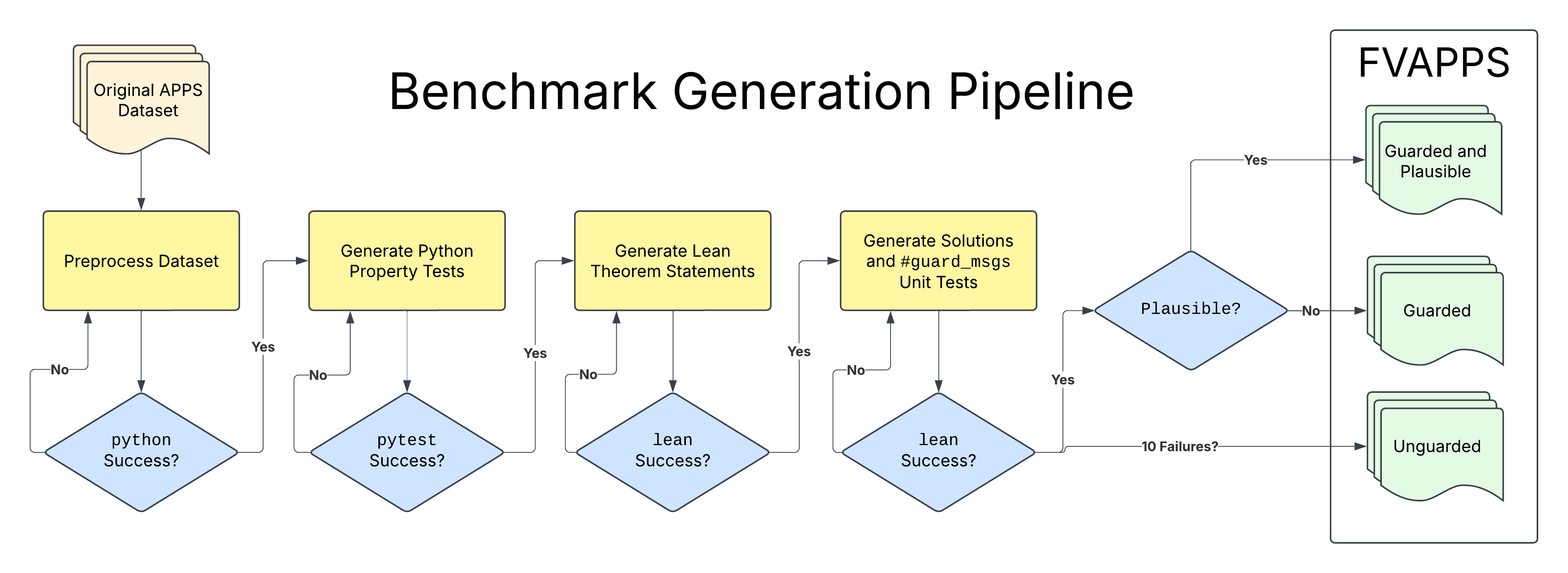
The image is a flowchart illustrating the benchmark generation pipeline. It starts with an original APPS dataset, preprocesses it, and then generates Python property tests, Lean theorem statements, and solutions with unit tests. The pipeline includes checks for Python and Pytest success, Lean success, and plausibility, leading to the creation of FVAPPS categorized as Guarded and Plausible, Guarded, or Unguarded.
### Components/Axes
* **Title:** Benchmark Generation Pipeline
* **Input:** Original APPS Dataset
* **Processes:**
* Preprocess Dataset (Yellow Rectangle)
* Generate Python Property Tests (Yellow Rectangle)
* Generate Lean Theorem Statements (Yellow Rectangle)
* Generate Solutions and #guard\_msgs Unit Tests (Yellow Rectangle)
* **Decision Points:**
* python Success? (Blue Diamond)
* pytest Success? (Blue Diamond)
* lean Success? (Blue Diamond)
* lean Success? (Blue Diamond)
* Plausible? (Blue Diamond)
* **Output:** FVAPPS (Rounded Rectangle)
* Guarded and Plausible (Green Stacked Pages)
* Guarded (Green Stacked Pages)
* Unguarded (Green Stacked Pages)
* **Flow Control:** Arrows indicate the flow of data and processes. "Yes" and "No" labels indicate the direction based on the outcome of the decision points.
### Detailed Analysis or ### Content Details
1. **Original APPS Dataset:** The process begins with the original APPS dataset.
2. **Preprocess Dataset:** The dataset is preprocessed. If this process fails ("No"), the flow loops back to the Preprocess Dataset step.
3. **Generate Python Property Tests:** Python property tests are generated. If the "python Success?" test fails ("No"), the flow loops back to the Preprocess Dataset step.
4. **Generate Lean Theorem Statements:** Lean theorem statements are generated. If the "pytest Success?" test fails ("No"), the flow loops back to the Generate Python Property Tests step.
5. **Generate Solutions and #guard\_msgs Unit Tests:** Solutions and unit tests are generated. If the "lean Success?" test fails ("No"), the flow loops back to the Generate Lean Theorem Statements step.
6. **Plausible?:** The generated solutions are checked for plausibility. If the "lean Success?" test fails ("No"), the flow loops back to the Generate Solutions and #guard\_msgs Unit Tests step.
7. **FVAPPS:**
* If the solutions are plausible ("Yes"), they are categorized as "Guarded and Plausible" within FVAPPS.
* If the solutions are not plausible ("No"), they are categorized as "Guarded" within FVAPPS.
* If there are "-10 Failures-", they are categorized as "Unguarded" within FVAPPS.
### Key Observations
* The pipeline involves iterative checks at each stage, looping back to previous steps if certain criteria are not met.
* The final output, FVAPPS, is categorized into three groups based on plausibility and guarding status.
### Interpretation
The diagram illustrates a systematic approach to generating benchmarks, incorporating multiple layers of testing and validation. The iterative nature of the pipeline suggests a focus on ensuring the quality and reliability of the generated benchmarks. The categorization of FVAPPS into "Guarded and Plausible," "Guarded," and "Unguarded" indicates a tiered system for assessing the suitability of the generated benchmarks for different purposes. The pipeline aims to produce high-quality benchmarks by rigorously testing and refining the generated solutions.