## Hybrid Reasoning Diagram: BayesVPGM
### Overview
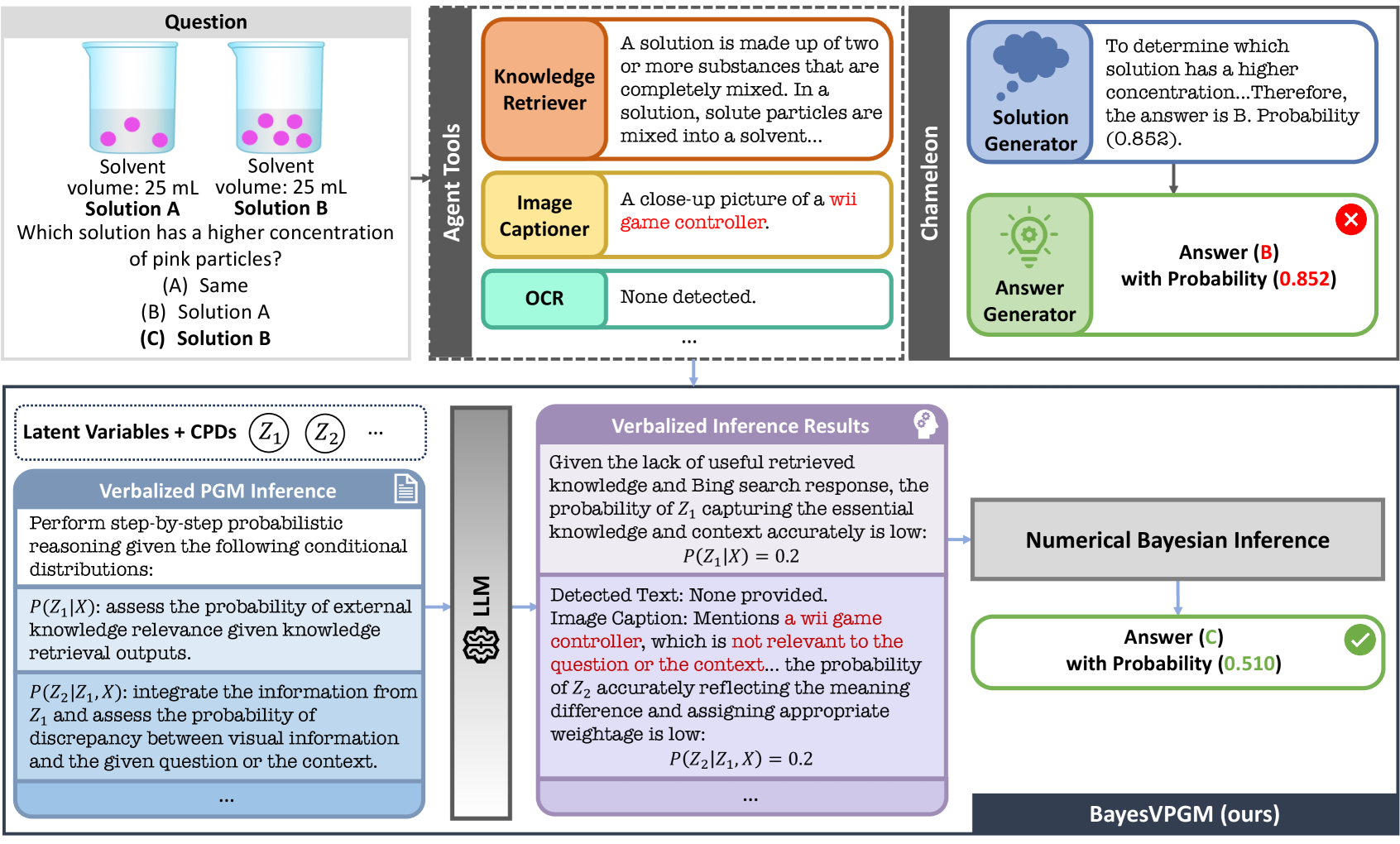
The image presents a diagram illustrating the reasoning process of a system called BayesVPGM (ours) in answering a question about the concentration of particles in two solutions. It combines visual information, knowledge retrieval, and probabilistic inference to arrive at an answer. The diagram is divided into sections representing different stages and components of the reasoning process.
### Components/Axes
* **Question (Top-Left)**: Presents the visual input and the question to be answered.
* Two beakers labeled "Solution A" and "Solution B" each containing a solvent and pink particles.
* Solvent volume for both solutions is 25 mL.
* Question: "Which solution has a higher concentration of pink particles?"
* Possible answers: (A) Same, (B) Solution A, (C) Solution B.
* **Agent Tools (Top-Middle-Left)**: Lists the tools used by the system.
* Knowledge Retriever (Orange): Retrieves relevant knowledge. Text: "A solution is made up of two or more substances that are completely mixed. In a solution, solute particles are mixed into a solvent..."
* Image Captioner (Yellow): Provides a description of the image. Text: "A close-up picture of a wii game controller."
* OCR (Green): Performs optical character recognition. Text: "None detected."
* **Chameleon (Top-Right)**: Represents the reasoning process.
* Solution Generator (Blue): Generates a possible solution. Text: "To determine which solution has a higher concentration...Therefore, the answer is B. Probability (0.852)."
* Answer Generator (Green): Generates the final answer. Text: "Answer (B) with Probability (0.852)" with a red "X" indicating it's incorrect.
* **Latent Variables + CPDs (Bottom-Left)**: Describes the probabilistic reasoning process.
* Verbalized PGM Inference (Blue): Performs step-by-step probabilistic reasoning.
* P(Z₁|X): assess the probability of external knowledge relevance given knowledge retrieval outputs.
* P(Z₂|Z₁, X): integrate the information from Z₁ and assess the probability of discrepancy between visual information and the given question or the context.
* **LLM (Bottom-Middle-Left)**: Large Language Model.
* **Verbalized Inference Results (Bottom-Middle)**: Shows the results of the probabilistic inference.
* Given the lack of useful retrieved knowledge and Bing search response, the probability of Z₁ capturing the essential knowledge and context accurately is low: P(Z₁|X) = 0.2
* Detected Text: None provided.
* Image Caption: Mentions a wii game controller, which is not relevant to the question or the context... the probability of Z₂ accurately reflecting the meaning difference and assigning appropriate weightage is low: P(Z₂|Z₁, X) = 0.2
* **Numerical Bayesian Inference (Bottom-Middle-Right)**: Performs numerical Bayesian inference.
* **Final Answer (Bottom-Right)**: Presents the final answer.
* Answer (C) with Probability (0.510) with a green checkmark indicating it's correct.
* **BayesVPGM (ours) (Bottom)**: Labels the system.
### Detailed Analysis or Content Details
* **Question**: The question asks which solution has a higher concentration of pink particles. Solution A and Solution B both have a solvent volume of 25 mL. Visually, Solution B appears to have a slightly higher concentration of pink particles.
* **Agent Tools**:
* The Knowledge Retriever provides a general definition of a solution.
* The Image Captioner incorrectly identifies a "wii game controller," indicating a failure in image understanding.
* The OCR detects no text in the image.
* **Chameleon**:
* The Solution Generator initially suggests Solution B with a probability of 0.852.
* The Answer Generator outputs Answer (B) with a probability of 0.852, which is marked as incorrect.
* **Latent Variables + CPDs**: The system uses probabilistic reasoning based on latent variables Z₁ and Z₂.
* **Verbalized Inference Results**: The probabilities P(Z₁|X) and P(Z₂|Z₁, X) are both low (0.2), indicating uncertainty in knowledge retrieval and visual understanding.
* **Numerical Bayesian Inference**: The system performs numerical Bayesian inference to arrive at the final answer.
* **Final Answer**: The final answer is (C) Solution B with a probability of 0.510, which is marked as correct.
### Key Observations
* The Image Captioner's failure to correctly identify the image content highlights a weakness in the system's visual understanding capabilities.
* The initial answer generated by the Solution Generator is incorrect, indicating that the system's initial reasoning is flawed.
* The probabilistic inference process assigns low probabilities to knowledge retrieval and visual understanding, reflecting the system's uncertainty.
* The final answer, obtained through numerical Bayesian inference, is correct, suggesting that the system is able to overcome its initial shortcomings through further processing.
### Interpretation
The diagram illustrates a hybrid reasoning approach that combines visual information, knowledge retrieval, and probabilistic inference. The system's performance is affected by limitations in image understanding and knowledge retrieval, as evidenced by the incorrect image caption and low probabilities assigned to these processes. However, the system is able to arrive at the correct answer through numerical Bayesian inference, suggesting that this final stage of processing is crucial for overcoming initial shortcomings. The diagram highlights the importance of robust visual understanding and knowledge retrieval capabilities for effective reasoning in complex tasks. The fact that the system initially fails, but then corrects itself, demonstrates the value of iterative refinement and probabilistic reasoning in AI systems.