## Screenshot: Content Credentials Verification Interface
### Overview
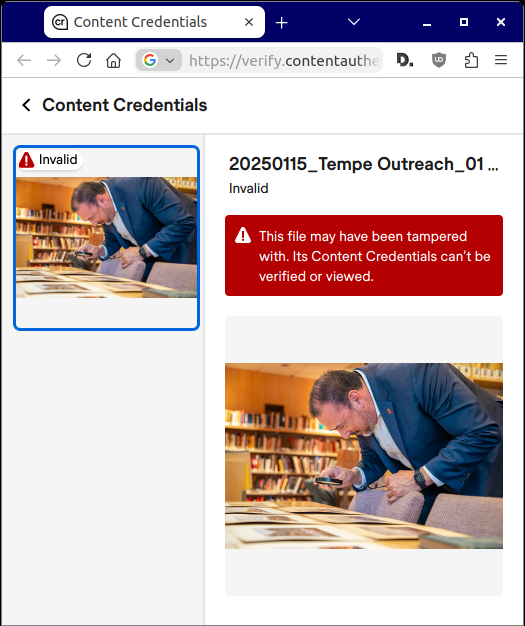
The image depicts a browser window displaying a webpage titled "Content Credentials" with a URL `https://verify.contentauth...`. The interface includes a red warning banner indicating invalid content credentials, a photograph of a man in a library, and browser UI elements (navigation buttons, address bar, etc.).
### Components/Axes
- **Browser UI Elements**:
- Tabs: "Content Credentials" (active tab) with a "cr" icon.
- Navigation: Back, forward, refresh, and home buttons.
- Address bar: Google search dropdown, URL `https://verify.contentauth...`, and icons (shield, puzzle piece, menu).
- **Webpage Content**:
- Title: "Content Credentials" (bold, left-aligned).
- Red warning banner: "This file may have been tampered with. Its Content Credentials can't be verified or viewed."
- Image: A photograph of a man in a blue suit leaning over a table in a library, labeled "Invalid" with a red triangle.
- File identifier: `20250115_Tempe Outreach_01...` (truncated).
### Detailed Analysis
- **Textual Content**:
- The red warning banner explicitly states the file's credentials are unverifiable.
- The image is marked "Invalid," suggesting automated validation failure.
- The URL implies a content authentication service, though the domain is truncated.
- **Visual Elements**:
- The photograph shows a man in a professional setting (library), but its purpose is unclear.
- The red triangle and "Invalid" label are spatially aligned with the image, emphasizing its status.
### Key Observations
1. The red warning banner dominates the interface, prioritizing security alerts.
2. The "Invalid" label on the image suggests a binary validation outcome (valid/invalid).
3. The truncated file identifier (`20250115_Tempe Outreach_01...`) hints at a structured naming convention.
### Interpretation
This interface appears to be part of a content verification system, likely used to authenticate digital files. The red warning indicates a critical failure in credential validation, possibly due to tampering or corruption. The photograph of the man in the library may represent the content being verified, but its inclusion here is ambiguous—it could be a placeholder, an example, or unrelated media. The truncated URL and lack of additional context (e.g., file type, source) limit diagnostic clarity. The system’s design emphasizes immediate alerts over detailed explanations, prioritizing user awareness of compromised content.
## Notes
- No numerical data, charts, or diagrams are present.
- All text is in English; no foreign languages detected.
- Spatial grounding confirms the warning banner and image are the focal points, with browser UI elements providing contextual framing.