## Chart Type: Line Chart - Average Correct Flips Over Iterations
### Overview
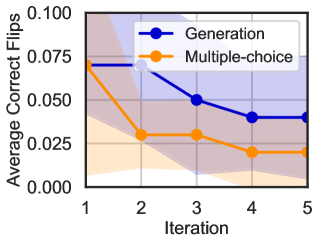
This image displays a 2D line chart comparing the "Average Correct Flips" for two different methods, "Generation" and "Multiple-choice," across five "Iterations." Each line is accompanied by a shaded area, likely representing a confidence interval or standard deviation, indicating the variability around the mean.
### Components/Axes
The chart is structured with a main plotting area, an X-axis, a Y-axis, and a legend.
* **X-axis:**
* **Title:** "Iteration"
* **Scale:** Numeric, ranging from 1 to 5.
* **Markers:** 1, 2, 3, 4, 5.
* **Y-axis:**
* **Title:** "Average Correct Flips"
* **Scale:** Numeric, ranging from 0.000 to 0.100.
* **Markers:** 0.000, 0.025, 0.050, 0.075, 0.100.
* **Legend:**
* Positioned in the top-right quadrant of the plotting area.
* **Entry 1:** A blue line with circular markers, labeled "Generation".
* **Entry 2:** An orange line with circular markers, labeled "Multiple-choice".
### Detailed Analysis
The chart presents two data series, "Generation" (blue) and "Multiple-choice" (orange), showing their performance in terms of "Average Correct Flips" across five iterations.
**1. Generation (Blue Line with Circular Markers):**
* **Trend:** The "Generation" line starts at a relatively high value, maintains this level for the second iteration, then drops significantly, and finally plateaus for the last two iterations.
* **Data Points (Approximate):**
* Iteration 1: Approximately 0.072 Average Correct Flips. The blue shaded area extends from roughly 0.055 to 0.090.
* Iteration 2: Approximately 0.072 Average Correct Flips. The blue shaded area extends from roughly 0.055 to 0.090.
* Iteration 3: Approximately 0.050 Average Correct Flips. The blue shaded area extends from roughly 0.035 to 0.065.
* Iteration 4: Approximately 0.042 Average Correct Flips. The blue shaded area extends from roughly 0.025 to 0.060.
* Iteration 5: Approximately 0.042 Average Correct Flips. The blue shaded area extends from roughly 0.025 to 0.060.
**2. Multiple-choice (Orange Line with Circular Markers):**
* **Trend:** The "Multiple-choice" line starts at a similar high value to "Generation," then experiences a sharp decline in the second iteration, plateaus for the third, drops slightly again in the fourth, and then plateaus for the final iteration.
* **Data Points (Approximate):**
* Iteration 1: Approximately 0.072 Average Correct Flips. The orange shaded area extends from roughly 0.055 to 0.090.
* Iteration 2: Approximately 0.028 Average Correct Flips. The orange shaded area extends from roughly 0.015 to 0.045.
* Iteration 3: Approximately 0.028 Average Correct Flips. The orange shaded area extends from roughly 0.015 to 0.045.
* Iteration 4: Approximately 0.020 Average Correct Flips. The orange shaded area extends from roughly 0.010 to 0.035.
* Iteration 5: Approximately 0.020 Average Correct Flips. The orange shaded area extends from roughly 0.010 to 0.035.
### Key Observations
* Both "Generation" and "Multiple-choice" methods start with nearly identical "Average Correct Flips" at Iteration 1, around 0.072.
* From Iteration 1 to Iteration 2, "Generation" maintains its performance, while "Multiple-choice" experiences a significant drop of about 60% (from ~0.072 to ~0.028).
* After Iteration 2, the "Generation" method consistently outperforms the "Multiple-choice" method in terms of "Average Correct Flips."
* Both methods show a general decreasing trend in "Average Correct Flips" over the iterations, although the "Generation" method's decline is delayed and less severe overall.
* The shaded areas, representing uncertainty, show some overlap between the two methods at Iteration 1, but diverge significantly thereafter, with the "Generation" method's uncertainty range generally higher than "Multiple-choice" from Iteration 2 onwards.
* Both lines show periods of plateauing, indicating stable performance over consecutive iterations after initial changes.
### Interpretation
The data suggests that while both "Generation" and "Multiple-choice" methods begin with similar initial performance in "Average Correct Flips," their trajectories diverge significantly over subsequent iterations. The "Multiple-choice" method experiences an immediate and sharp decline in performance, stabilizing at a lower level. In contrast, the "Generation" method maintains its initial performance for a longer period before experiencing a more moderate decline, ultimately stabilizing at a higher level than "Multiple-choice."
This could imply that the "Generation" method is more robust or effective in maintaining performance over time or across iterations compared to "Multiple-choice." The initial drop for "Multiple-choice" at Iteration 2 is a critical point, indicating a potential weakness or a scenario where it quickly loses effectiveness. The "Average Correct Flips" metric itself, being relatively low (maxing out around 0.07-0.075), suggests that "correct flips" are a rare event or a challenging task for both methods. The consistent outperformance of "Generation" after Iteration 1 suggests it might be the preferred method for tasks where sustained, albeit declining, performance is desired over multiple iterations. The shaded regions indicate that while there is variability, the observed differences between the means of the two methods are likely statistically significant after Iteration 1, given the clear separation of the confidence intervals.