## Code Snippet: Lean 4 Mathematical Lemma
### Overview
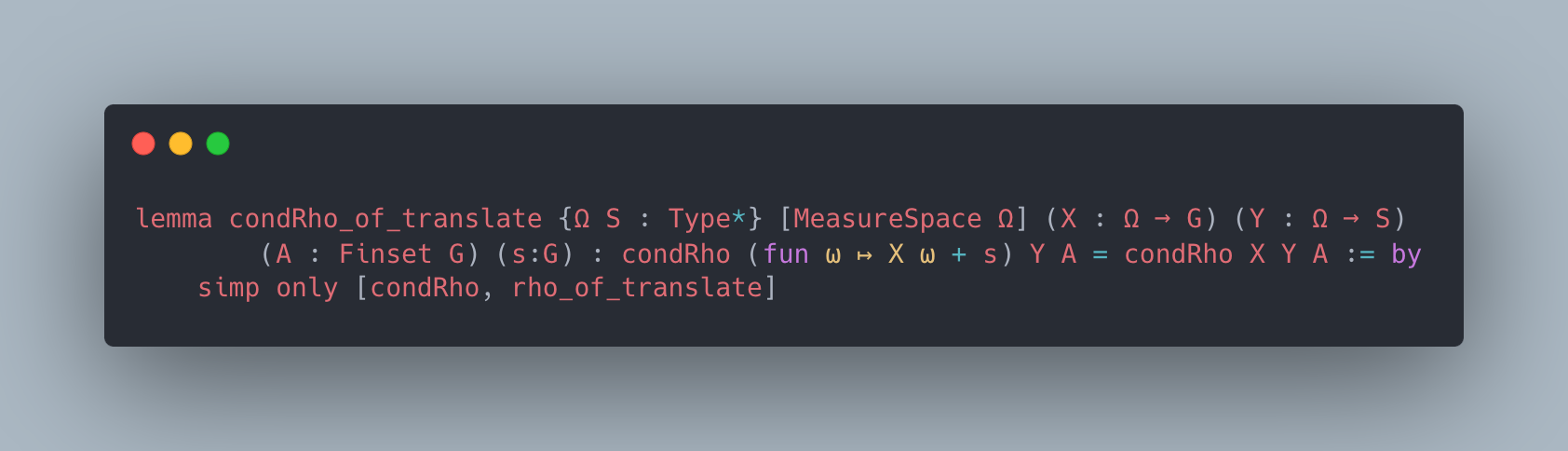
The image displays a screenshot of a code editor window (dark theme, macOS-style traffic light buttons in the top-left) containing a single mathematical lemma written in the Lean 4 proof assistant language. The lemma concerns the invariance of a conditional rho function (`condRho`) under translation of one of its arguments.
### Components/Axes
* **Window Frame**: A dark gray (`#2d2d2d` approximate) rectangular window with rounded corners, centered on a light gray (`#b0b8c4` approximate) background.
* **Window Controls**: Three circular buttons in the top-left corner of the window, from left to right: red, yellow, green.
* **Code Content**: Monospaced text with syntax highlighting. The primary text color is a light gray/off-white. Keywords (`lemma`, `by`, `simp`) are highlighted in a pink/magenta color. Type names (`Type*`, `MeasureSpace`, `Finset`, `G`, `S`) are in a light blue. The proof tactic `simp` and its arguments are in a purple/violet shade.
### Detailed Analysis / Content Details
The code is a single, complete Lean 4 lemma and its proof. The transcription is as follows:
```lean
lemma condRho_of_translate {Ω S : Type*} [MeasureSpace Ω] (X : Ω → G) (Y : Ω → S)
(A : Finset G) (s:G) : condRho (fun ω ↦ X ω + s) Y A = condRho X Y A := by
simp only [condRho, rho_of_translate]
```
**Breakdown of the Statement:**
1. **Lemma Name**: `condRho_of_translate`
2. **Implicit Parameters**: `{Ω S : Type*}` - Declares `Ω` and `S` as arbitrary types.
3. **Type Class Instance**: `[MeasureSpace Ω]` - Assumes `Ω` is equipped with a measure space structure.
4. **Function Parameters**:
* `(X : Ω → G)`: A function `X` from `Ω` to an additive group `G`.
* `(Y : Ω → S)`: A function `Y` from `Ω` to type `S`.
5. **Additional Parameters**:
* `(A : Finset G)`: A finite subset `A` of the group `G`.
* `(s:G)`: An element `s` of the group `G`.
6. **Main Claim (Theorem)**: `condRho (fun ω ↦ X ω + s) Y A = condRho X Y A`
* This states that the conditional rho function (`condRho`) applied to the *translated* function `(fun ω ↦ X ω + s)` (which adds the constant `s` to each output of `X`) is equal to `condRho` applied to the original function `X`, given the same `Y` and `A`.
7. **Proof**: `:= by simp only [condRho, rho_of_translate]`
* The proof is a single tactic call. It uses the simplifier (`simp`) with only the specified lemmas: the definition of `condRho` and a lemma named `rho_of_translate`. This suggests the result follows directly from unfolding definitions and applying a previously proven lemma about rho and translation.
### Key Observations
* **Syntactic Precision**: The code uses precise Lean 4 syntax, including the Unicode arrow `→`, the maps-to symbol `↦`, and the colon `:` for type annotations.
* **Proof Brevity**: The proof is extremely concise, indicating the result is likely a straightforward consequence of more fundamental definitions and lemmas within the formalized theory.
* **Contextual Clues**: The names `condRho`, `rho_of_translate`, `MeasureSpace`, and `Finset` strongly suggest this lemma is part of a formalization of measure theory or probability theory, possibly involving group actions or invariant measures.
### Interpretation
This image captures a formal mathematical statement and its machine-checked proof. The lemma asserts a specific **invariance property**: the value of the `condRho` function does not change when its first functional argument (`X`) is uniformly translated by a group element `s`. This is a common type of lemma in areas like ergodic theory or the study of invariant measures, where properties are expected to be unchanged under group actions.
The proof strategy (`simp only [condRho, rho_of_translate]`) reveals the logical dependency: the property is not proven from first principles here but is derived by combining the definition of `condRho` with a pre-existing lemma (`rho_of_translate`) that likely establishes a more general or foundational relationship between rho functions and translation. This exemplifies the hierarchical and reusable nature of formalized mathematics. The screenshot itself serves as a record of this verified mathematical fact within a specific digital environment.