# Technical Document: Text Extraction from Image
## Overview
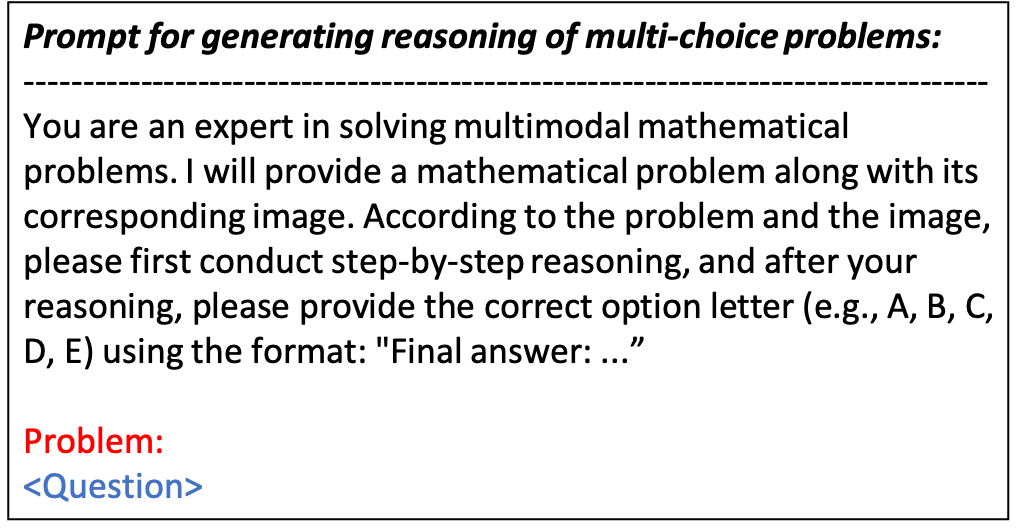
The image contains a structured textual prompt designed for generating reasoning for multi-choice problems. It includes formatting instructions, a problem placeholder, and a question placeholder. No charts, diagrams, or data tables are present.
---
## Textual Content
### Header
- **Text**: "Prompt for generating reasoning of multi-choice problems:"
- **Formatting**: Bold, followed by a dashed line separator.
### Main Instructions
- **Text**:
"You are an expert in solving multimodal mathematical problems. I will provide a mathematical problem along with its corresponding image. According to the problem and the image, please first conduct step-by-step reasoning, and after your reasoning, please provide the correct option letter (e.g., A, B, C, D, E) using the format: 'Final answer: ...'"
- **Key Elements**:
- Role definition: "expert in solving multimodal mathematical problems."
- Input requirements: "mathematical problem + corresponding image."
- Output format: "Final answer: ..." with option letters (A–E).
### Problem Placeholder
- **Label**: "Problem:" (in red).
- **Content**: `<Question>` (in blue, acting as a placeholder for the actual question).
---
## Structural Analysis
1. **Header Section**:
- Purpose: Introduce the prompt's objective.
- Visual Cue: Bold text and dashed line for emphasis.
2. **Main Body**:
- Role: Define the user's expected behavior (step-by-step reasoning).
- Output Specification: Strict format for final answers (e.g., "Final answer: A").
3. **Footer Section**:
- Placeholders:
- "Problem:" (red) to denote the input problem.
- `<Question>` (blue) to indicate where the question will be inserted.
---
## Observations
- **Language**: All text is in English. No non-English content detected.
- **Formatting**:
- Color coding: "Problem:" in red, `<Question>` in blue.
- Placeholders: `<Question>` suggests dynamic insertion of content.
- **No Data Visualization**: No charts, diagrams, or numerical data present.
---
## Conclusion
The image provides a template for generating reasoning for multi-choice problems, emphasizing structured input (problem + image) and output (step-by-step reasoning + final answer). No additional data or visual elements are included.