## Line Graph: Test Accuracy vs. Time for Neural Network Training
### Overview
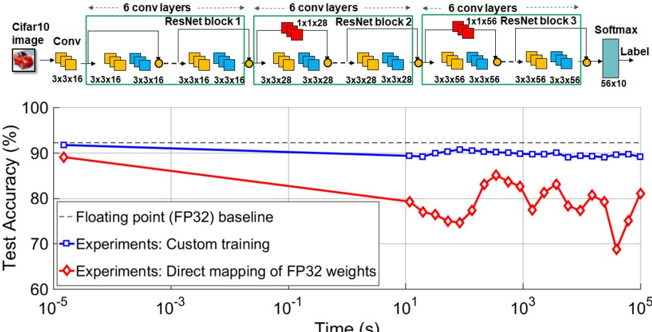
The image contains two primary components:
1. A **neural network architecture diagram** (top) depicting a ResNet-based model for CIFAR-10 image classification.
2. A **line graph** (bottom) comparing test accuracy over time for three training methods: FP32 baseline, custom training, and direct mapping of FP32 weights.
---
### Components/Axes
#### Neural Network Diagram
- **Input**: CIFAR-10 image (3x32x32)
- **Layers**:
- 6 convolutional layers (Conv) with 3x3x16 filters
- 3 ResNet blocks (each with 6 convolutional layers):
- Block 1: 3x16x16 → 3x28x28
- Block 2: 3x28x28 → 3x56x56
- Block 3: 3x56x56 → 3x56x56
- Output: Softmax layer (56x10) for label prediction
- **Color Coding**:
- Yellow: Convolutional layers
- Blue: ResNet blocks
- Red: ResNet blocks (highlighted in diagram)
- Gray: Softmax layer
#### Line Graph
- **X-axis**: Time (s) on logarithmic scale (10⁻⁵ to 10⁵)
- **Y-axis**: Test Accuracy (%) from 60% to 100%
- **Legend**:
- Dashed gray: FP32 baseline (90% accuracy)
- Solid blue: Custom training experiments (90% accuracy)
- Red diamonds: Direct mapping of FP32 weights (80–85% accuracy)
---
### Detailed Analysis
#### Neural Network Diagram
- **Flow**:
- Input → 6 Conv layers → ResNet Block 1 → ResNet Block 2 → ResNet Block 3 → Softmax → Label
- **Key Details**:
- ResNet blocks use residual connections (indicated by red arrows in diagram).
- Output dimensions grow from 3x16x16 to 3x56x56 across blocks.
#### Line Graph
1. **FP32 Baseline (Gray Dashed Line)**:
- Constant at ~90% accuracy across all time scales.
2. **Custom Training (Blue Line)**:
- Stable at ~90% accuracy, matching the FP32 baseline.
3. **Direct Mapping of FP32 Weights (Red Diamonds)**:
- Starts at ~85% accuracy, dips below 80% at ~10¹ seconds, then recovers to ~80% by 10³ seconds.
- Exhibits significant volatility compared to other methods.
---
### Key Observations
1. **Accuracy Stability**:
- Custom training and FP32 baseline maintain near-identical accuracy (~90%), suggesting robust performance.
2. **Direct Mapping Limitations**:
- Red line shows a 10% accuracy drop relative to the baseline, with erratic fluctuations.
3. **Time Correlation**:
- Direct mapping’s performance degradation occurs at intermediate time scales (~10¹–10³ seconds).
---
### Interpretation
1. **Model Architecture**:
- The ResNet-based design (with residual connections) likely enables efficient feature extraction, contributing to high accuracy.
2. **Training Method Impact**:
- Direct mapping of FP32 weights introduces instability, possibly due to quantization errors or suboptimal weight initialization.
- Custom training avoids these issues, maintaining performance parity with the FP32 baseline.
3. **Practical Implications**:
- Direct mapping may be unsuitable for production without additional optimization (e.g., fine-tuning).
- The FP32 baseline serves as a critical reference for evaluating quantization trade-offs.
---
### Notable Anomalies
- **Red Line Dip**: The sharp accuracy drop at ~10¹ seconds suggests a potential instability during mid-training phases for direct mapping.
- **Recovery at 10³ Seconds**: Partial recovery implies some adaptation to the training process, but residual performance gaps persist.