## Chart: Effect of Time Step (CIM-CAC)
### Overview
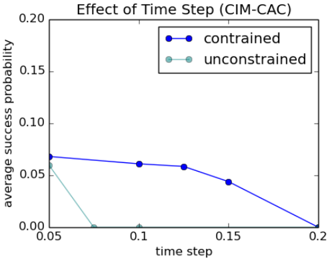
The image is a line chart comparing the average success probability of "constrained" and "unconstrained" scenarios with varying time steps. The x-axis represents the time step, and the y-axis represents the average success probability.
### Components/Axes
* **Title:** Effect of Time Step (CIM-CAC)
* **X-axis:** time step
* Scale: 0.05, 0.1, 0.15, 0.2
* **Y-axis:** average success probability
* Scale: 0.00, 0.05, 0.10, 0.15, 0.20
* **Legend:** Located in the top-right corner.
* Blue: "contrained"
* Light Green: "unconstrained"
### Detailed Analysis
* **Constrained (Blue):** The line starts at approximately 0.07 at time step 0.05, gradually decreases to approximately 0.06 at time step 0.1, remains around 0.058 at time step 0.125, then decreases to approximately 0.042 at time step 0.15, and finally reaches 0 at time step 0.2.
* **Unconstrained (Light Green):** The line starts at approximately 0.06 at time step 0.05, then drops sharply to 0 at time step 0.1 and remains at 0 for the rest of the time steps.
### Key Observations
* The "constrained" scenario consistently shows a higher average success probability than the "unconstrained" scenario, except at time step 0.2 where both are 0.
* The "unconstrained" scenario experiences a sharp drop in success probability between time steps 0.05 and 0.1.
* Both scenarios show a decrease in average success probability as the time step increases, but the "constrained" scenario decreases more gradually.
### Interpretation
The chart suggests that constraining the system leads to a more stable and higher average success probability, especially at lower time steps. The "unconstrained" scenario is highly sensitive to the time step, with a rapid decline in success probability. As the time step increases, the success probability decreases for both scenarios, indicating that larger time steps may negatively impact the system's performance. The data demonstrates the importance of constraints in maintaining a higher success rate, particularly when the time step is small.