## Line Chart: Pretrain (Warmup) Performance Comparison
### Overview
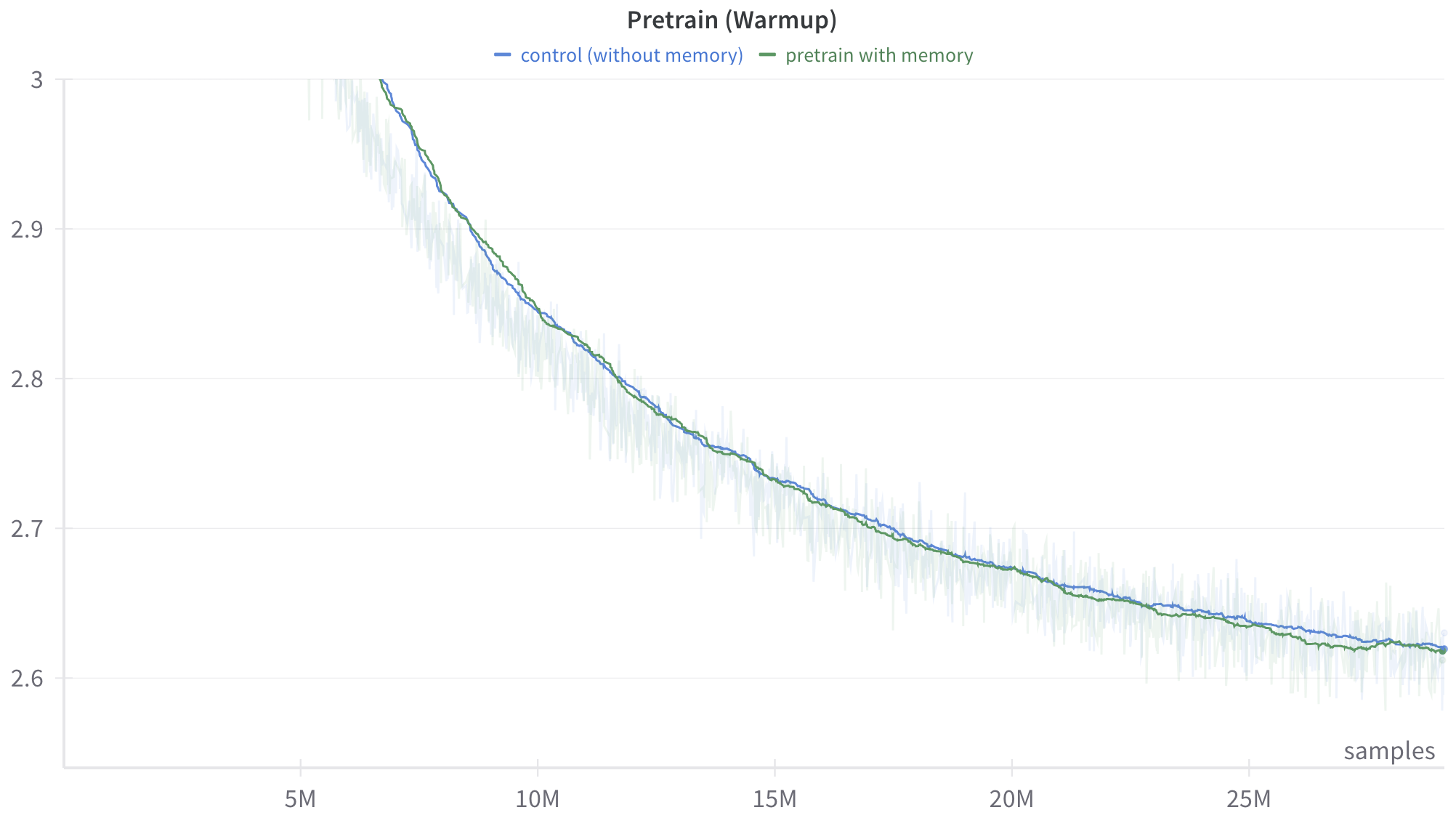
The chart compares the performance of two pretraining methods during a warmup phase: "control (without memory)" (blue line) and "pretrain with memory" (green line). Performance is measured on a y-axis scale from 2.6 to 3.0, plotted against increasing sample counts (x-axis: 5M to 25M). Both lines show a downward trend, with the control method consistently outperforming the memory-based method.
### Components/Axes
- **Title**: "Pretrain (Warmup)" (top center)
- **Legend**:
- Blue line: "control (without memory)"
- Green line: "pretrain with memory"
- Positioned at the top of the chart
- **X-axis**:
- Label: "samples"
- Scale: 5M → 25M (logarithmic spacing)
- Markers: 5M, 10M, 15M, 20M, 25M
- **Y-axis**:
- Label: Implied performance metric (no explicit label)
- Scale: 2.6 → 3.0 (linear)
- Gridlines at 0.1 intervals
### Detailed Analysis
1. **Control (Blue Line)**:
- Starts near **y=3.0** at 5M samples.
- Gradually declines to **y≈2.62** at 25M samples.
- Shaded region (variability) narrows from ~±0.05 at 5M to ~±0.02 at 25M.
2. **Pretrain with Memory (Green Line)**:
- Begins slightly below control at **y≈2.98** at 5M samples.
- Declines to **y≈2.61** at 25M samples.
- Shaded region remains wider than control throughout (~±0.04 at 5M, ~±0.03 at 25M).
3. **Trends**:
- Both lines show a **logarithmic decay** in performance as samples increase.
- Control method maintains a **~0.03–0.04 advantage** over the memory-based method across all sample counts.
- Variability (shaded regions) decreases for both methods as samples grow, indicating stabilizing performance.
### Key Observations
- The control method (blue) consistently outperforms the memory-based method (green) by a small margin.
- Performance degradation slows significantly after 15M samples for both methods.
- The memory-based method exhibits **higher initial variability** but converges toward similar stability as the control method at higher sample counts.
### Interpretation
The data suggests that omitting memory during pretraining warmup yields marginally better performance, though both approaches converge toward similar performance levels as training progresses. The narrower variability in later stages implies that both methods stabilize, but the control method’s slight edge may stem from reduced computational overhead or simpler architecture. The memory-based approach’s higher initial variability could indicate instability during early training phases, which may be mitigated with extended sampling. This trend highlights the trade-off between memory efficiency and performance in pretraining warmup scenarios.