## Cognitive Process Diagram: Metacognitive and Task-Level Learning
### Overview
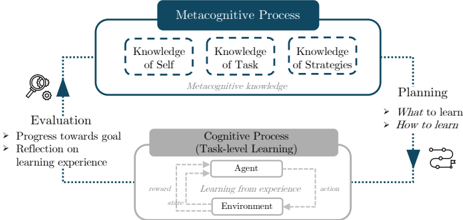
The image presents a diagram illustrating the relationship between metacognitive processes and cognitive processes (task-level learning). It depicts a cyclical flow of information and actions between these two levels, emphasizing planning, execution, evaluation, and learning from experience.
### Components/Axes
* **Header:** Contains the "Metacognitive Process" block.
* **Main Chart:** Shows the flow between Metacognitive Process, Planning, Cognitive Process, and Evaluation.
* **Metacognitive Process:** A rounded rectangle at the top, labeled "Metacognitive Process" in dark blue. It contains three sub-components: "Knowledge of Self," "Knowledge of Task," and "Knowledge of Strategies," all enclosed within a dashed-line rounded rectangle labeled "Metacognitive knowledge."
* **Planning:** Located on the right side of the diagram, connected to the Metacognitive Process. It includes two bullet points: "What to learn" and "How to learn."
* **Cognitive Process (Task-level Learning):** A rounded rectangle at the bottom, labeled "Cognitive Process (Task-level Learning)" in gray. It contains two sub-components: "Agent" and "Environment," connected by arrows indicating "action," "state," "reward," and "Learning from experience."
* **Evaluation:** Located on the left side of the diagram. It includes two bullet points: "Progress towards goal" and "Reflection on learning experience."
### Detailed Analysis
* **Metacognitive Process:**
* The "Metacognitive Process" block is positioned at the top of the diagram.
* The "Knowledge of Self," "Knowledge of Task," and "Knowledge of Strategies" are arranged horizontally within the "Metacognitive knowledge" container.
* **Planning:**
* The "Planning" section is connected to the "Metacognitive Process" via a solid arrow pointing downwards.
* The bullet points "What to learn" and "How to learn" indicate the outputs of the planning stage.
* **Cognitive Process (Task-level Learning):**
* The "Cognitive Process" block is positioned at the bottom of the diagram.
* The "Agent" and "Environment" are connected in a loop, with arrows indicating the flow of "action," "state," and "reward."
* "Learning from experience" is shown as a dashed arrow connecting the "Environment" back to the "Agent."
* **Evaluation:**
* The "Evaluation" section is connected to the "Cognitive Process" via a dotted arrow pointing upwards.
* The bullet points "Progress towards goal" and "Reflection on learning experience" indicate the outputs of the evaluation stage.
* **Flow:**
* The overall flow of the diagram is cyclical, starting with the "Metacognitive Process," moving to "Planning," then to the "Cognitive Process," followed by "Evaluation," and finally back to the "Metacognitive Process."
* The connections between the components are represented by arrows, indicating the direction of information flow.
### Key Observations
* The diagram emphasizes the iterative nature of learning, with continuous feedback and adjustments based on experience and evaluation.
* The "Metacognitive Process" plays a crucial role in guiding the learning process by setting goals, planning strategies, and evaluating progress.
* The "Cognitive Process" represents the actual execution of tasks and interaction with the environment.
* The diagram highlights the importance of both internal knowledge (self, task, strategies) and external feedback (environment, reward) in the learning process.
### Interpretation
The diagram illustrates a model of learning that integrates metacognitive and cognitive processes. It suggests that effective learning involves not only acquiring knowledge and skills but also reflecting on one's own learning process, setting goals, planning strategies, and evaluating progress. The cyclical nature of the diagram emphasizes the importance of continuous feedback and adaptation in the learning process. The model highlights the interplay between internal cognitive processes (agent) and external environmental factors, suggesting that learning is a dynamic interaction between the individual and their environment. The diagram implies that by understanding and managing our own cognitive processes, we can become more effective learners.