\n
## Diagram: Metacognitive and Cognitive Processes
### Overview
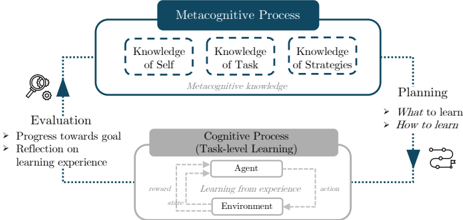
The image is a diagram illustrating the relationship between metacognitive and cognitive processes in learning. It depicts a cyclical flow between evaluation, planning, and the cognitive process itself, with the metacognitive process overseeing and influencing the cognitive process. The diagram uses boxes, arrows, and icons to represent these processes and their interactions.
### Components/Axes
The diagram is divided into two main sections:
* **Metacognitive Process:** Located at the top, enclosed in a large, rounded rectangle with a dark blue fill. It contains three sub-components: "Knowledge of Self", "Knowledge of Task", and "Knowledge of Strategies", each within a dashed-line rectangle. The text "Metacognitive knowledge" is placed below these three components.
* **Cognitive Process (Task-level Learning):** Located at the bottom, enclosed in a large, rounded rectangle with a gray fill. It contains an "Agent" and an "Environment" within a cyclical flow of "reward", "state", and "action". The text "Learning from experience" is placed within the cycle.
Additional components include:
* **Evaluation:** Located on the left side, with bullet points listing "Progress towards goal" and "Reflection on learning experience".
* **Planning:** Located on the right side, with bullet points listing "What to learn" and "How to learn".
* **Arrows:** Representing the flow of information and influence between the processes.
* **Icons:** A magnifying glass and a gear icon are used to visually represent Evaluation and Planning respectively.
### Detailed Analysis or Content Details
The diagram illustrates a cyclical process:
1. **Evaluation:** The process begins with evaluation, represented by a magnifying glass icon and the text "Evaluation". This involves assessing "Progress towards goal" and "Reflection on learning experience".
2. **Metacognitive Process:** Evaluation feeds into the "Metacognitive Process", which consists of "Knowledge of Self", "Knowledge of Task", and "Knowledge of Strategies". This knowledge informs the planning stage.
3. **Planning:** The "Metacognitive Process" influences "Planning", represented by a gear icon and the text "Planning". Planning focuses on "What to learn" and "How to learn".
4. **Cognitive Process:** Planning drives the "Cognitive Process (Task-level Learning)", which involves an "Agent" interacting with an "Environment". This interaction is a cycle of "action", "state", and "reward", leading to "Learning from experience".
5. **Feedback Loop:** The "Learning from experience" then feeds back into the "Evaluation" stage, completing the cycle.
The "Agent" and "Environment" are connected by arrows labeled "action", "state", and "reward", indicating a continuous interaction.
### Key Observations
The diagram emphasizes the iterative and interconnected nature of learning. The metacognitive process is presented as a higher-level control mechanism that guides and evaluates the cognitive process. The cyclical flow highlights the importance of continuous reflection and adaptation in learning. The diagram does not contain numerical data or specific measurements.
### Interpretation
The diagram illustrates a model of learning that incorporates both cognitive and metacognitive processes. It suggests that effective learning is not simply about acquiring knowledge (cognitive process) but also about understanding one's own learning processes, the nature of the task, and the strategies available to achieve learning goals (metacognitive process). The cyclical nature of the diagram emphasizes the importance of continuous evaluation and adaptation in the learning process. The diagram is a conceptual model and does not provide specific data or empirical evidence. It serves as a visual representation of a theoretical framework for understanding learning. The use of icons and clear labeling makes the diagram accessible and easy to understand. The diagram suggests that learning is an active, iterative process that requires both cognitive effort and metacognitive awareness.