## Diagram: Metacognitive and Cognitive Learning Process Model
### Overview
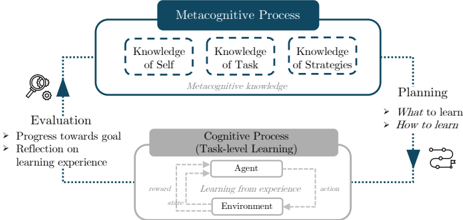
The image is a conceptual diagram illustrating the relationship between metacognitive processes and cognitive (task-level) processes in a learning system. It depicts a cyclical, interconnected model where higher-level metacognitive knowledge informs planning and evaluation, which in turn guide the agent's interaction with an environment for learning.
### Components/Axes
The diagram is structured into two primary, interconnected blocks:
1. **Top Block: Metacognitive Process**
* **Title:** "Metacognitive Process" (in a dark teal header box).
* **Core Components (Metacognitive knowledge):** Three dashed-line boxes containing:
* "Knowledge of Self"
* "Knowledge of Task"
* "Knowledge of Strategies"
* **Label:** The text "Metacognitive knowledge" is placed below these three boxes.
2. **Bottom Block: Cognitive Process (Task-level Learning)**
* **Title:** "Cognitive Process (Task-level Learning)" (in a grey header box).
* **Core Components:** A cyclical loop containing:
* "Agent" (central box)
* "Environment" (box below the agent)
* **Arrows & Labels:** An arrow labeled "action" points from the Agent to the Environment. An arrow labeled "observation" points from the Environment back to the Agent. The text "Learning from experience" is placed inside this loop.
3. **Connecting Processes (Left & Right):**
* **Left Side: Evaluation**
* **Title:** "Evaluation"
* **Components (Bullet points):**
* "Progress towards goal"
* "Reflection on learning experience"
* **Spatial Grounding:** Positioned to the left of the main blocks. A dotted arrow points from the Evaluation section up to the Metacognitive Process block.
* **Right Side: Planning**
* **Title:** "Planning"
* **Components (Bullet points):**
* "What to learn"
* "How to learn"
* **Spatial Grounding:** Positioned to the right of the main blocks. A dotted arrow points from the Planning section down to the Cognitive Process block.
### Detailed Analysis
The diagram maps a closed-loop system of learning:
* **Flow Direction:** The primary flow is cyclical. The **Metacognitive Process** (top) provides the foundational knowledge that informs the **Planning** stage (right). Planning dictates the "What" and "How" of learning, which directs the **Cognitive Process** (bottom). The agent in the cognitive process takes actions in the environment, receives observations, and learns from this experience. The outcomes and experiences from this cognitive loop feed into the **Evaluation** stage (left), which assesses progress and reflects on the experience. This evaluation then updates the **Metacognitive knowledge** (self, task, strategies), completing the cycle.
* **Component Relationships:**
* The **Metacognitive Process** is the overarching, strategic layer. It is not directly involved in task execution but manages the learning process itself.
* The **Cognitive Process** is the operational, task-execution layer where direct interaction with the environment occurs.
* **Planning** acts as the translator from metacognitive strategy to cognitive action plan.
* **Evaluation** acts as the feedback mechanism, converting experiential data from the cognitive process into updated metacognitive knowledge.
### Key Observations
* **Hierarchical yet Interdependent:** The model presents a clear hierarchy (metacognition above cognition) but emphasizes their complete interdependence through the dotted-line feedback loops.
* **Agent-Centric:** The "Agent" is the central actor within the cognitive process, directly interfacing with the "Environment."
* **Emphasis on Reflection:** "Reflection on learning experience" is explicitly listed as a component of Evaluation, highlighting its critical role in updating metacognitive knowledge.
* **Visual Coding:** Dashed lines are used for the components of metacognitive knowledge, possibly indicating their abstract or internal nature. Solid lines define the main process blocks and the agent-environment loop.
### Interpretation
This diagram presents a sophisticated model of self-regulated learning or adaptive AI systems. It argues that effective learning is not merely about executing tasks (cognitive process) but requires a parallel, higher-order system (metacognitive process) that plans, monitors, and reflects.
The **Peircean investigative reading** suggests this is a diagram of a *learning habit*. The **Metacognitive Process** represents the *interpretant*—the rule or disposition for learning. The **Cognitive Process** is the *action* or *habit* being formed through interaction with the *environment* (the *object*). The **Evaluation** and **Planning** stages are the critical abductive moments where the system interprets outcomes (observations) to revise its rules (metacognitive knowledge) and plan new actions.
The model implies that without the metacognitive layer, learning is reactive and unoptimized. The inclusion of "Knowledge of Self" suggests the system (or learner) must have a model of its own capabilities and limitations. The entire structure is a blueprint for building systems that don't just perform tasks, but can intelligently decide *which* tasks to perform, *how* to approach them, and *how to improve* based on experience. It moves beyond simple reinforcement learning to a framework incorporating self-awareness and strategic planning.