## Diagram: Metacognitive and Cognitive Processes in Learning
### Overview
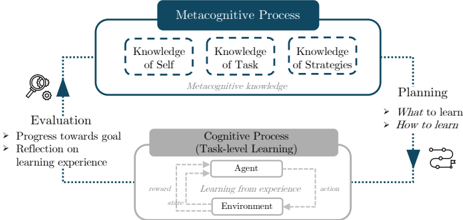
The diagram illustrates a two-tiered framework for learning, integrating metacognitive and cognitive processes. It emphasizes the interplay between self-awareness, task understanding, strategy knowledge, and task-level learning through agent-environment interactions.
### Components/Axes
1. **Top Section (Metacognitive Process)**:
- **Knowledge of Self**: Self-awareness and introspection.
- **Knowledge of Task**: Understanding task requirements and constraints.
- **Knowledge of Strategies**: Awareness of learning methods and approaches.
- **Evaluation**: Feedback on progress toward goals and reflection on learning experiences.
- **Planning**: Decision-making for "What to learn" and "How to learn."
2. **Bottom Section (Cognitive Process - Task-level Learning)**:
- **Agent**: Learner interacting with the environment.
- **Environment**: Context in which learning occurs.
- **Learning from Experience**: Feedback loop between agent actions and environmental rewards/states.
3. **Arrows and Flow**:
- **Metacognitive Knowledge** (dashed blue lines) connects the three knowledge components to Evaluation and Planning.
- **Cognitive Process** (solid gray lines) links the agent, environment, and learning feedback.
- **Planning** (right side) directs flow from metacognitive knowledge to task-level learning.
### Detailed Analysis
- **Metacognitive Knowledge**: Positioned at the top, it acts as a supervisory layer. The three knowledge components (Self, Task, Strategies) are interdependent, feeding into Evaluation and Planning.
- **Cognitive Process**: The agent-environment loop is central, with "Learning from Experience" as a bidirectional feedback mechanism. Rewards and states influence agent actions.
- **Planning**: Explicitly labeled with two directional arrows: "What to learn" (goal-oriented) and "How to learn" (strategy-driven).
### Key Observations
- **Hierarchical Structure**: Metacognitive processes govern cognitive processes, suggesting a top-down regulatory role.
- **Feedback Loops**: Both sections include feedback mechanisms (Evaluation and Learning from Experience), emphasizing iterative improvement.
- **Dual Arrows in Planning**: Highlights the balance between goal selection and strategy adaptation.
### Interpretation
The diagram models learning as a dynamic system where metacognition (self-awareness, task understanding, and strategy knowledge) guides task-level learning. The agent-environment interaction is framed as a reinforcement learning process, where rewards and states shape behavior. Evaluation and Planning ensure alignment with goals, while feedback loops enable adaptation. This structure underscores the importance of self-regulation in learning, where reflection and strategy adjustment are critical for progress. The absence of numerical data suggests a conceptual rather than empirical model, focusing on process relationships over quantitative metrics.