## Diagram: Quantized Weights Processing Flowchart
### Overview
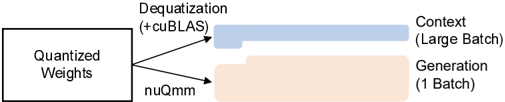
The diagram illustrates a two-pathway processing flow originating from "Quantized Weights," splitting into "Dequatization (+cuBLAS)" and "nuQmm." Each pathway feeds into distinct output stages: "Context (Large Batch)" and "Generation (1 Batch)."
### Components/Axes
- **Left Section**:
- **Box**: "Quantized Weights" (source node).
- **Arrows**:
- Top arrow labeled "Dequatization (+cuBLAS)" (blue).
- Bottom arrow labeled "nuQmm" (orange).
- **Right Section**:
- **Top Bar**: "Context (Large Batch)" (blue, matching the top arrow).
- **Bottom Bar**: "Generation (1 Batch)" (orange, matching the bottom arrow).
### Detailed Analysis
- **Quantized Weights**: Central starting point, feeding into two parallel processes.
- **Dequatization (+cuBLAS)**:
- Process name combines "Dequatization" with the cuBLAS library (NVIDIA's GPU-accelerated BLAS implementation).
- Outputs to "Context (Large Batch)," implying optimization for high-throughput scenarios.
- **nuQmm**:
- Likely a specialized quantization method (abbreviated from "nuQuantized Matrix Multiplication").
- Outputs to "Generation (1 Batch)," suggesting single-batch processing for targeted tasks.
### Key Observations
1. **Batch Size Differentiation**:
- "Context" uses a large batch, while "Generation" uses a single batch.
- This implies resource allocation trade-offs: larger batches for efficiency vs. smaller batches for precision.
2. **Library Integration**:
- cuBLAS integration in the "Dequatization" path highlights GPU acceleration for scalability.
3. **Pathway Divergence**:
- The split suggests architectural choices for balancing speed and accuracy in different use cases.
### Interpretation
The diagram represents an optimized workflow for deploying quantized neural network models. The "Dequatization (+cuBLAS)" path prioritizes throughput for large-scale context processing (e.g., real-time inference on GPUs), while "nuQmm" targets precision in single-batch generation tasks (e.g., fine-tuning or specialized inference). The use of cuBLAS indicates reliance on hardware acceleration, whereas "nuQmm" may represent a custom or lightweight quantization strategy. This bifurcation reflects a design philosophy where different quantization methods and batch strategies are tailored to specific computational demands.
**Note**: No numerical data or trends are present; the diagram focuses on architectural relationships and process flow.