## ASCII Art Diagram: Smiley Face Emoticon
### Overview
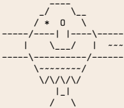
The image is a minimalist ASCII art representation of a smiling face, constructed using text characters. It features symmetrical elements to depict facial features (eyes, nose, mouth) and a simple outline. No numerical data, axes, or legends are present.
### Components/Axes
- **Eyes**:
- Left eye: `*` (asterisk) at the top-left of the face.
- Right eye: `0` (zero) at the top-right of the face.
- **Nose**:
- A single vertical pipe `|` centered below the eyes.
- **Mouth**:
- A curved smile formed by `\_/` (underscore and forward slash) at the bottom.
- **Outline**:
- Horizontal and diagonal lines (`/`, `\`, `_`, `-`) form the head and neck contours.
### Detailed Analysis
- **Eyes**: The left eye (`*`) and right eye (`0`) are positioned symmetrically at the top of the face, separated by a single space.
- **Nose**: The nose (`|`) is centered directly below the midpoint of the eyes, aligned vertically.
- **Mouth**: The smile (`\_/`) is centered at the bottom, with the underscore (`_`) forming the base and the forward slash (`/`) creating the upward curve.
- **Outline**:
- The top of the head uses `/` and `\` to form a triangular shape.
- The neck is outlined with horizontal dashes (`-`) and vertical pipes (`|`).
### Key Observations
1. **Symmetry**: The face is balanced, with mirrored elements (e.g., eyes, outline).
2. **Character Usage**: Common ASCII characters (`*`, `0`, `|`, `_`, `/`, `\`, `-`) are repurposed to create a recognizable face.
3. **Simplicity**: No shading, gradients, or complex patterns—relies on basic geometric shapes.
### Interpretation
This ASCII art serves as a universal emoticon to convey a happy or smiling expression in text-based communication. The use of `*` and `0` for eyes and `\_/` for the mouth is a widely recognized convention. The absence of additional elements (e.g., eyebrows, ears) suggests intentional minimalism, prioritizing clarity over detail. The diagram does not represent data but functions as a symbolic representation, likely for informal or decorative purposes.
No numerical values, trends, or anomalies are present. The image is purely structural, with no hidden or implicit data.