## Bar Chart: Latency Comparison for FP16 and INT8 Across Batch Sizes
### Overview
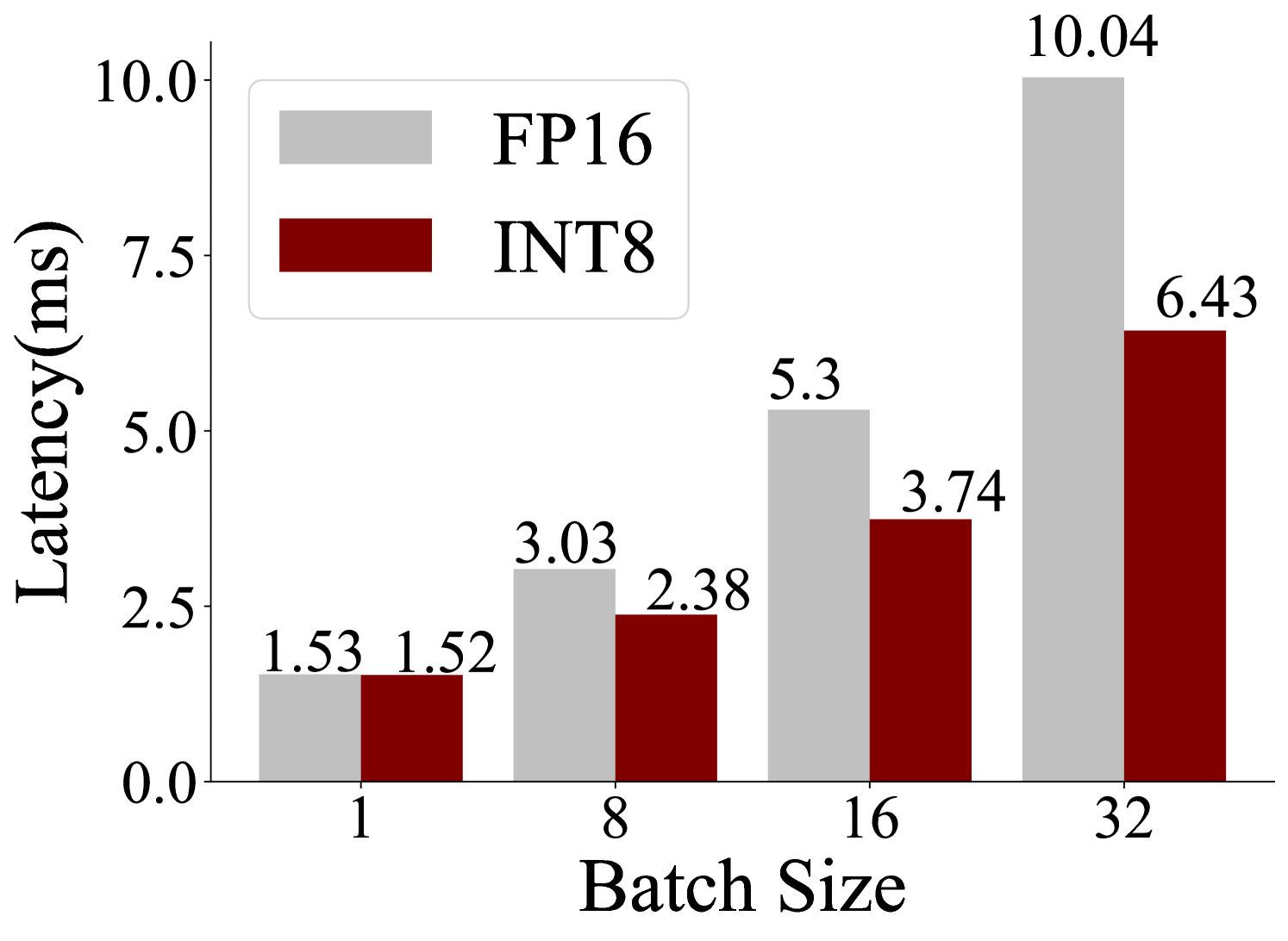
The chart compares latency (in milliseconds) for two computational methods, FP16 and INT8, across four batch sizes: 1, 8, 16, and 32. FP16 (gray bars) consistently exhibits higher latency than INT8 (red bars) at all batch sizes, with the disparity widening as batch size increases.
### Components/Axes
- **X-axis (Batch Size)**: Labeled with values 1, 8, 16, 32.
- **Y-axis (Latency)**: Scaled from 0.0 to 10.0 ms in increments of 2.5 ms.
- **Legend**: Located in the top-left corner, associating gray with FP16 and red with INT8.
- **Bars**: Paired bars for FP16 and INT8 at each batch size, with numerical labels on top of each bar.
### Detailed Analysis
- **Batch Size 1**:
- FP16: 1.53 ms (gray bar).
- INT8: 1.52 ms (red bar).
- **Batch Size 8**:
- FP16: 3.03 ms (gray bar).
- INT8: 2.38 ms (red bar).
- **Batch Size 16**:
- FP16: 5.3 ms (gray bar).
- INT8: 3.74 ms (red bar).
- **Batch Size 32**:
- FP16: 10.04 ms (gray bar).
- INT8: 6.43 ms (red bar).
### Key Observations
1. **FP16 Latency Trends**:
- Increases monotonically with batch size (1.53 → 10.04 ms).
- Doubles between batch sizes 16 and 32 (5.3 → 10.04 ms).
2. **INT8 Latency Trends**:
- Also increases with batch size but at a slower rate (1.52 → 6.43 ms).
- Remains below FP16 latency at all batch sizes.
3. **Disparity Growth**:
- At batch size 1, FP16 latency exceeds INT8 by 0.01 ms.
- At batch size 32, the gap widens to 3.61 ms.
### Interpretation
The data demonstrates that FP16 incurs significantly higher latency than INT8, particularly at larger batch sizes. This suggests FP16 may be less efficient for high-throughput or latency-sensitive applications. The steep rise in FP16 latency at batch size 32 could indicate computational bottlenecks or memory constraints specific to that configuration. INT8’s consistent performance advantage implies it might be preferable for optimizing real-time systems or resource-constrained environments. The outlier at FP16’s 32-batch latency warrants further investigation into hardware/software optimizations.