## Line Graph: Test Accuracy vs Communication Rounds (N=100, CIFAR-100)
### Overview
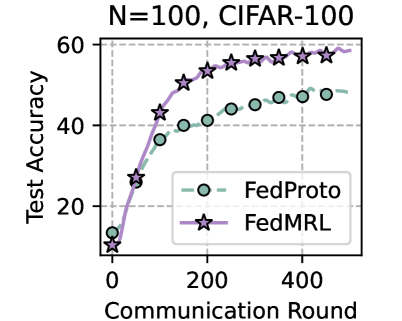
The image is a line graph comparing the test accuracy of two federated learning algorithms, **FedProto** and **FedMRL**, over communication rounds on the CIFAR-100 dataset with 100 clients (N=100). The y-axis represents test accuracy (0–60%), and the x-axis represents communication rounds (0–400). Two data series are plotted: FedProto (dashed line with green circles) and FedMRL (solid line with purple stars).
---
### Components/Axes
- **Title**: "N=100, CIFAR-100" (top center).
- **Y-Axis**: "Test Accuracy" (0–60%, labeled vertically on the left).
- **X-Axis**: "Communication Round" (0–400, labeled horizontally at the bottom).
- **Legend**: Located at the bottom-right corner, with:
- **FedProto**: Dashed green line with hollow green circles.
- **FedMRL**: Solid purple line with filled purple stars.
- **Grid**: Dashed gray grid lines for reference.
---
### Detailed Analysis
#### FedProto (Green Dashed Line)
- **Initial Value**: ~10% accuracy at 0 rounds.
- **Trend**: Gradual increase to ~50% accuracy at 200 rounds, followed by a plateau near 50%.
- **Key Points**:
- 0 rounds: ~10%.
- 100 rounds: ~35%.
- 200 rounds: ~50%.
- 400 rounds: ~50%.
#### FedMRL (Purple Solid Line)
- **Initial Value**: ~5% accuracy at 0 rounds.
- **Trend**: Sharp rise to ~55% accuracy at 200 rounds, followed by stabilization near 55%.
- **Key Points**:
- 0 rounds: ~5%.
- 100 rounds: ~45%.
- 200 rounds: ~55%.
- 400 rounds: ~55%.
**Crossing Point**: The lines intersect at ~100 rounds, where FedMRL surpasses FedProto in accuracy.
---
### Key Observations
1. **Performance Gap**: FedMRL consistently outperforms FedProto after 100 rounds, achieving ~55% accuracy vs. FedProto’s ~50%.
2. **Diminishing Returns**: Both algorithms plateau after 200 rounds, suggesting limited gains from additional communication.
3. **Efficiency**: FedMRL achieves higher accuracy with fewer rounds (e.g., 55% at 200 rounds vs. FedProto’s 50%).
4. **Initial Disparity**: FedProto starts stronger (10% vs. 5% at 0 rounds), but FedMRL accelerates faster.
---
### Interpretation
- **Algorithm Efficiency**: FedMRL’s superior performance indicates better optimization for communication efficiency, critical in resource-constrained federated learning scenarios.
- **Plateau Implications**: The plateau at ~200 rounds suggests that further communication rounds yield minimal accuracy improvements, highlighting the importance of early-stage optimization.
- **Trade-Off Analysis**: The crossing point at 100 rounds implies a trade-off between initial accuracy (FedProto) and long-term efficiency (FedMRL). FedMRL’s rapid convergence makes it preferable for scenarios prioritizing rapid deployment.
**Uncertainties**: Values are approximate due to lack of error bars. The exact crossing point (100 rounds) is inferred from visual alignment, not explicit data points.