\n
## Diagram: State Border Analysis
### Overview
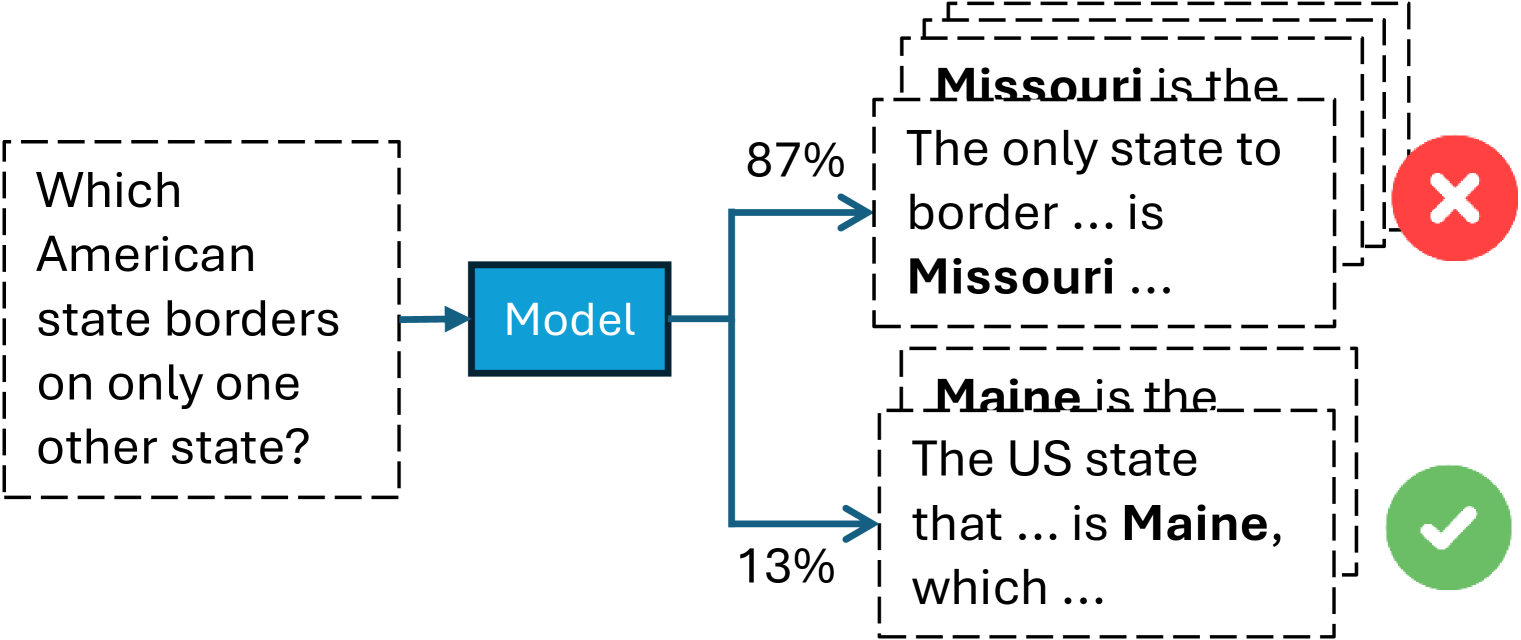
This diagram illustrates the output of a "Model" attempting to answer the question: "Which American state borders on only one other state?". The model provides two potential answers, Missouri and Maine, along with associated confidence levels. Each answer is presented within a dashed-line box, with a visual indicator (red 'X' or green checkmark) signifying whether the answer is correct or incorrect.
### Components/Axes
The diagram consists of the following components:
* **Question Box (Left):** A dashed-line box containing the question: "Which American state borders on only one other state?".
* **Model Box (Center):** A blue rectangular box labeled "Model", representing the processing unit.
* **Answer Boxes (Right):** Two dashed-line boxes, one for Missouri and one for Maine, each containing the model's response and a correctness indicator.
* **Confidence Levels:** Numerical percentages (87% and 13%) associated with each answer, indicating the model's confidence.
* **Correctness Indicators:** A red 'X' next to the Missouri answer and a green checkmark next to the Maine answer.
### Content Details
The diagram presents the following information:
* **Question:** "Which American state borders on only one other state?"
* **Model Output 1:**
* State: Missouri
* Confidence: 87%
* Correctness: Incorrect (indicated by the red 'X')
* Text: "Missouri is the... The only state to border... is Missouri..."
* **Model Output 2:**
* State: Maine
* Confidence: 13%
* Correctness: Correct (indicated by the green checkmark)
* Text: "Maine is the... The US state that... is Maine, which..."
### Key Observations
The model incorrectly identifies Missouri as the state bordering only one other state, assigning it a high confidence level of 87%. Conversely, it correctly identifies Maine but with a low confidence level of 13%. This suggests the model is biased towards Missouri, despite it being the incorrect answer.
### Interpretation
The diagram demonstrates a potential flaw in the model's reasoning or training data. While the model provides a confidence score, it appears to be unreliable in this case, as the higher confidence is associated with the incorrect answer. The model's output suggests it may be prioritizing factors other than the actual number of bordering states when making its prediction. The incomplete sentences within the answer boxes suggest the model is generating text based on the identified state, but the core logic of identifying the correct state is flawed. The visual indicators (red 'X' and green checkmark) provide a clear and immediate assessment of the model's performance on this specific question. The low confidence in the correct answer (Maine) is also noteworthy, indicating a need for further refinement of the model's training or algorithm.