## Diagram: Numbered Icons within a Circular Boundary
### Overview
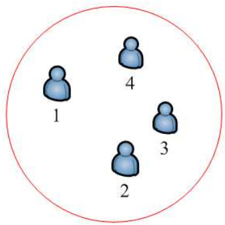
The image is a simple conceptual diagram featuring four identical blue human-figure icons arranged within a thin red circular boundary. Each icon is accompanied by a numerical label (1 through 4) placed directly below it. The diagram appears to represent a set of distinct entities or nodes within a defined group or system.
### Components/Axes
* **Boundary:** A single, thin red circle defines the perimeter of the diagram.
* **Icons:** Four identical blue icons representing simplified human figures (head and shoulders silhouette). Each has a black outline.
* **Labels:** The numbers "1", "2", "3", and "4" are printed in a black, sans-serif font. Each number is positioned directly beneath its corresponding icon.
* **Spatial Arrangement:** The icons are distributed within the circle in a non-grid, somewhat scattered pattern.
* Icon 1 is located in the left-center region.
* Icon 4 is located in the top-center region.
* Icon 3 is located in the right-center region.
* Icon 2 is located in the bottom-center region.
### Detailed Analysis
* **Icon 1:** Blue human-figure icon. Label "1" is centered below it. Positioned approximately at the 9 o'clock position within the circle.
* **Icon 2:** Blue human-figure icon. Label "2" is centered below it. Positioned approximately at the 6 o'clock position within the circle.
* **Icon 3:** Blue human-figure icon. Label "3" is centered below it. Positioned approximately at the 4 o'clock position within the circle.
* **Icon 4:** Blue human-figure icon. Label "4" is centered below it. Positioned approximately at the 12 o'clock position within the circle.
* **Relationships:** There are no connecting lines, arrows, or other visual indicators of flow, hierarchy, or relationship between the icons. They exist as separate entities within the common boundary.
### Key Observations
1. **Uniformity:** All four icons are graphically identical, suggesting the entities they represent are of the same type or class.
2. **Numerical Sequence:** The labels follow a simple sequential order (1, 2, 3, 4), which may imply an order of introduction, priority, or simple enumeration.
3. **Lack of Hierarchy:** The spatial distribution does not suggest a clear hierarchy (e.g., no icon is centrally dominant or elevated above others).
4. **Defined Grouping:** The red circle acts as a strong visual container, explicitly grouping the four numbered entities together and separating them from the external space.
### Interpretation
This diagram is a high-level abstraction. Its primary function is to visually communicate the existence of **four distinct, similar entities contained within a single system or group**. The lack of relational connectors means it does not specify *how* these entities interact, only *that* they coexist within a defined boundary.
The numbering provides a basic method for identification and reference. The choice of human-figure icons strongly implies the entities represent people, users, roles, or agents. The red circle could symbolize a team, a network, a meeting, a user group, a system perimeter, or any other conceptual container.
**Potential Underlying Concepts:**
* A team of four members.
* Four users in a system.
* Four nodes in a peer-to-peer network.
* Participants in a group discussion or process.
* A simple enumeration of roles (e.g., User 1, User 2, etc.).
The diagram's power lies in its simplicity, making it a versatile template for representing any scenario involving a small, defined set of similar actors. To derive specific meaning, this diagram would require additional context from accompanying text or a more detailed schematic.